


Skid Filter
In the landscape of modern industrial processing, the requirement for efficient, reliable, and portable filtration has led to the widespread adoption of the skid filter. A skid-mounted filtration system is a self-contained, modular unit where all necessary components—including filter housings, pumps, valves, piping, and control systems—are integrated onto a single structural frame or "skid." This engineering approach allows for "plug-and-play" installation, significantly reducing on-site assembly time and ensuring that the entire filtration process is pre-tested and optimized before reaching the facility.
For engineers and procurement teams, selecting a skid filter involves more than just choosing a micron rating. It requires a comprehensive understanding of fluid dynamics, material compatibility, and the structural integrity of the modular assembly. As a specialized manufacturer, Kaifil provides the high-precision stainless steel filtration components that form the heart of these systems, ensuring that the Main Page of any industrial filtration strategy is built on durable and accurate hardware.
Understanding the Architecture of a Skid-Mounted Filtration System
The primary advantage of a skid filter is its integrated design. Unlike traditional field-erected systems, a skid-mounted unit is engineered as a cohesive whole. The structural frame, typically constructed from heavy-duty carbon steel or stainless steel, provides a rigid base that protects sensitive instrumentation and ensures alignment of the piping and pump sets during transport and operation.
The Structural Frame and Layout
Space optimization is a critical factor in skid design. Engineers must balance the need for a compact footprint with the requirement for easy access during maintenance. A well-designed skid includes dedicated lifting points, vibration-dampening mounts for pumps, and a layout that minimizes pressure drops caused by unnecessary bends in the piping. For applications in the chemical or food and beverage industries, the frame itself may require specific coatings or a polished stainless steel finish to comply with hygiene and corrosion standards.
Interconnecting Piping and Valving
The piping within a skid filter must be sized to handle the maximum design flow rate while keeping fluid velocity within acceptable limits to prevent erosion and cavitation. Standard materials include 304 or 316L stainless steel, often joined via TIG welding to ensure leak-proof performance under high-pressure conditions. The valve array—comprising isolation valves, bypass valves, and sampling ports—allows operators to divert flow during cartridge changes or system cleaning without shutting down the entire process line.
Core Filtration Components and Media Selection
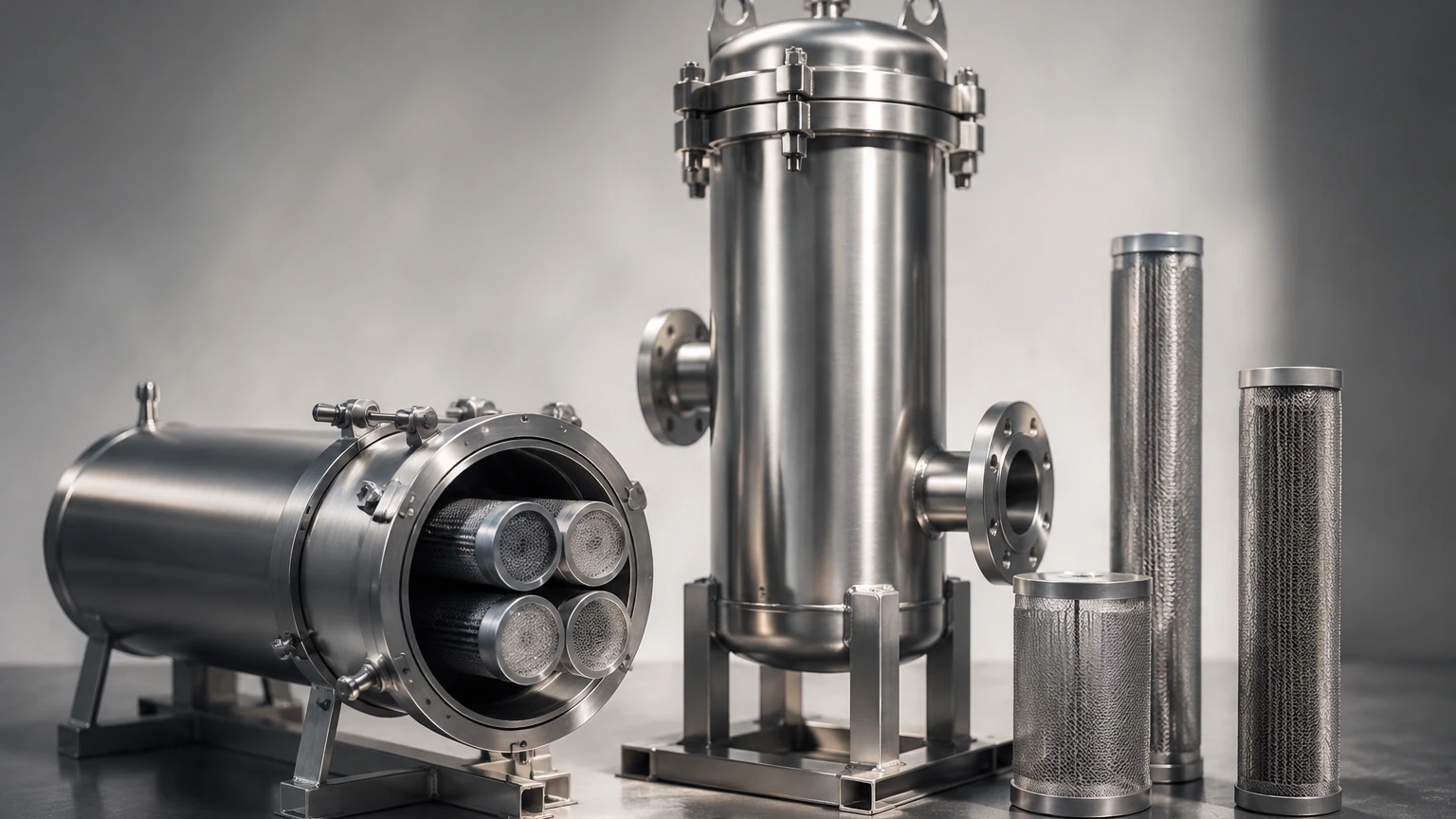
At the center of every skid filter is the filter housing and the internal media. The choice of media dictates the system's efficiency, dirt-holding capacity, and compatibility with the process fluid. Kaifil specializes in custom stainless steel filtration solutions that are frequently integrated into high-performance skids.
Stainless Steel Filter Cartridges
In demanding industrial environments, stainless steel cartridges are often preferred over disposable polymer filters. These components, available in pleated or cylindrical designs, offer superior thermal stability and chemical resistance. Sintered wire mesh or multi-layer metal laminates provide precise filtration ratings from 1 micron to several hundred microns. Because these elements can be cleaned and reused, they significantly lower the total cost of ownership for a skid filter system.
Basket Strainers and Multi-Bag Housings
For applications involving high solids loading, a skid filter may utilize large-scale basket strainers or multi-bag filter housings. These are often used as pre-filtration stages to protect finer downstream membranes or high-precision cartridges. The housing design must account for the ease of element removal; quick-opening covers and davit arms are common features on larger skids to facilitate rapid maintenance.
Engineering Parameters: Flow, Pressure, and Efficiency
Designing a skid filter requires a rigorous analysis of the operating conditions. Engineers must confirm several technical parameters to ensure the system performs as expected over its operational lifespan.
1. Flow Rate (GPM/m³/h): The system must be sized for the peak flow rate, not just the average. Over-sizing the filter area reduces the flux rate (flow per unit area), which can extend the life of the filter media and reduce the frequency of cleaning cycles.
2. Differential Pressure (ΔP): This is the difference in pressure between the inlet and outlet of the filter. A skid filter should be designed with a low initial differential pressure (typically < 2-5 psi). As the filter media captures contaminants, the ΔP increases. The skid's instrumentation must accurately monitor this to signal when a cleaning or replacement cycle is required.
3. Filtration Efficiency and Beta Ratio: For critical applications, understanding the "nominal" vs. "absolute" rating is essential. A skid filter utilizing absolute-rated stainless steel mesh ensures that 99.9% of particles at the specified micron size are captured, providing a consistent filtrate quality that is vital in pharmaceutical and chemical processing.
Material Science and Corrosion Resistance in Skid Design
The longevity of a skid filter is heavily dependent on material selection. Industrial fluids can be highly corrosive, abrasive, or sensitive to metallic contamination.
Grade 304 vs. 316L Stainless Steel
Grade 304 stainless steel is suitable for many general-purpose water treatment and industrial applications. However, for environments involving chlorides, acids, or high-purity requirements (such as in the pharmaceutical industry), 316L stainless steel is the standard. The "L" denotes low carbon content, which minimizes carbide precipitation during welding, thereby enhancing the corrosion resistance of the heat-affected zones in the skid's piping and housings.
Gaskets and Seal Compatibility
Often overlooked, the elastomeric seals and gaskets within a skid filter must be compatible with the process temperature and chemical composition. Common options include Viton (FKM) for high temperatures and chemical resistance, EPDM for water and steam, and PTFE for nearly universal chemical inertness. Failure to match the seal material to the application can lead to leaks, process contamination, and unplanned downtime.
Automation and Instrumentation in Modern Skid Filters
To maximize efficiency and reduce labor costs, many skid filters are equipped with advanced automation packages. This transforms a simple mechanical filter into an intelligent process tool.
* PLC Integration: A Programmable Logic Controller (PLC) can manage the entire filtration cycle. In self-cleaning or backwashing skid filters, the PLC monitors the differential pressure and automatically initiates the cleaning sequence when a set point is reached.
* Instrumentation Sensors: Standard instrumentation on a high-quality skid includes pressure transducers, flow meters, and sometimes turbidity sensors to monitor the clarity of the filtrate in real-time. These sensors provide the data necessary for predictive maintenance and process optimization.
* Human-Machine Interface (HMI): A skid-mounted touch screen allows operators to visualize system performance, adjust set points, and troubleshoot alarms without needing to access a centralized control room.
Maintenance, Cleaning, and Lifecycle Management
A skid filter is an investment in process stability. Maintaining that stability requires a clear understanding of the cleaning and replacement protocols for the internal filtration elements.
Clean-In-Place (CIP) Capabilities
In industries like food, beverage, and pharmaceuticals, the ability to clean the skid filter without disassembly is paramount. CIP systems use a combination of chemicals, heat, and high-velocity flow to sanitize the internal surfaces. The skid must be designed with "dead-leg" free piping and high-grade surface finishes (often electropolished) to ensure that no bacteria or process residue can remain trapped after a cleaning cycle.
Replacement Cycles and Total Cost of Ownership
While the initial capital expenditure (CAPEX) for a skid filter with high-quality stainless steel internals may be higher than disposable alternatives, the operating expenditure (OPEX) is often much lower. By utilizing cleanable metal filters from manufacturers like Kaifil, facilities reduce the waste stream of spent cartridges and the recurring costs of purchasing new media. Engineers should calculate the total cost of ownership over a 5-to-10-year period to truly evaluate the value of the skid.
Procurement Considerations for Industrial Filtration Skids
When purchasing a skid filter, technical professionals should confirm several key details with the manufacturer to avoid integration issues later:
* Compliance and Certification: Does the skid meet ASME Section VIII for pressure vessels? Are the materials FDA-compliant for food contact? Is the electrical enclosure rated for hazardous areas (ATEX/Class I Div 1)?
* Testing Protocols: Request documentation for hydrostatic pressure testing, dye penetrant testing of welds, and functional testing of the control logic before the skid leaves the factory.
* Customization Options: Every facility has unique constraints. A reliable partner should be able to customize the skid's orientation, inlet/outlet locations, and component brands to match existing plant standards.
In conclusion, the skid filter represents a sophisticated solution for complex industrial filtration needs. By integrating high-quality stainless steel components, precise engineering, and robust automation, these systems provide a level of reliability and performance that is essential for modern manufacturing. For those seeking to optimize their filtration processes, focusing on the quality of the internal media and the integrity of the skid's design is the first step toward long-term operational success.
