


Stainless Steel Cartridge Filter
In industrial filtration, the selection of a stainless steel cartridge filter is a critical decision that impacts process efficiency, product purity, and long-term operational costs. Unlike disposable polymer-based filters, stainless steel components are engineered for durability, high-temperature resistance, and the ability to withstand aggressive chemical environments. For engineers and procurement teams, understanding the technical nuances of these components is essential to ensuring system reliability.
Industrial filtration systems often operate under extreme conditions where pressure fluctuations, thermal stress, and corrosive fluids are common. A precision-engineered stainless steel cartridge filter provides a robust solution that can be cleaned and reused, offering a sustainable alternative to traditional filtration media. This guide explores the engineering considerations, material selection criteria, and performance expectations necessary for selecting the right filtration solution for demanding applications.
The Role of Stainless Steel Cartridge Filters in Industrial Systems
The primary function of a stainless steel cartridge filter is to remove particulate matter from liquid or gaseous streams while maintaining structural integrity under high differential pressures. These filters are ubiquitous in sectors such as chemical processing, pharmaceuticals, food and beverage, and hydraulic systems.
One of the most significant advantages of using stainless steel is its mechanical strength. In high-viscosity applications or systems with high flow rates, disposable filters may deform or bypass. A stainless steel cartridge, however, maintains its shape and filtration accuracy. Furthermore, in applications involving steam sterilization or high-temperature processing (exceeding 250°C), stainless steel is often the only viable material.
For those seeking comprehensive technical data on various filtration configurations, the Main Page of specialized manufacturers offers detailed insights into the standard and custom options available for industrial integration.
Material Science: Selecting the Right Alloy for Filtration
The performance of a stainless steel cartridge filter is heavily dependent on the specific alloy used in its construction. While several grades of stainless steel exist, the most common in filtration are 304, 316, and 316L.
* Grade 304: This is the standard industrial grade, offering good corrosion resistance and excellent forming properties. It is suitable for water treatment, general industrial fluids, and less aggressive chemical environments.
* Grade 316: Containing molybdenum, Grade 316 provides superior resistance to chlorides and pitting. It is the preferred choice for marine environments and many chemical processing applications.
* Grade 316L: The low-carbon version of 316, this alloy is essential for components that require extensive welding. The reduced carbon content prevents carbide precipitation during welding, ensuring the filter remains resistant to intergranular corrosion in the heat-affected zones.
In more extreme cases, such as those involving highly acidic or alkaline solutions, specialized alloys like Monel, Hastelloy, or Inconel may be utilized. Engineers must evaluate the chemical compatibility of the fluid stream with the filter media and the housing to prevent premature failure due to stress corrosion cracking or general oxidation.
Filtration Media and Structural Design Considerations
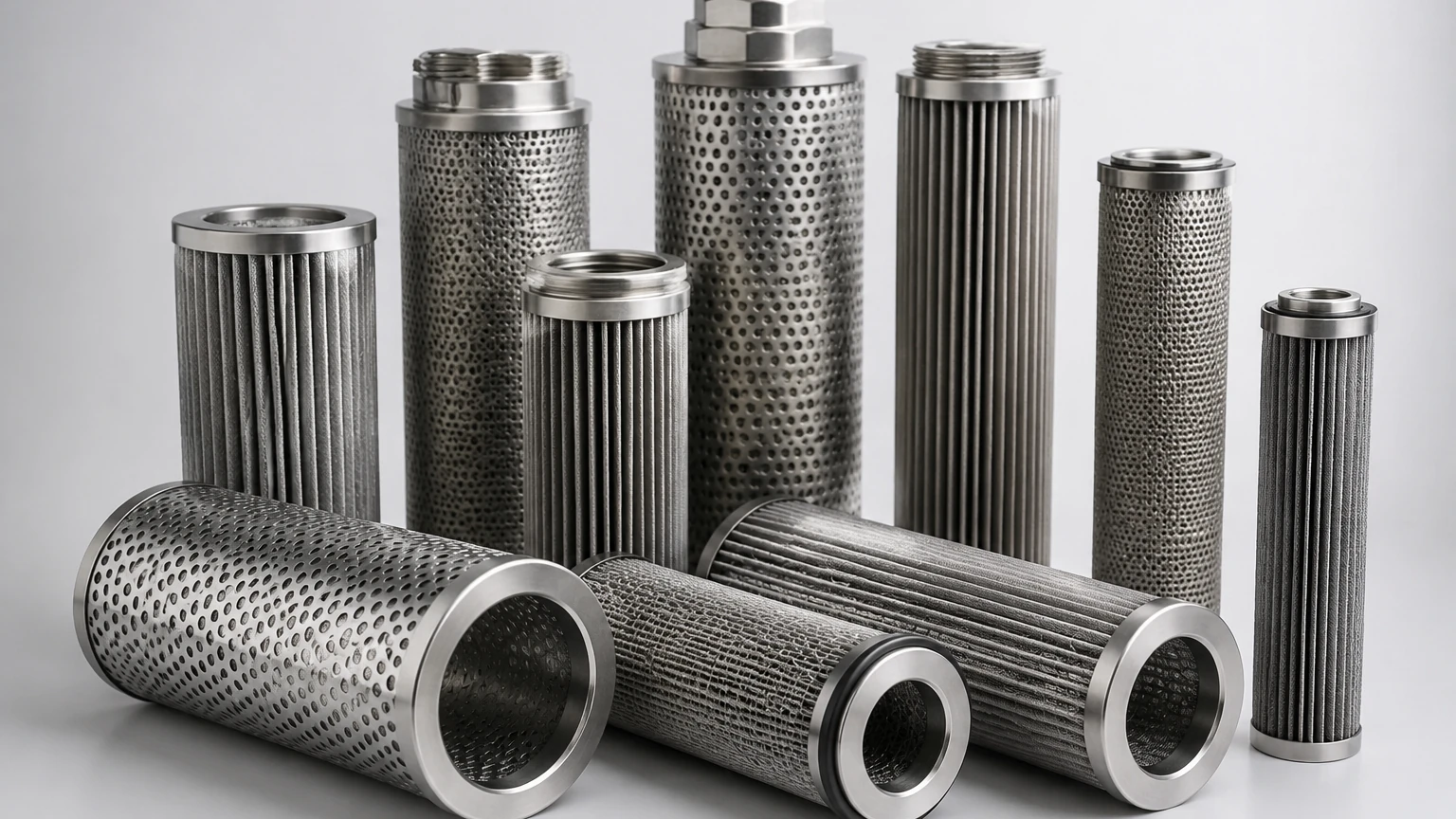
A stainless steel cartridge filter can be constructed using several different types of media, each offering distinct advantages depending on the application requirements.
Sintered Metal Mesh
Sintered wire mesh is created by diffusion-bonding multiple layers of woven wire cloth together. This process creates a stable, rigid structure that does not migrate media into the filtrate. Sintered mesh filters offer high permeability and are easily cleaned via backwashing or ultrasonic methods.
Pleated Wire Cloth
To maximize surface area within a standard cartridge footprint, the wire cloth is often pleated. This design is ideal for high-flow applications where low initial pressure drop is required. The increased surface area also extends the dirt-holding capacity, leading to longer service intervals between cleaning cycles.
Sintered Metal Fiber (Felt)
Sintered fiber felt is composed of non-woven stainless steel fibers that are sintered into a porous structure. This media provides high porosity (up to 80%) and exceptional dirt-holding capacity, making it suitable for high-viscosity fluids like polymers or heavy oils. It offers deep filtration characteristics, capturing particles throughout the thickness of the media rather than just on the surface.
Evaluating Performance: Flow Rates, Pressure Drops, and Micron Ratings
When specifying a stainless steel cartridge filter, engineers must balance filtration efficiency with system throughput. Two key metrics define this balance: micron rating and differential pressure.
Micron Rating: Nominal vs. Absolute
* Nominal Rating: This indicates the ability of the filter to retain a majority of particles of a specific size (usually 60% to 90%). It is a less precise measurement and is often used for pre-filtration.
* Absolute Rating: This represents the diameter of the largest hard spherical particle that will pass through the filter under specified test conditions. For critical applications in the pharmaceutical or semiconductor industries, an absolute rating is mandatory to ensure consistent product quality.
Pressure Drop (Delta P)
The differential pressure across a filter increases as it captures contaminants. A well-designed stainless steel cartridge filter should have a low initial pressure drop to minimize energy consumption by the system pumps. Engineers must calculate the "terminal pressure drop"—the point at which the filter must be cleaned or replaced to prevent damage to the system or the filter element itself.
Operational Risks and Environmental Compatibility
While stainless steel is exceptionally durable, it is not immune to failure if misapplied. Several risks must be managed during the selection process:
1. Thermal Shock: Rapid changes in temperature can cause mechanical stress in the filter media and joints. If the application involves frequent temperature cycling, the filter design must account for thermal expansion and contraction.
2. Corrosion Pitting: In high-chloride environments, even 316L can suffer from localized pitting. Regular inspection and proper material selection are the only defenses against this risk.
3. Mechanical Fatigue: In hydraulic systems with high-frequency pressure pulses, the filter media can experience fatigue. Using reinforced cores and outer supports can mitigate the risk of structural collapse.
4. Compatibility of Seals: A stainless steel cartridge filter is only as good as its seals. O-rings and gaskets made of Viton, EPDM, PTFE, or silicone must be selected based on their compatibility with the process fluid and operating temperature.
Maintenance, Cleaning, and Life Cycle Management
One of the primary drivers for choosing a stainless steel cartridge filter over a disposable alternative is the total cost of ownership (TCO). While the initial investment is higher, the ability to clean and reuse the filter significantly reduces waste and long-term procurement costs.
Cleaning Methodologies
* Ultrasonic Cleaning: This is the most effective method for removing fine particulates lodged deep within sintered media. High-frequency sound waves create cavitation bubbles that dislodge contaminants without damaging the metal structure.
* Chemical Cleaning (CIP): In many food and pharmaceutical applications, Clean-In-Place (CIP) systems use caustic or acidic solutions to dissolve organic or mineral deposits.
* Backwashing: For coarse filtration, reversing the flow of the fluid can effectively clear the surface of the filter mesh.
* Burn-off/Pyrolysis: In polymer or resin applications, filters are often placed in high-temperature ovens to carbonize organic contaminants, which are then removed through ultrasonic cleaning.
Determining the end of a filter’s life cycle involves monitoring the pressure drop after cleaning. If the "clean" pressure drop begins to rise over successive cycles, it indicates that permanent fouling is occurring, and the cartridge should be replaced.
Technical Specifications for Custom Procurement
For engineers ready to integrate these components into their systems, providing precise specifications to the manufacturer is vital. When requesting a quote or designing a custom stainless steel cartridge filter, the following data points should be confirmed:
* Dimensions: Overall length, outer diameter (OD), and inner diameter (ID).
* End Cap Configuration: Options include Double Open End (DOE), 222 O-rings with a flat cap, 226 O-rings with a fin, or threaded connections (NPT/BSP).
* Operating Conditions: Maximum operating temperature, maximum differential pressure, and normal operating pressure.
* Fluid Characteristics: Viscosity, pH level, and chemical composition.
* Filtration Target: Desired micron rating (absolute or nominal) and the nature of the contaminants (deformable vs. hard particles).
By addressing these technical parameters, procurement teams can ensure they receive a filtration solution that is optimized for their specific industrial environment. Customization allows for the adjustment of mesh layers, pleat density, and reinforcement structures to meet the exact demands of the application, ensuring that the stainless steel cartridge filter performs reliably throughout its intended service life.
