


Stainless Steel Filter Media
In industrial filtration, the selection of filter media is a critical engineering decision that directly impacts process efficiency, product purity, and operational costs. Stainless steel filter media has emerged as the standard for demanding environments where polymer-based alternatives fail due to temperature, pressure, or chemical incompatibility. Unlike disposable media, stainless steel variants offer a combination of mechanical strength, precise pore geometry, and the ability to be cleaned and reused, making them a cornerstone of sustainable industrial separation.
Selecting the appropriate stainless steel filter media requires a deep understanding of fluid dynamics, material science, and the specific requirements of the application. This guide examines the technical characteristics, selection criteria, and engineering considerations essential for technical professionals and purchasing teams.
Types of Stainless Steel Filter Media and Their Structures
Stainless steel filter media is not a singular product but a category of materials engineered with different structures to suit specific filtration mechanisms. The choice of structure determines the media’s dirt-holding capacity, flow resistance, and filtration accuracy.
Woven Wire Mesh
Woven wire mesh is the most common form of metallic filter media. It is produced by weaving individual stainless steel wires in various patterns, such as plain weave, twilled weave, or Dutch weave.
* Plain Weave: Offers a simple, straight-through flow path, ideal for coarse filtration and high-flow applications.
* Dutch Weave (Plain and Twilled): Uses thicker warp wires and finer shute wires driven closely together. This creates a "tortuous path" that allows for much finer filtration ratings while maintaining high mechanical strength. It is often used in high-pressure systems where surface filtration is required.
Sintered Metal Fiber Felt
Sintered fiber felt is a non-woven filter medium composed of stainless steel fibers that are randomly laid, compressed, and then bonded through a high-temperature vacuum sintering process. This results in a highly porous structure (up to 80% porosity). The high void volume ensures a low-pressure drop and an exceptional dirt-holding capacity compared to woven mesh. It is particularly effective for depth filtration in applications involving high-viscosity fluids or fine particulate matter.
Sintered Metal Powder
This media is created by sintering spherical or irregular stainless steel powders into a rigid porous structure. Sintered powder media provides excellent depth filtration and is highly resistant to mechanical stress. Its rigid nature makes it suitable for applications requiring high-pressure differentials and precise micron ratings in the sub-micron to 100-micron range.
Multi-Layer Sintered Mesh
For applications requiring both the precision of fine mesh and the structural integrity of heavy plates, manufacturers bond multiple layers of woven wire mesh together through sintering. This creates a composite material that is mechanically robust, easy to clean, and resistant to delamination under back-pulsing or high-pressure conditions.
Material Selection: Alloy Grades and Chemical Compatibility
The performance of stainless steel filter media is largely dictated by the alloy used in its construction. Engineers must match the alloy to the chemical composition of the process fluid and the operating temperature.
1. AISI 304/304L: The standard grade for general industrial use. It offers good corrosion resistance in mildly corrosive environments and is widely used in food and beverage applications where sanitation is a priority.
2. AISI 316/316L: Contains molybdenum, which significantly enhances resistance to pitting and crevice corrosion, especially in chloride-rich environments. This is the preferred choice for pharmaceutical and chemical processing.
3. 904L and Duplex Steels: For extreme environments involving high concentrations of sulfuric acid or seawater, specialized alloys provide superior longevity.
4. High-Temperature Alloys: In gas filtration or molten polymer applications, alloys like Inconel or Hastelloy may be utilized to maintain structural integrity at temperatures exceeding 600°C.
To explore the full range of material options and specific component designs, engineers can refer to the Main Page for detailed technical specifications on custom filtration solutions.
Engineering Metrics: Micron Ratings and Pressure Drop
When specifying stainless steel filter media, two metrics are paramount: filtration accuracy (micron rating) and permeability (pressure drop).
Absolute vs. Nominal Micron Ratings
* Nominal Rating: Refers to an arbitrary micron value indicating that the media will retain a major percentage (usually 60% to 90%) of particles of that size. It does not guarantee the capture of all particles.
* Absolute Rating: Defines the pore size at which 99.9% (or higher) of particles of a specific size are retained. In critical applications like pharmaceutical sterile filtration or aerospace hydraulics, an absolute rating is mandatory to ensure system safety.
Pressure Drop ($ΔP$)
The pressure drop is the difference in pressure between the upstream and downstream sides of the filter. A high initial $ΔP$ indicates high flow resistance, which increases energy consumption and reduces the effective life of the filter before cleaning is required. Stainless steel media, particularly sintered fiber felt, is designed to maximize porosity to keep the initial $ΔP$ as low as possible while meeting the required filtration efficiency.
Durability, Cleaning, and Maintenance Cycles
One of the primary advantages of stainless steel filter media is its cleanability. Unlike synthetic filters that are disposed of once blinded, metallic media can be restored to near-original performance through several methods:
* Backwashing/Backpulsing: Reversing the flow of the fluid to dislodge accumulated particles from the surface. This is common in continuous process industries.
* Ultrasonic Cleaning: Using high-frequency sound waves in a cleaning solvent to remove fine particulates trapped deep within the pores of sintered media.
* Chemical Cleaning: Using acids, alkalis, or surfactants to dissolve organic or inorganic deposits that cannot be removed mechanically.
* Burn-off/Pyrolysis: In applications like polymer filtration, the media is heated to high temperatures to carbonize and remove organic residues.
Determining Replacement Cycles
While stainless steel media is durable, it is not infinite. Factors such as "media migration" (the shedding of fibers), permanent blinding (where pores are irreversibly clogged), or mechanical fatigue from repeated pressure cycles will eventually necessitate replacement. Engineers should monitor the rate of pressure increase after each cleaning cycle; a consistent decrease in the time between cleanings often indicates that the media is reaching the end of its functional life.
Customization and OEM Considerations
Industrial filtration systems rarely use "off-the-shelf" solutions without some degree of modification. Customization of stainless steel filter media involves several engineering steps:
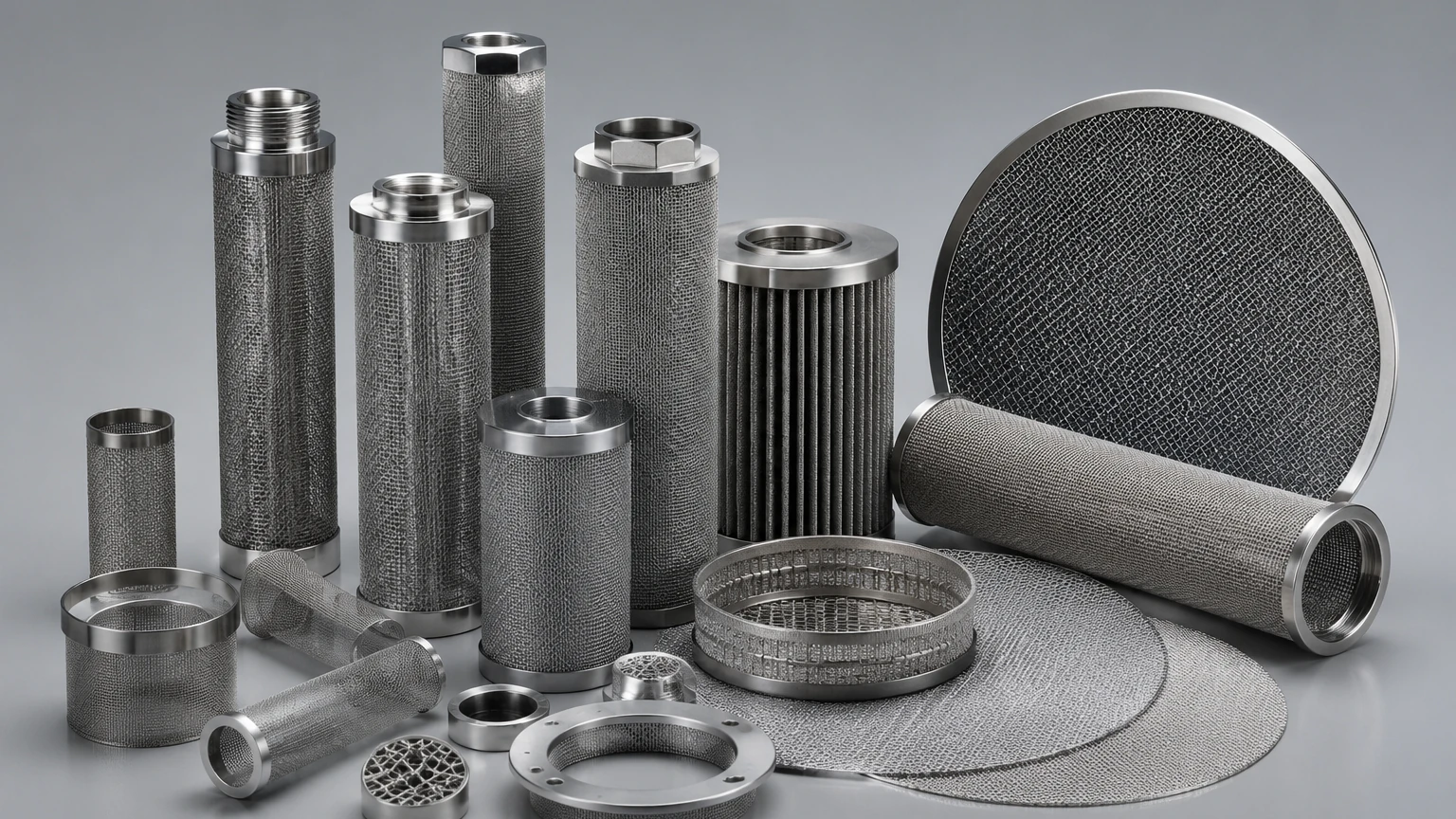
* Pleating: To increase the effective filtration area within a fixed housing volume, the media can be pleated. This reduces the flux (flow per unit area), which in turn lowers the pressure drop and extends service life.
* Reinforcement: In high-pressure applications, the filter media may require internal or external support cores (perforated tubes) or outer shrouds to prevent collapse or bursting.
* End Fittings: Custom machining of flanges, threads, or O-ring seats is necessary to ensure a leak-proof bypass-free installation within existing housings.
Manufacturers like Kaifil specialize in these OEM requirements, providing the necessary engineering support to transition from a theoretical filtration requirement to a finished, high-performance component.
Total Cost of Ownership (TCO) Analysis
From a procurement perspective, the initial cost of stainless steel filter media is significantly higher than that of polypropylene or fiberglass cartridges. However, a Total Cost of Ownership (TCO) analysis often reveals that stainless steel is more cost-effective in the long term.
* Reduction in Waste: Eliminating the disposal costs associated with hazardous waste (spent filter cartridges).
* Reduced Downtime: Longer intervals between changes and the ability to clean in-place (CIP) reduce labor costs and production halts.
* Process Stability: Metallic media does not suffer from "unloading" (where trapped particles are released due to pressure surges) or bypass caused by media deformation.
Conclusion: Confirming Technical Requirements
Before proceeding with a purchase or a new design, engineers must confirm several variables to ensure the selected stainless steel filter media will perform as expected:
1. Fluid Properties: Viscosity, density, and chemical composition at operating temperatures.
2. Contaminant Profile: Particle size distribution, concentration, and the nature of the solids (deformable vs. rigid).
3. Operating Parameters: Maximum flow rate, operating pressure, and maximum allowable pressure drop.
4. Cleaning Constraints: Availability of ultrasonic baths, chemical compatibility with cleaning agents, and the feasibility of backwashing.
By addressing these technical boundaries, purchasing and engineering teams can select a filtration solution that provides the necessary precision and durability for their specific industrial application. For those requiring specialized designs or high-volume OEM production, reviewing the capabilities and product ranges on the Main Page is the recommended next step in the procurement process.
