


Stainless Steel Filter Mesh
In industrial filtration, the selection of media is a critical engineering decision that directly impacts process efficiency, product purity, and equipment longevity. Stainless steel filter mesh stands as one of the most versatile and durable solutions available for liquid and gas separation. Unlike synthetic or disposable media, metallic mesh offers a unique combination of mechanical strength, thermal stability, and chemical resistance, making it the standard for demanding applications in chemical processing, pharmaceuticals, and food production.
For engineers and procurement teams, understanding the technical nuances of stainless steel filter mesh—from weave patterns to metallurgical grades—is essential for optimizing filtration performance. This guide explores the engineering considerations, material specifications, and selection criteria required to implement effective filtration solutions.
Material Science: Selecting the Right Alloy
The performance of a stainless steel filter mesh begins with its chemical composition. Industrial environments often expose filtration components to corrosive fluids, high temperatures, and high-pressure differentials. Selecting the appropriate grade ensures the mesh maintains structural integrity throughout its service life.
Grade 304 and 304L
Grade 304 is the most common stainless steel used for industrial mesh. It provides excellent resistance to atmospheric corrosion and is suitable for most water treatment and food-grade applications. However, in environments involving high-temperature welding, the low-carbon variant (304L) is preferred to prevent carbide precipitation and maintain corrosion resistance at the weld joints.
Grade 316 and 316L
For applications involving chlorides, acids, or marine environments, Grade 316 is the industry standard. The addition of molybdenum (2-3%) significantly enhances its resistance to pitting and crevice corrosion. Grade 316L is typically specified for precision filter cartridges and sintered components where maximum weldability and corrosion resistance are required, such as in pharmaceutical manufacturing.
Specialized Alloys
In extreme conditions, such as highly acidic chemical processing or high-temperature exhaust filtration, specialized alloys like 904L, Duplex stainless steel, or even nickel-based alloys (Inconel or Hastelloy) may be integrated into the mesh design. These materials are chosen when standard 300-series steels would succumb to stress corrosion cracking or rapid oxidation.
Engineering the Weave: Mechanical and Filtration Properties
The geometry of the weave determines the filtration rating, flow capacity, and mechanical stability of the stainless steel filter mesh. Different weave styles are engineered to balance the trade-off between fine particle retention and pressure drop.
Plain Weave and Twill Weave
* Plain Weave: This is the simplest construction, where each warp wire crosses over and under each weft wire. It offers a high percentage of open area and predictable flow characteristics, making it ideal for high-flow, low-pressure applications.
* Twill Weave: In this style, wires pass over two and under two. This allows for the use of heavier wires in a given mesh count, increasing the mechanical strength and durability of the mesh without significantly sacrificing the aperture size.
Dutch Weave (Plain and Twill)
Dutch weaves utilize different diameters for the warp and weft wires. The weft wires are driven closer together, creating a "zero-aperture" appearance.
* Plain Dutch Weave: Provides high strength and is effective for heavy-duty filtration where a cake layer must be formed and removed.
* Twill Dutch Weave: This is the most common choice for fine filtration. By combining a twill pattern with Dutch wire diameters, manufacturers can achieve filtration ratings as low as 1 to 5 microns. The geometry creates a complex path for fluid, enhancing depth filtration capabilities while maintaining a robust structure.
Technical Specifications and Performance Metrics
When evaluating stainless steel filter mesh for a specific project, engineers must look beyond the basic "mesh count." Several interrelated metrics define the performance profile of the media:
1. Mesh Count: The number of openings per linear inch. While common, this does not account for wire diameter, which is why two "100 mesh" screens can have vastly different performance characteristics.
2. Aperture (Pore Size): The clear distance between adjacent wires. This determines the largest particle that can pass through the mesh (absolute filtration rating).
3. Wire Diameter: Thicker wires increase the burst strength and service life but reduce the open area.
4. Open Area Percentage: Calculated as (Aperture / (Aperture + Wire Diameter))². A higher open area results in a lower clean pressure drop and higher throughput but may reduce the structural rigidity of the screen.
For high-pressure hydraulic systems or high-viscosity polymer filtration, the mesh must be able to withstand significant differential pressure without deforming. In these cases, multi-layer sintered mesh is often used, where several layers of stainless steel filter mesh are heat-bonded to create a monolithic structure with superior mechanical properties.
Customization and Secondary Processing
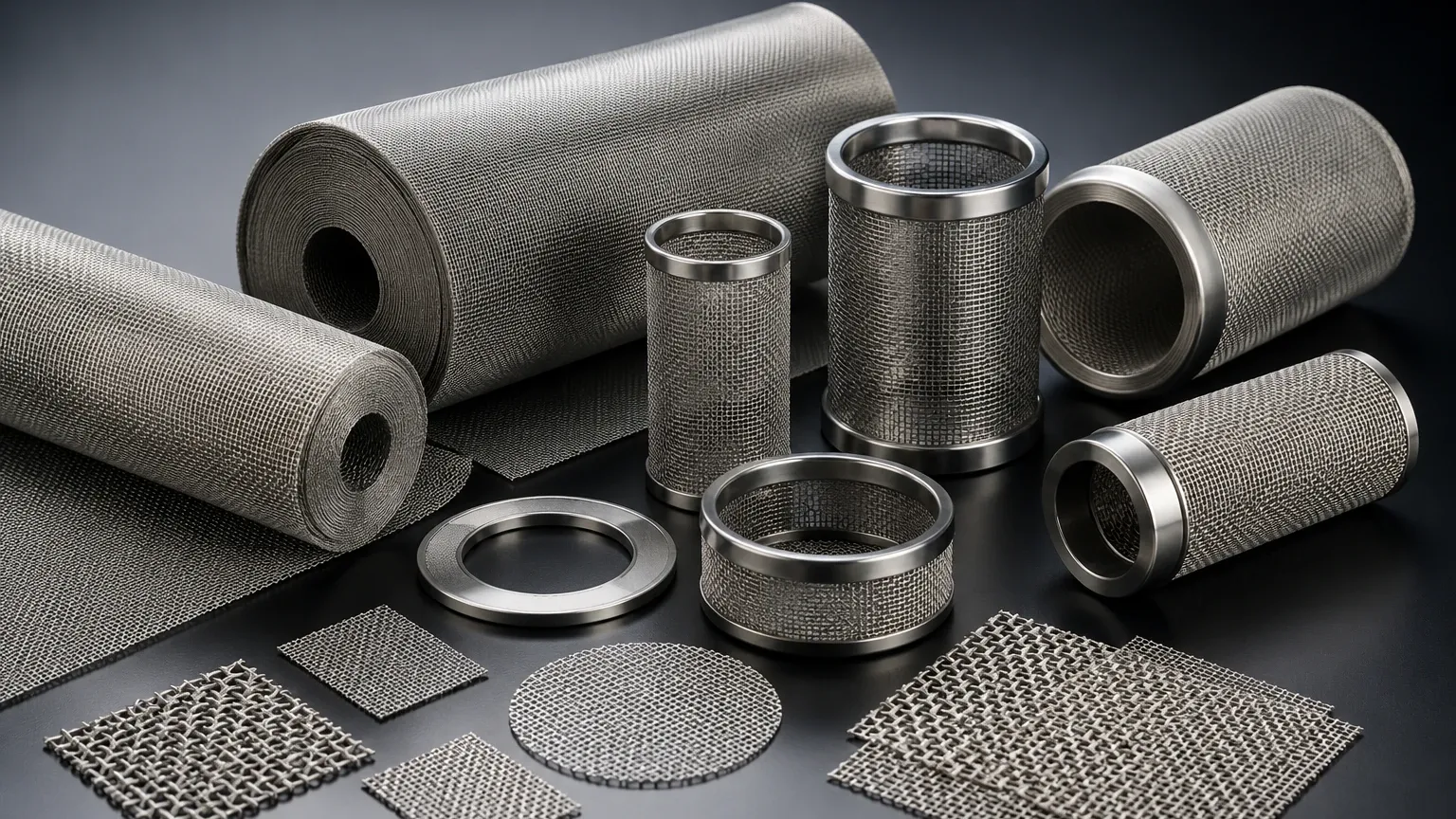
Raw stainless steel filter mesh is rarely used in its flat, bulk form for industrial applications. Most systems require customized components designed to fit specific housing geometries or to maximize surface area. Common customization techniques include:
* Pleating: Folding the mesh into a star-shaped configuration increases the effective surface area by 3 to 10 times compared to a cylindrical design. This significantly extends the time between cleaning cycles and reduces the face velocity of the fluid.
* Sintering: As mentioned, sintering layers of mesh together provides a fixed pore structure that cannot shift under pressure. This is essential for precision gas filtration and pharmaceutical applications where fiber migration must be zero.
* Welding and Forming: Precision TIG, plasma, or ultrasonic welding is used to form the mesh into discs, cylinders, or cones. Proper welding technique is vital to ensure the filtration integrity at the seams matches the performance of the mesh itself.
As a professional manufacturer, Kaifil specializes in these custom configurations, ensuring that the filtration media is perfectly aligned with the mechanical requirements of the end-use equipment. Detailed technical information on these capabilities can be found on our Main Page.
Application-Specific Selection Criteria
Different industries prioritize different performance aspects of stainless steel filter mesh. Understanding these priorities helps in narrowing down the material and weave choices.
Chemical and Petrochemical
The primary concern here is chemical compatibility and resistance to high-temperature oxidation. 316L or 904L alloys are frequently specified. The mesh must also be robust enough to handle backpulsing or backwashing cycles used to clean the filters in situ.
Food and Beverage
Filtration media in this sector must comply with FDA and international food safety standards. Stainless steel is preferred because it is non-leaching and can withstand rigorous Clean-in-Place (CIP) procedures involving caustic chemicals and high-pressure steam sterilization. Smooth surface finishes are often required to prevent bacterial growth in the mesh interstices.
Hydraulics and Lubrication
In hydraulic systems, the mesh must protect sensitive valves and pumps from particulate contamination. High-strength twill or Dutch weaves are used to handle high-pressure spikes and ensure that the filtration rating remains consistent even under turbulent flow conditions.
Maintenance, Cleaning, and Total Cost of Ownership
One of the primary B2B advantages of stainless steel filter mesh is its reusability. While the initial capital expenditure is higher than disposable polymer or paper filters, the total cost of ownership (TCO) is often lower due to the longevity of the metal media.
Cleaning Methods
* Ultrasonic Cleaning: Effective for removing fine particles trapped deep within Dutch weave structures.
* Backwashing: Using a reverse flow of clean fluid or gas to dislodge the filter cake.
* Chemical Cleaning: Using solvents or acids to dissolve organic or mineral scaling, provided the alloy is compatible with the cleaning agent.
* Burn-off/Pyrolysis: For polymer filtration, the mesh can be heated in a controlled oven to burn off plastic residues without damaging the stainless steel structure.
Replacement Indicators
Despite their durability, stainless steel filters eventually require replacement. Engineers should monitor the "dirty" pressure drop. If the pressure drop after cleaning remains significantly higher than the original "clean" pressure drop, it indicates permanent blinding or structural fatigue. Regular inspection for wire displacement or mechanical tears is also necessary to prevent bypass.
Procurement and Quality Assurance
When sourcing stainless steel filter mesh, it is vital to confirm technical specifications with the manufacturer to avoid process failures. Key information to verify includes:
* Material Certification: Ensure the alloy meets ASTM or ISO standards to guarantee corrosion resistance.
* Tolerances: Precision filtration requires tight tolerances on aperture size and wire diameter.
* Structural Integrity: For high-pressure applications, confirm the burst pressure and collapse pressure ratings of the finished component.
Kaifil provides comprehensive support for engineers looking to develop custom filtration solutions. By focusing on material quality and advanced manufacturing techniques, we help our partners achieve reliable and cost-effective filtration performance across diverse industrial sectors. For more information on our full range of stainless steel filtration products and OEM services, please visit our Main Page.
