


Stainless Steel Porous
In the landscape of industrial filtration and fluid handling, the term stainless steel porous refers to a category of advanced materials engineered for precise permeability, mechanical robustness, and high thermal stability. Unlike traditional fabric, paper, or polymer-based filters, porous stainless steel components are manufactured through a process known as sintering. This process creates a rigid, self-supporting structure that can withstand extreme pressures, corrosive chemicals, and temperatures that would cause other materials to fail. For engineers and procurement specialists, understanding the technical nuances of these materials is essential for optimizing system performance and reducing long-term operational costs.
Industrial applications—ranging from chemical processing and pharmaceuticals to food and beverage production—require filtration media that offer more than just particle retention. They demand materials that are chemically inert, easily cleanable, and capable of maintaining structural integrity under fluctuating hydraulic loads. As a specialized manufacturer, Kaifil provides these solutions through a variety of sintered configurations tailored to specific industrial requirements. To explore the full range of these engineered solutions, technical teams can visit our Main Page for detailed product specifications.
Manufacturing Techniques: Sintering and Pore Control
The performance of a stainless steel porous element is primarily determined by its manufacturing process. Sintering is the core technology used to produce these materials. It involves taking stainless steel in the form of powder, fine wire mesh, or metal fibers and heating it in a controlled-atmosphere furnace to a temperature just below its melting point. At these temperatures, metallurgical bonds form between the contact points of the particles or wires without melting the entire structure.
This solid-state diffusion creates a highly porous yet incredibly strong matrix. The primary advantage of this method is the ability to control the pore size distribution with extreme precision. By selecting specific particle sizes or mesh counts, manufacturers can engineer the material to have a specific micron rating.
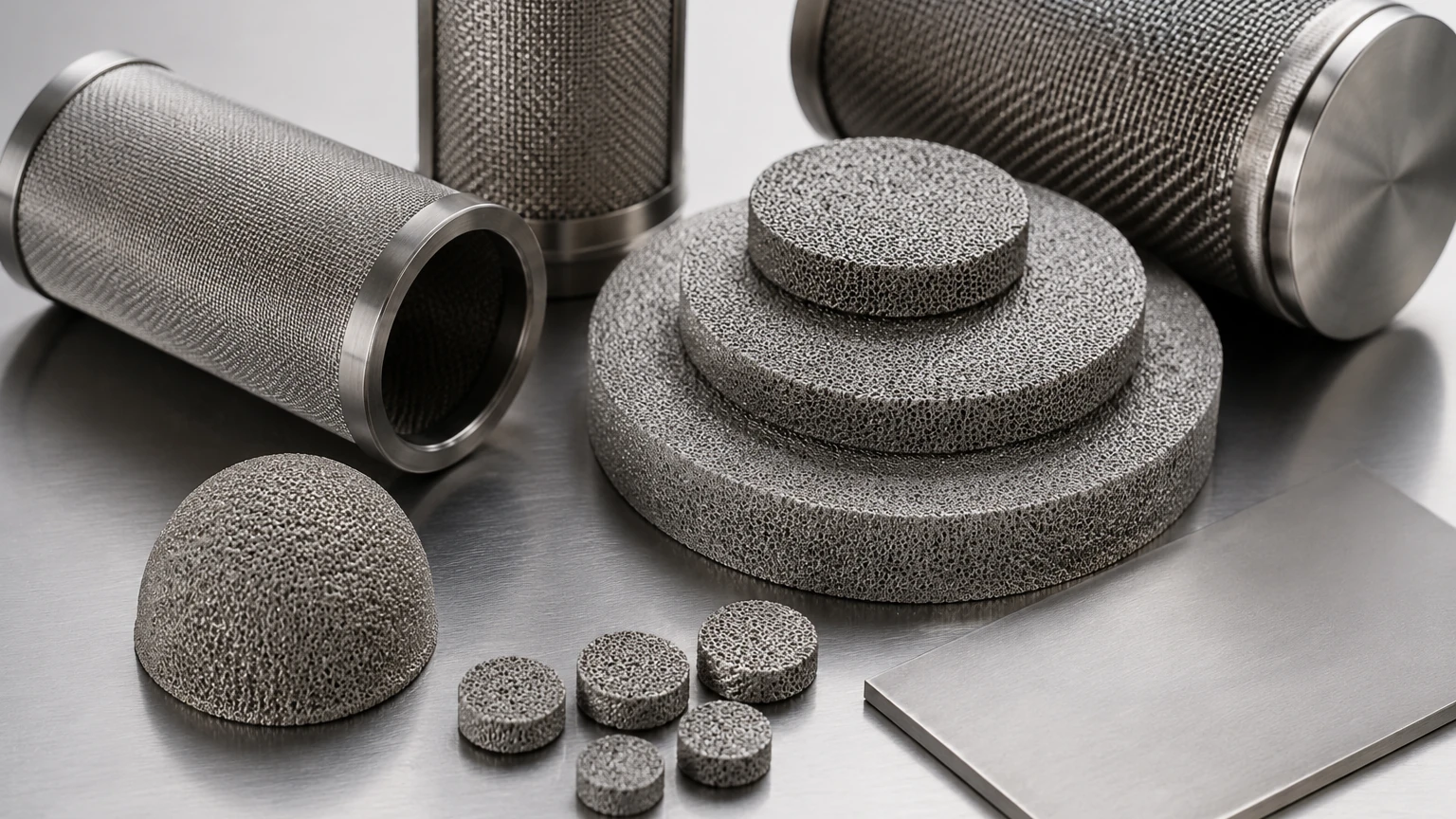
1. Sintered Powder Media: Produced by compacting stainless steel powder into a mold and then sintering it. This creates a depth-filtration medium with a tortuous path for fluids, making it ideal for capturing irregular particles and providing high filtration efficiency at low micron levels (down to 0.5 microns).
2. Sintered Wire Mesh: This involves layering multiple sheets of stainless steel wire cloth and sintering them together. The result is a robust, easy-to-clean surface filtration medium with predictable flow characteristics and high mechanical strength.
3. Sintered Metal Fiber: Made from extremely fine stainless steel fibers that are non-woven and sintered. This structure offers exceptionally high porosity (up to 80%), which translates to lower pressure drops and higher dirt-holding capacity compared to powder-based media.
Key Material Properties and Grade Selection
When specifying stainless steel porous components, material grade is a critical engineering decision. The most common alloys used are 304 and 316L stainless steel, though others may be used for specialized environments.
316L Stainless Steel
316L is the industry standard for most porous metal applications. The "L" stands for low carbon, which is vital for maintaining corrosion resistance after welding or sintering. The addition of molybdenum (2-3%) significantly improves resistance to pitting and crevice corrosion, particularly in chloride-rich environments. This makes 316L the preferred choice for marine applications, chemical processing, and pharmaceutical manufacturing where rigorous cleaning protocols are standard.
304 Stainless Steel
304 stainless steel is suitable for less aggressive environments. It offers excellent mechanical properties and good corrosion resistance for food and beverage applications or general industrial water treatment. However, it lacks the molybdenum found in 316L, making it more susceptible to chloride-induced stress corrosion cracking.
Mechanical Integrity
Beyond chemical resistance, the mechanical properties of porous stainless steel are a major factor in its selection. These materials exhibit high fatigue strength and can operate in temperatures ranging from cryogenic levels up to 600°C (1112°F) in oxidizing atmospheres, and even higher in reducing environments. This thermal stability allows for the filtration of hot gases and steam, which would be impossible with synthetic media.
Comparing Sintered Powder, Mesh, and Fiber Felt
Selecting the right stainless steel porous structure depends on the specific filtration goals: efficiency, flow rate, or dirt-holding capacity.
| Feature | Sintered Powder | Sintered Wire Mesh | Sintered Metal Fiber |
| :— | :— | :— | :— |
| Filtration Type | Depth | Surface | Depth/Hybrid |
| Porosity | 30% – 50% | 35% – 60% | 60% – 85% |
| Micron Rating | 0.5 – 100 µm | 1 – 200 µm | 1 – 100 µm |
| Permeability | Moderate | High | Very High |
| Cleanability | Moderate | Excellent | Good |
| Strength | Very High (Rigid) | High (Flexible) | Moderate |
Sintered wire mesh is often chosen when the filter must be frequently cleaned and reused, as the surface-loading nature of the mesh allows for effective backwashing. Sintered powder is preferred for high-precision gas filtration or applications requiring a very rigid, self-supporting structure. Sintered fiber felt is the optimal choice for high-viscosity fluids or systems where minimizing pressure drop is the primary concern.
Engineering Considerations for System Integration
Integrating a stainless steel porous filter into an industrial system requires more than just selecting a micron rating. Engineers must consider the fluid dynamics and the physical constraints of the housing.
Pressure Drop and Permeability
The pressure drop (ΔP) across a porous medium is a function of the fluid's viscosity, the flow velocity, and the permeability of the material. Using Darcy’s Law, engineers can calculate the expected resistance. Because stainless steel porous media are rigid, they do not compress or deform under high differential pressure, ensuring that the pore structure remains open and the filtration efficiency stays constant throughout the service cycle.
Flow Distribution and Sparging
In addition to filtration, these materials are frequently used for gas sparging—the process of injecting gas into a liquid. The uniform pore distribution of sintered stainless steel allows for the creation of millions of tiny, uniform bubbles. This increases the surface area for gas-liquid contact, which is critical in fermentation, carbonation, and oxygenation processes. The choice of pore size directly influences the bubble size and, consequently, the mass transfer efficiency of the system.
Customization and OEM Requirements
Industrial systems often require non-standard shapes to fit into existing hardware. Customization options for stainless steel porous components include discs, plates, tubes, and pleated cartridges. Pleating a sintered mesh or fiber felt significantly increases the filtration surface area within the same footprint, which is essential for high-flow applications where space is limited.
Maintenance, Cleaning, and Service Life Optimization
One of the most significant advantages of stainless steel porous media is their cleanability. Unlike disposable filters, these components represent a long-term capital investment rather than a recurring consumable cost. Proper maintenance can extend the service life of a sintered filter to several years.
Cleaning Protocols
Depending on the nature of the contaminant, several cleaning methods can be employed:
* Backpulsing/Backwashing: Using a reverse flow of fluid or gas to dislodge particles from the surface of the filter. This is most effective with sintered wire mesh.
* Ultrasonic Cleaning: Using high-frequency sound waves in a cleaning solvent to break loose fine particles trapped deep within the pores of sintered powder or fiber media.
* Chemical Cleaning: Utilizing acids, caustic solutions, or specialized solvents to dissolve organic or inorganic deposits. Stainless steel's chemical resistance allows for the use of aggressive cleaning agents that would destroy other materials.
* Thermal Cleaning: For organic contaminants, heating the filter in a controlled oven can burn off the residue, leaving the metallic structure intact.
Total Cost of Ownership (TCO)
While the initial purchase price of a stainless steel porous filter is higher than that of a disposable polymer filter, the TCO is often significantly lower. When factoring in the costs of replacement filters, labor for change-outs, disposal fees for contaminated media, and system downtime, the durability and reusability of stainless steel provide a clear economic advantage in demanding industrial environments.
Selecting a Manufacturer for Custom Filtration Solutions
Choosing a partner for stainless steel porous components requires an evaluation of both manufacturing capability and engineering expertise. A reliable manufacturer should be able to provide documentation on filtration efficiency, material certifications (such as 3.1 material certificates), and performance data under specific operating conditions.
At Kaifil, we specialize in the design and production of custom stainless steel filtration solutions. Our process begins with a thorough understanding of the application's parameters: fluid type, operating temperature, pressure requirements, and target particle size. By leveraging advanced sintering technologies and precision machining, we ensure that every component meets the exact needs of the end-user.
Whether you are designing a new chemical reactor, upgrading a hydraulic system, or seeking more durable filtration for a food processing line, our technical team is available to assist with material selection and design optimization. For more information on our capabilities and to view our full product catalog, please visit our Main Page.
In summary, stainless steel porous materials offer a unique combination of strength, heat resistance, and precise filtration that is unmatched by other media. By understanding the differences between powder, mesh, and fiber structures, and by implementing proper cleaning and maintenance schedules, industrial operators can achieve superior filtration performance and significant long-term savings.
