


Sterile Filtered
In high-precision industrial processing, the term "sterile filtered" refers to a critical validation state where a liquid or gas has passed through a filtration medium capable of removing all viable microorganisms. This process is foundational in industries such as pharmaceuticals, biotechnology, and food and beverage production, where the presence of even a single microbial contaminant can lead to batch failure, safety hazards, or regulatory non-compliance. Achieving a sterile filtered output requires more than just a fine mesh; it demands a rigorous understanding of pore size distribution, material compatibility, and the mechanical integrity of the filtration system.
For engineers and procurement specialists, selecting the right components to support a sterile filtration train involves evaluating the entire process flow. While the final sterile grade membrane (typically 0.22 microns) performs the ultimate task of microbial retention, the performance and lifespan of that membrane depend heavily on the upstream stainless steel pre-filters and precision metal components that protect it.
The Fundamentals of Sterile Filtration Technology
A product is considered sterile filtered when it has been processed through a filter with a pore size small enough to retain specific indicator organisms. The industry standard for liquid sterilization is the removal of *Brevundimonas diminuta*, a bacterium with a minimum dimension of approximately 0.3 micrometers. To ensure a safety margin, filters with a nominal rating of 0.22 microns are utilized.
However, the concept of "sterile" in an industrial B2B context extends beyond the pore size. It encompasses the "Log Reduction Value" (LRV), which measures the filter's ability to reduce the concentration of microorganisms. A sterile-grade filter must typically demonstrate an LRV of greater than 7 per square centimeter of effective filtration area. This means the filter can handle a challenge of 10^7 organisms and yield a sterile effluent. For technical teams, the challenge lies in maintaining this level of performance under varying flow rates and differential pressures without compromising the structural integrity of the filter media.
Critical Role of Pre-filtration in Sterile Systems
Final sterile membranes are often delicate and prone to premature fouling if exposed to raw process fluids. This is where high-performance stainless steel filtration solutions become indispensable. By implementing a multi-stage filtration strategy, facilities can protect expensive sterile-grade cartridges from particulate load, thereby extending their service life and reducing the total cost of ownership.
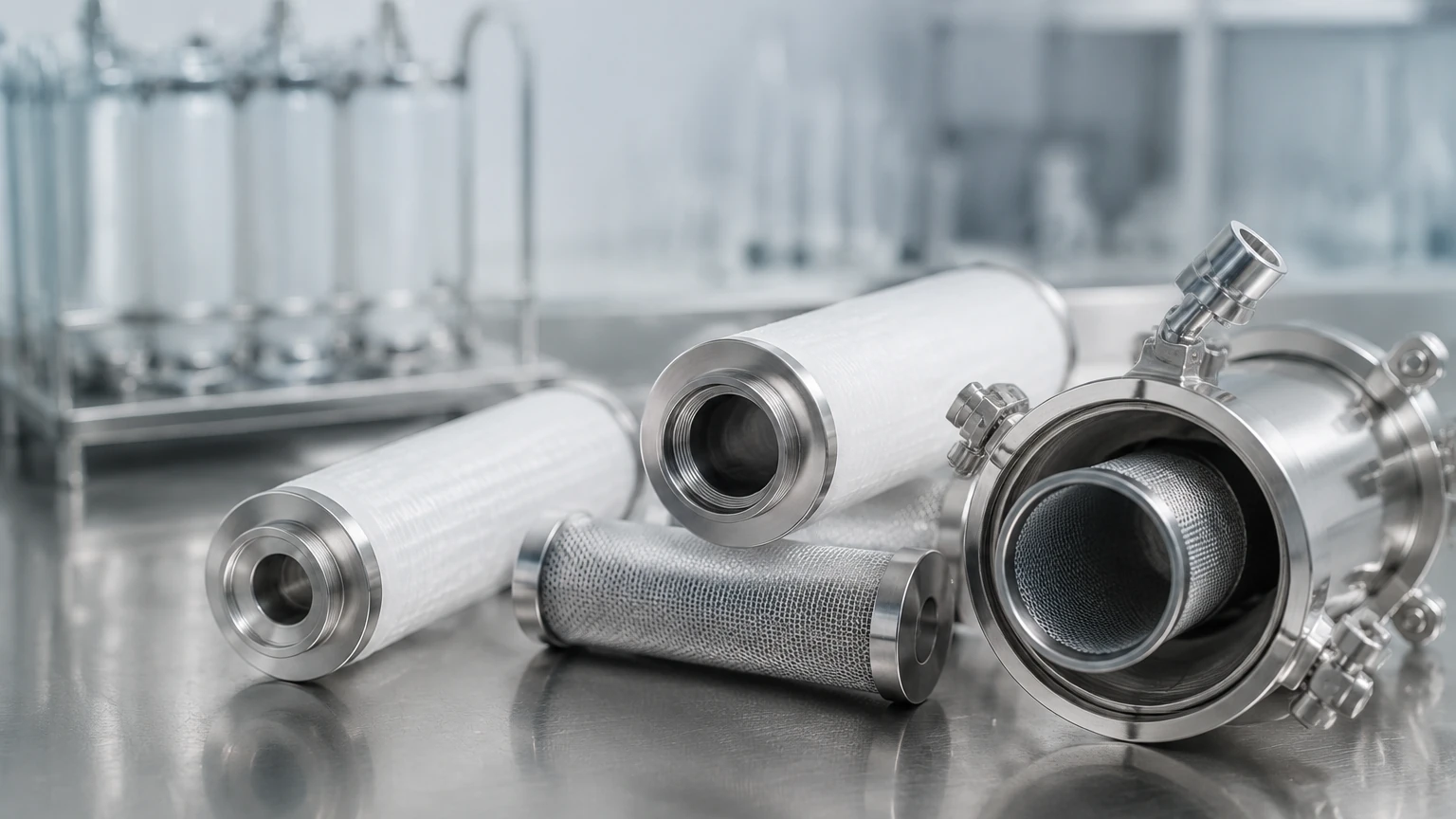
Stainless steel wire mesh filters and sintered metal components are frequently used as the primary and secondary stages in a sterile filtration train. These components are designed to remove bulk contaminants, such as pipe scale, precipitates, and larger microbial aggregates. Because these metal filters can be manufactured with precise micron ratings—ranging from 1 micron to several hundred—they provide a customizable barrier that ensures the final sterile filtered stage only encounters the microscopic particles it is designed to handle. This tiered approach is essential for maintaining consistent flow rates and preventing sudden pressure spikes that could lead to membrane rupture.
Material Engineering: Why Stainless Steel is Critical
In sterile environments, the material of construction for filter housings, cartridges, and support structures is just as important as the filtration media itself. 316L stainless steel is the industry benchmark for these applications due to its superior corrosion resistance and ability to withstand aggressive cleaning protocols.
Sterile filtered processes often require the system to undergo Steam-in-Place (SIP) or Clean-in-Place (CIP) cycles. Unlike polymer-based components, stainless steel filter elements can endure repeated exposure to high-pressure saturated steam (typically at 121°C or 134°C) without losing their dimensional stability or shedding particles. This durability is vital for maintaining a closed, sterile system. Furthermore, the low carbon content in 316L stainless steel minimizes carbide precipitation during welding, ensuring that the filter components remain resistant to intergranular corrosion in the demanding environments of chemical processing and pharmaceutical manufacturing.
Engineering Standards and Integrity Validation
A critical aspect of producing a sterile filtered product is the ability to validate the integrity of the filter before and after use. For industrial engineers, this involves non-destructive testing methods such as the Bubble Point Test, Pressure Hold Test, or Diffusion Flow Test.
1. Bubble Point Test: This measures the minimum pressure required to force air through a liquid-wetted filter. It is directly correlated to the largest pore size in the medium.
2. Diffusion Flow Test: In larger systems, air diffuses through the liquid-filled pores of the membrane at pressures below the bubble point. Measuring this flow rate allows engineers to detect minor leaks or defects in the filter or seals.
3. Water Intrusion Test (WIT): Often used for hydrophobic vent filters, this test measures the movement of water into the pore structure under pressure.
Ensuring that the stainless steel housings and support components are engineered to high tolerances is essential for these tests to be accurate. Any bypass around a seal or a minor structural deformation in the filter cage can lead to a false failure or, worse, a false pass that compromises the sterility of the entire batch.
System Integration and Customization
No two industrial filtration applications are identical. The requirements for a sterile filtered vaccine line differ significantly from those of a high-volume beverage bottling plant. Customization in filter design allows engineers to optimize the balance between filtration surface area, flow velocity, and hold-up volume.
Custom stainless steel filter cartridges can be engineered with specific end-cap configurations (such as Code 7, 222, or 226) to ensure a secure, leak-proof fit within existing housings. Additionally, the internal support cores and outer cages can be reinforced for applications involving high-viscosity fluids or significant back-pressure. By working with a manufacturer that offers OEM capabilities, technical teams can develop filtration components that are tailored to the specific geometry and hydraulic demands of their machinery, ensuring that the sterile filtered output remains consistent even under fluctuating operational conditions. To explore specific engineering specifications and customized designs, professionals can visit the Main Page for detailed technical documentation.
Operational Efficiency and Total Cost of Ownership
While the initial focus of sterile filtration is often on the "sterile" outcome, the long-term focus for purchasing teams is on "efficiency." The total cost of ownership (TCO) for a filtration system is influenced by the frequency of filter replacements, the labor costs associated with change-outs, and the yield loss during processing.
Stainless steel filtration components offer a distinct advantage in TCO because they are often cleanable and reusable. While the final membrane might be a single-use item, the stainless steel pre-filters and housings are long-term assets. Proper maintenance, including ultrasonic cleaning or chemical back-flushing, can restore the permeability of metal filters multiple times. This reduces the waste stream and ensures that the system remains operational for longer periods between major overhauls. Furthermore, the high mechanical strength of metal components prevents "media migration," where parts of the filter itself break off and contaminate the downstream flow—a common risk with lower-quality polymer filters.
Risk Mitigation in Sterile Processing
The risks associated with a failure in sterile filtration are substantial. Beyond the loss of product, companies face the risk of regulatory audits, recalls, and damage to brand reputation. To mitigate these risks, engineers must confirm several factors before finalizing their filtration strategy:
* Chemical Compatibility: Ensure the filter media and seals (O-rings) are compatible with both the process fluid and the cleaning agents used.
* Thermal Stability: Verify that the components can withstand the maximum temperature and duration of the SIP cycles.
* Mechanical Strength: Confirm the maximum allowable differential pressure (PSID) to prevent structural collapse during high-flow events.
* Extractables and Leachables: In pharmaceutical applications, it is critical to ensure that the filter components do not leach any chemicals into the sterile filtered product.
By addressing these technical boundaries during the design phase, manufacturers can create a robust filtration environment that consistently delivers sterile results. The integration of high-quality stainless steel components provides the physical foundation necessary for these high-stakes processes, ensuring that the final sterile filtered product meets the most stringent quality standards of the modern industrial landscape.
