


Sterilization Filter
In industrial processing, the requirement for absolute purity is not merely a quality standard but a critical operational necessity. A sterilization filter serves as the final barrier against microbial contamination in gases and liquids, ensuring that end products in the pharmaceutical, food and beverage, and biotechnology sectors remain safe and compliant. Unlike standard clarification filters, sterilization-grade components must meet rigorous validation criteria, demonstrating the ability to remove specific concentrations of microorganisms under defined conditions.
For engineers and procurement teams, selecting a sterilization filter involves a complex evaluation of material science, fluid dynamics, and mechanical durability. While polymer membranes are common in laboratory settings, industrial-scale applications often demand the robustness of stainless steel and sintered metal media to withstand high temperatures, aggressive chemicals, and repeated sterilization cycles.
Fundamentals of Industrial Sterilization Filtration
Sterilization filtration is defined by its ability to produce a sterile effluent from a non-sterile influent. In liquid applications, this typically refers to the removal of *Brevundimonas diminuta* at a concentration of 10⁷ CFU/cm² of effective filtration area. In gas applications, the focus shifts to the removal of airborne bacteria, viruses, and bacteriophages.
Mechanisms of Retention
The effectiveness of a sterilization filter relies on three primary mechanisms:
1. Size Exclusion (Sieving): The most reliable form of filtration where particles or microbes larger than the pore size are physically trapped on the surface or within the matrix of the filter media.
2. Adsorption: Electrostatic or van der Waals forces attract smaller particles to the surface of the filter fibers. This is particularly relevant in depth filtration media.
3. Inertial Impaction and Diffusion: Primarily occurring in gas filtration, these mechanisms involve particles colliding with and adhering to the filter fibers due to their momentum or Brownian motion.
Pore Size and Distribution
While a nominal rating of 0.22 microns is often cited as the standard for sterilization, industrial engineers must look closer at the pore size distribution. A filter with a wide distribution may allow "bypass" under high-pressure pulses. Precision-engineered metal filters, such as those produced by Kaifil, utilize controlled sintering processes to ensure a highly uniform pore structure, providing consistent performance across the entire surface area.
Material Considerations: The Role of Stainless Steel in Sterile Environments
The choice of material dictates the filter’s lifespan and its compatibility with sterilization protocols like Steam-in-Place (SIP). While disposable plastic filters are suitable for single-use batches, permanent stainless steel filtration systems offer significant advantages in high-volume industrial environments.
316L Stainless Steel
316L is the industry standard for sterile applications due to its low carbon content and high molybdenum levels, which provide superior resistance to pitting and corrosion. In the context of a sterilization filter, 316L can withstand the repeated thermal expansion and contraction associated with steam sterilization without losing structural integrity.
Sintered Wire Mesh vs. Sintered Metal Powder
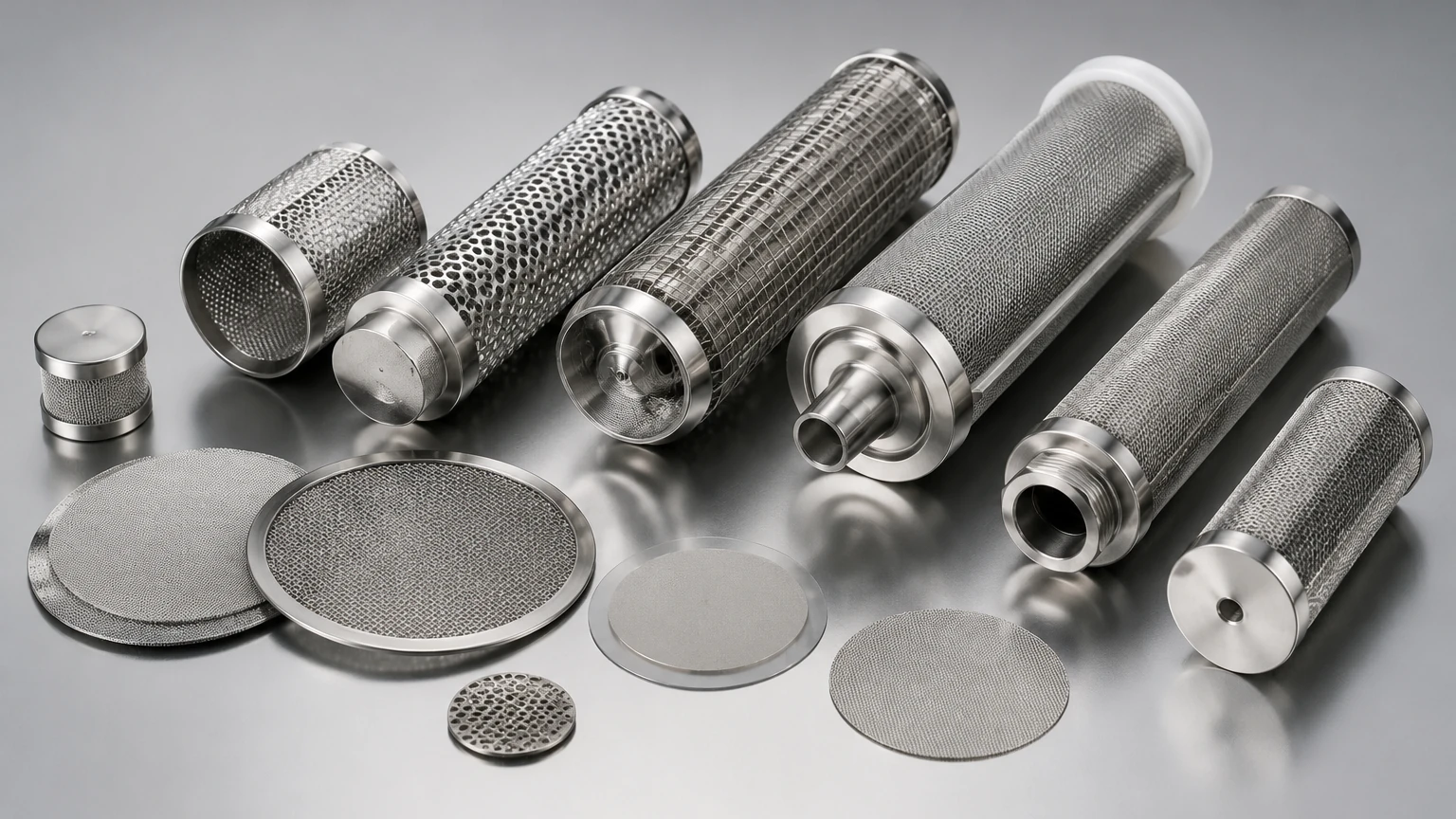
* Sintered Wire Mesh: Composed of multiple layers of woven wire cloth bonded through heat and pressure. This structure offers excellent permeability and is easily cleaned, making it ideal for high-flow gas sterilization.
* Sintered Metal Powder: Created by compressing and heating metal powders to form a porous solid. This media provides a tortuous path for fluids, offering high filtration efficiency and mechanical strength, which is essential for high-pressure hydraulic or chemical sterilization tasks.
Chemical and Thermal Resistance
Industrial processes often involve aggressive cleaning agents or high-temperature solvents. Stainless steel filters are inert to most organic solvents and can operate at temperatures exceeding 200°C, far beyond the limits of polyethersulfone (PES) or polytetrafluoroethylene (PTFE) membranes.
Performance Evaluation: Flow Dynamics and Filtration Efficiency
When integrating a sterilization filter into a production line, engineers must balance filtration efficiency with operational costs, specifically focusing on pressure drop and throughput.
Differential Pressure (ΔP)
The pressure drop across a filter is a key indicator of its efficiency and remaining service life. A high initial ΔP suggests that the filter is undersized for the required flow rate, leading to increased energy consumption and potential media deformation. Sintered metal filters are engineered to provide a high void volume, which minimizes initial ΔP while maintaining high dirt-holding capacity.
Throughput and Flux
Flux—the flow rate per unit area—determines how many filter elements are required for a specific process. In sterile gas filtration, such as fermenter aeration, maintaining high flux is critical to prevent oxygen limitation in the biological culture. Metal filters allow for higher operating pressures, which can be used to maintain flux even as the filter begins to load with particulates.
Total Cost of Ownership (TCO)
While the initial investment in a stainless steel sterilization filter is higher than a disposable alternative, the TCO is often lower. Factors contributing to this include:
* Longevity: Metal filters can be cleaned and reused for years.
* Reduced Downtime: Fewer filter changes mean less system downtime and lower risk of contamination during replacement.
* Waste Reduction: Eliminating the disposal of plastic cartridges aligns with corporate sustainability goals.
System Integration: SIP and CIP Compatibility
A sterilization filter is only as effective as the system it inhabits. Proper integration requires adherence to Clean-in-Place (CIP) and Steam-in-Place (SIP) protocols to ensure the entire fluid path is decontaminated.
Steam-in-Place (SIP) Challenges
During SIP, the filter is subjected to saturated steam, typically at 121°C or 134°C. Polymeric filters often have a limited number of steam cycles before the membrane becomes brittle or the housing seals fail. Stainless steel components are immune to these failure modes, allowing for hundreds or even thousands of sterilization cycles. However, engineers must ensure that the housing design allows for complete condensate drainage, as trapped water can create cold spots where sterilization is incomplete.
Clean-in-Place (CIP) Procedures
For liquid sterilization, the filter must be compatible with caustic or acidic cleaning solutions. The corrosion resistance of 316L stainless steel ensures that the filter media does not leach metallic ions into the process stream during cleaning. It is essential to verify that the filter’s pore structure can be fully reached by the CIP fluids to remove any residual biological load or process debris.
Housing Design and Surface Finish
To prevent microbial growth, the internal surfaces of the filter housing should be electro-polished to a Ra (Roughness Average) of less than 0.4 μm. Sanitary connections, such as Tri-Clamp fittings, should be used to eliminate dead legs where bacteria could proliferate.
Quality Assurance: Integrity Testing and Validation Protocols
In regulated industries, the performance of a sterilization filter must be verifiable. Integrity testing is the non-destructive method used to confirm that a filter meets its stated bacterial retention rating.
Common Integrity Tests
1. Bubble Point Test: Measures the pressure required to force air through a liquid-saturated filter. A lower-than-expected bubble point indicates a damaged filter or an incorrect pore size.
2. Pressure Hold Test: Observes the decay in pressure over time in a pressurized housing. This test is highly sensitive and is often preferred for large-scale industrial systems.
3. Water Intrusion Test (WIT): Specifically used for hydrophobic gas filters. It measures the movement of water into the filter matrix under pressure, providing a highly accurate assessment without the need for alcohol wetting agents.
Validation Documentation
For pharmaceutical applications, filters must be accompanied by a validation guide. This document includes data on extractables, toxicity (USP Class VI), and bacterial challenge results. When sourcing custom solutions, engineers should confirm that the manufacturer can provide the necessary documentation to support regulatory filings.
Customization and Strategic Procurement Considerations
Off-the-shelf filtration solutions often fail to meet the specific constraints of specialized industrial equipment. Customization is frequently required in terms of dimensions, end-cap configurations, and alloy selection.
Engineering for Specific Applications
In the chemical industry, a sterilization filter might need to handle highly viscous fluids at extreme pressures. In these cases, a standard pleated cartridge might collapse. A custom-engineered sintered metal element with internal reinforcements can provide the necessary mechanical stability. Similarly, in food processing, the filter must be designed to withstand rapid temperature fluctuations without bypassing.
Selecting a Manufacturing Partner
When evaluating suppliers, technical expertise is more valuable than a low price point. A reliable partner should offer:
* Material Traceability: Ensuring all metals used are of the specified grade and origin.
* Design Consultation: Ability to review system schematics and recommend the optimal filter geometry.
* OEM Capabilities: For equipment manufacturers, the ability to produce proprietary filter designs that integrate seamlessly into their machines.
As a professional manufacturer specializing in custom stainless steel filtration solutions, Kaifil provides the technical depth required for these demanding environments. Their expertise in wire mesh and precision metal components allows for the development of high-performance filters tailored to specific industrial needs. To explore the full range of capabilities and technical specifications, professionals can visit the Main Page for detailed product overviews and application support.
Conclusion: The Strategic Value of Robust Filtration
Selecting the right sterilization filter is a critical decision that impacts product safety, process efficiency, and long-term operational costs. By moving beyond generic solutions and focusing on the technical requirements of the application—such as material durability, thermal resistance, and verifiable integrity—engineers can build more resilient production lines.
Whether the application involves sterile air for fermentation, the filtration of pharmaceutical intermediates, or the protection of sensitive hydraulic components, the transition to high-quality stainless steel filtration media offers a path toward greater reliability. In an era of increasing regulatory scrutiny and competitive pressure, the robustness of the sterilization barrier remains a cornerstone of industrial excellence.
