


Stirred Reactors
Stirred reactors, often referred to as Continuous Stirred-Tank Reactors (CSTR) or batch stirred reactors, are fundamental components in chemical engineering and industrial processing. These vessels are designed to facilitate chemical reactions, mixing, and heat transfer under controlled conditions. In demanding environments such as chemical synthesis, pharmaceutical production, and polymer manufacturing, the efficiency of a stirred reactor is not only dependent on the agitation system but also on the precision of integrated components, particularly filtration and sparging systems.
For engineers and technical procurement teams, understanding the mechanical and chemical requirements of stirred reactors is essential for optimizing yield and ensuring equipment longevity. This guide explores the technical considerations of stirred reactors, with a specific focus on the role of stainless steel filtration and internal components in maintaining process integrity.
Fundamentals of Stirred Reactor Design
At its core, a stirred reactor consists of a vessel equipped with an agitator or impeller. The primary goal is to achieve a high degree of homogeneity in the reaction mass. This involves ensuring that reactants are uniformly distributed and that temperature gradients are minimized.
Agitation and Flow Patterns
The design of the impeller—whether it is a turbine, anchor, or paddle type—determines the flow pattern within the reactor. Radial flow impellers move fluid toward the vessel walls, while axial flow impellers move fluid along the axis of the stirrer. The choice of agitation affects the mass transfer rates, which is critical when dealing with multi-phase reactions, such as gas-liquid or solid-liquid systems.
Heat Transfer Mechanisms
Most chemical reactions are either exothermic or endothermic, requiring robust heat management. Stirred reactors typically utilize internal heating/cooling coils or external jackets. The efficiency of heat transfer is directly influenced by the turbulence created by the stirrer. However, the presence of internal components, such as baffles or filter assemblies, can alter flow patterns and must be accounted for during the engineering phase to prevent "dead zones" where the temperature or concentration might deviate from the set parameters.
The Role of Filtration in Stirred Reactors
Filtration is a critical auxiliary process within many stirred reactor applications. It is rarely a standalone step; rather, it is integrated into the reactor's lifecycle to manage catalysts, purify products, or protect downstream equipment.
Catalyst Recovery and Retention
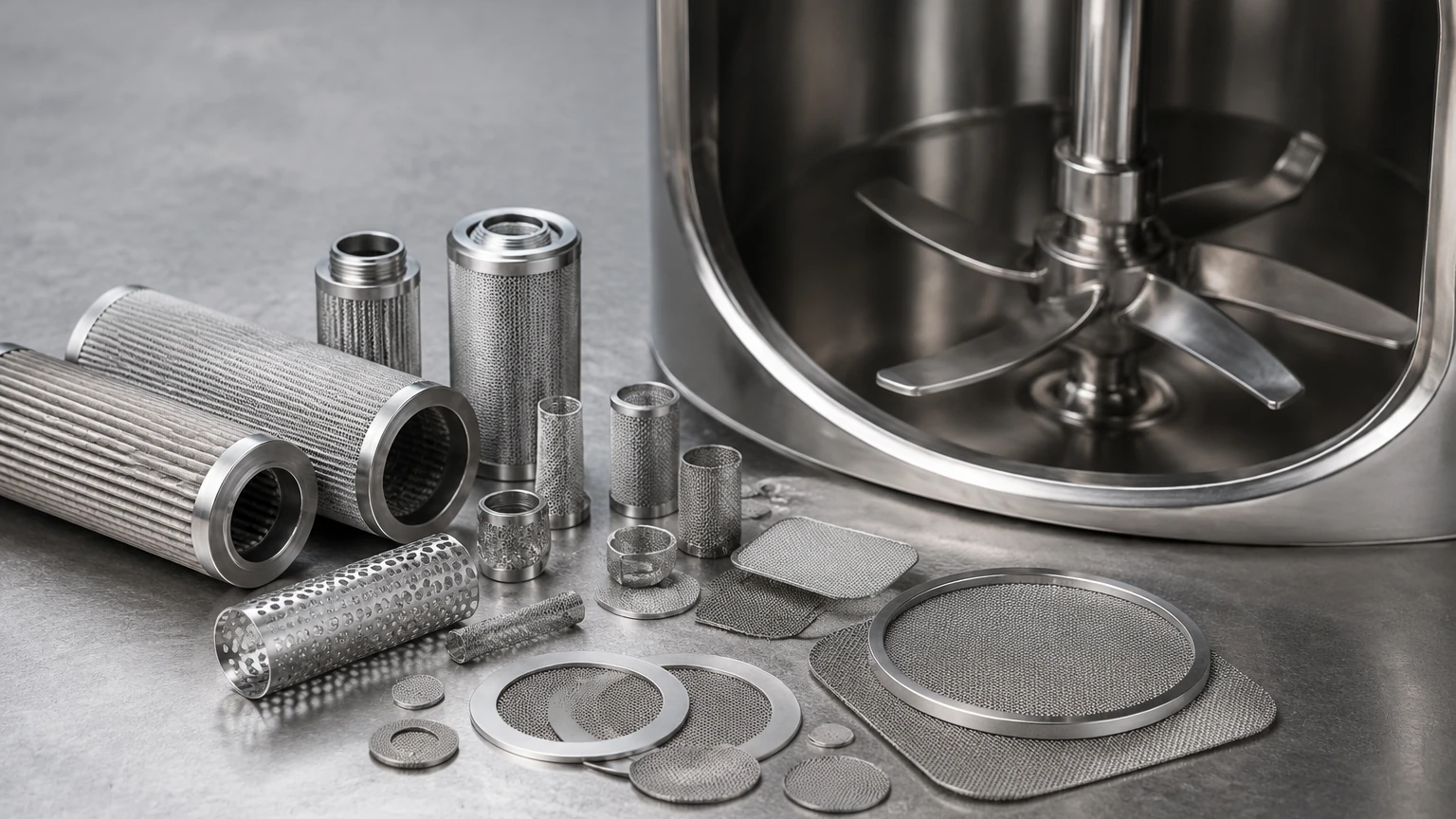
In many catalytic reactions, the catalyst is a high-value solid material that must be retained within the reactor or recovered with high efficiency. Internal filtration systems, often utilizing stainless steel wire mesh or sintered metal cartridges, allow the liquid product to be drawn off while keeping the catalyst particles inside the vessel. This "in-situ" filtration reduces the need for external separation stages, minimizing product loss and exposure to the environment.
Gas Sparging and Distribution
In aerobic fermentations or gas-liquid reactions (like hydrogenation), gas must be introduced into the liquid phase. Porous metal spargers are frequently used in stirred reactors to create fine bubbles, increasing the surface area for gas-liquid mass transfer. The durability of stainless steel ensures that these spargers can withstand the mechanical stress of the agitator's flow and the chemical environment of the reactor.
Material Selection for Reactor Internals
The harsh conditions inside stirred reactors—characterized by high temperatures, fluctuating pressures, and corrosive reagents—demand materials with exceptional resistance. Stainless steel remains the industry standard for these applications.
300-Series Stainless Steel
Grade 316L stainless steel is the most common choice for reactor internals due to its superior corrosion resistance, particularly against chlorides and organic acids. For less aggressive environments, 304L may be used, but 316L is generally preferred in pharmaceutical and fine chemical sectors to prevent metallic contamination of the product.
Sintered Metal and Wire Mesh
When selecting filtration components for stirred reactors, engineers must choose between different structures. Sintered metal fiber or multi-layer wire mesh provides the structural integrity needed to survive the high-velocity fluid flows generated by impellers. Unlike fabric or polymer filters, stainless steel components do not shed fibers, ensuring that the purity of the reaction remains uncompromised. For more information on material specifications and custom filtration designs, engineers can visit the Main Page to review technical capabilities.
Engineering Considerations for Integrated Filtration
Integrating a filter into a stirred reactor requires careful calculation of several physical variables. Failure to account for these can lead to premature filter failure or reduced reactor throughput.
Pressure Drop (Delta P)
As a reaction progresses, especially those involving polymers or precipitates, solids can accumulate on the filter surface. This creates a pressure drop. Engineers must specify the maximum allowable pressure drop before the filter requires cleaning or the process must be halted. High-strength stainless steel cartridges are designed to withstand significant differential pressures without collapsing.
Micron Rating and Particle Size Distribution
The filtration accuracy must be matched to the particle size of the catalyst or the solids being managed. If the micron rating is too large, valuable catalyst is lost; if it is too small, the filter will clog (blind) too quickly. A detailed analysis of the particle size distribution (PSD) is necessary before selecting the wire mesh or sintered metal grade.
Mechanical Stress and Vibration
The agitator in a stirred reactor creates significant hydraulic forces. Internal filter assemblies must be mechanically reinforced to prevent vibration fatigue. Custom-engineered supports and heavy-duty end caps are often necessary to ensure the filter remains stationary and intact during high-speed mixing cycles.
Maintenance and Cleaning Protocols
The total cost of ownership for a stirred reactor is heavily influenced by the ease of maintenance. Stainless steel filtration components offer a distinct advantage here: they are cleanable and reusable.
1. Backpulsing and Backwashing: In many continuous processes, the flow is periodically reversed to dislodge the filter cake from the surface of the stainless steel mesh. This extends the time between manual cleanings.
2. Chemical Cleaning (CIP): Stainless steel is compatible with a wide range of Clean-In-Place (CIP) chemicals, including caustic sodas and acids, allowing for thorough sterilization in pharmaceutical applications without dismantling the reactor.
3. Ultrasonic Cleaning: For deep-seated particulates in sintered media, ultrasonic baths can restore the filter to near-original permeability, a process not possible with disposable filter elements.
Customization and OEM Solutions
Every chemical process has unique requirements regarding flow rates, chemical compatibility, and vessel geometry. Off-the-shelf filtration solutions often fall short in specialized stirred reactors. Customization allows for the optimization of the filter’s surface area within the limited footprint of the reactor vessel.
Custom OEM solutions can include:
* Specific flange connections to match existing reactor ports.
* Variable pore sizes across a single element for specialized flow control.
* Reinforced structural cores for high-viscosity mixing.
* Electropolished surfaces to prevent product adhesion and facilitate cleaning.
By working with a manufacturer that understands the nuances of industrial filtration, engineering teams can ensure that their stirred reactors operate at peak efficiency with minimal downtime.
Conclusion
Stirred reactors are complex systems where the interaction between chemistry and mechanical engineering is constant. The inclusion of high-quality stainless steel filtration and internal components is not merely an accessory but a core requirement for modern industrial processing. By focusing on material durability, precise micron ratings, and robust mechanical design, facilities can achieve reliable, repeatable results in their most demanding applications. For those seeking to optimize their reactor systems or develop custom filtration components, exploring professional manufacturing resources at the Main Page provides the technical foundation necessary for informed decision-making and successful project execution.
