


Strainer Baskets Filtration
In industrial fluid handling, the integrity of downstream equipment—such as pumps, valves, heat exchangers, and spray nozzles—depends heavily on the efficiency of mechanical separation. Strainer baskets filtration serves as the primary line of defense, removing macroscopic solids and contaminants from liquid streams. Unlike disposable filter cartridges, strainer baskets are designed for durability, high flow rates, and repeated cleaning, making them a cornerstone of sustainable industrial filtration strategies.
For engineers and procurement professionals, selecting the appropriate strainer basket involves more than matching a diameter. It requires a deep understanding of fluid dynamics, material compatibility, and the specific mechanical stresses of the application. As a specialist in custom stainless steel filtration, Kaifil provides precision-engineered components that address these technical requirements across diverse sectors, including chemical processing, food and beverage, and hydraulic systems.
Understanding the Mechanics of Strainer Baskets Filtration
Strainer baskets filtration operates on the principle of mechanical sieving. As fluid enters the strainer housing, it is directed into the basket. The media—typically perforated metal or a combination of perforated metal and fine wire mesh—allows the liquid to pass through while trapping solids larger than the opening size.
The effectiveness of this process is governed by several variables:
* Flow Velocity: Higher velocities increase the force at which particles strike the mesh, potentially leading to particle bypass or mechanical deformation of the basket if not properly reinforced.
* Viscosity: High-viscosity fluids require larger open areas and potentially coarser media to prevent excessive pressure drops.
* Contaminant Loading: The concentration and nature of the solids (e.g., hard scales versus soft organic matter) dictate the cleaning frequency and the required structural strength of the basket.
In many industrial setups, strainer baskets are used for "coarse" filtration, typically ranging from 1/2 inch down to 40 microns. When finer filtration is required, multi-layered sintered mesh or pleated stainless steel inserts may be integrated into the basket design to provide the necessary surface area and micron precision.
Material Engineering: Selecting the Right Stainless Steel Grade
Material selection is perhaps the most critical factor in ensuring the longevity of strainer baskets filtration components. Industrial fluids can be highly corrosive, abrasive, or subject to extreme temperatures. Stainless steel is the industry standard due to its mechanical strength and resistance to oxidation.
Grade 304 Stainless Steel
Grade 304 is the most common choice for general industrial applications. It offers excellent strength and good corrosion resistance for water treatment, cooling systems, and non-acidic chemical processing. It is cost-effective for environments where chloride exposure is minimal.
Grade 316 and 316L Stainless Steel
For more demanding environments, such as pharmaceutical manufacturing or marine applications, Grade 316 is preferred. The addition of molybdenum enhances resistance to pitting and crevice corrosion, particularly in chloride-rich environments. Grade 316L (low carbon) is often specified for components requiring extensive welding to prevent carbide precipitation, which can lead to intergranular corrosion.
Specialty Alloys
In extreme cases involving highly concentrated acids or high-temperature caustic solutions, specialty alloys like Monel, Hastelloy, or Duplex stainless steel may be required. Engineering teams must confirm the chemical compatibility of the fluid with both the basket material and any gaskets or seals used in the assembly.
Structural Design and Customization for Industrial Demands
Standard off-the-shelf baskets often fail in specialized industrial environments due to inadequate structural support or poor fitment. Customization in strainer baskets filtration allows for the optimization of several design elements:
Perforation and Mesh Combinations
Most heavy-duty baskets utilize a "dual-media" approach. A heavy-gauge perforated metal sheet provides the structural skeleton, while a fine stainless steel wire mesh is lined or wrapped around it to achieve the target micron rating. This design allows the basket to withstand high differential pressures without collapsing, while still providing fine filtration.
Basket Geometry and Handles
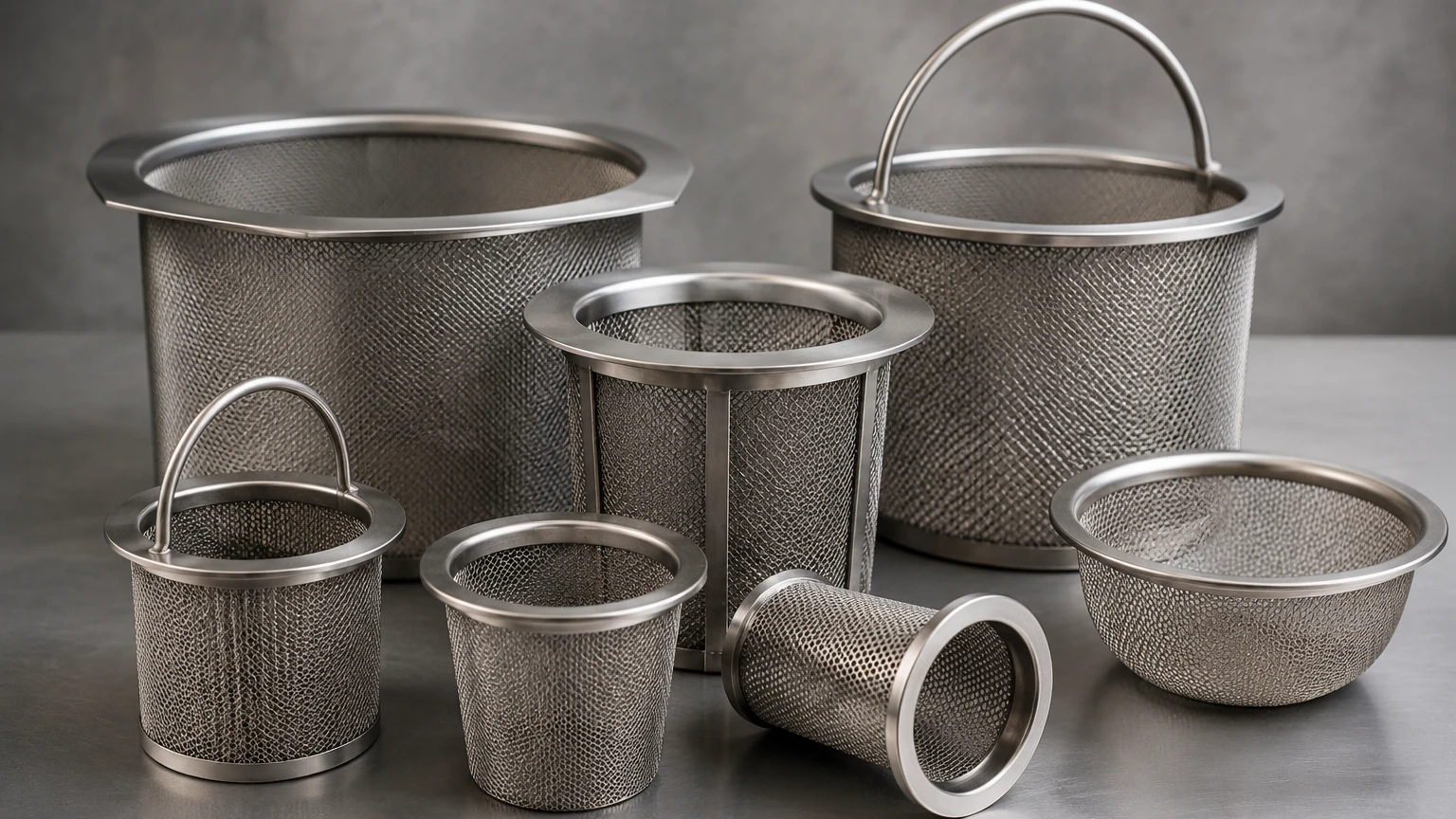
Depending on the housing design, baskets may be cylindrical, conical (witch’s hat), or slanted. The top flange must be precision-machined to ensure a tight seal against the housing, preventing "bypass"—where fluid escapes around the basket rather than through it. Handle designs, such as heavy-duty bale handles or slanted grips, are essential for safe and efficient removal during maintenance cycles.
Reinforcement Techniques
In high-pressure systems, baskets may feature longitudinal or circumferential reinforcement ribs. For applications with high flow turbulence, the bottom of the basket is often reinforced with a solid plate or a heavier mesh to prevent erosion and fatigue failure over time.
Evaluating Performance: Micron Ratings and Pressure Drop
When specifying strainer baskets filtration, engineers must balance filtration fineness with system performance. Two key metrics define this balance: the micron rating and the clean pressure drop (ΔP).
Micron vs. Mesh
In the B2B sector, filtration levels are often discussed in terms of "mesh count" (the number of openings per linear inch) or "micron rating" (the size of the smallest particle the mesh will trap). It is vital to distinguish between nominal and absolute ratings. A nominal rating indicates the ability to trap a high percentage of particles of a certain size, whereas an absolute rating guarantees that no particle larger than the specified size will pass through.
The Importance of Open Area Ratio
The "Open Area Ratio" (OAR) is the ratio of the total area of the holes in the basket to the cross-sectional area of the inlet pipe. A common engineering standard is a 6:1 or 8:1 OAR. A higher ratio means the strainer can accumulate more debris before the pressure drop becomes critical, thereby extending the time between cleaning cycles. If the OAR is too low, the system will experience frequent downtime and potential pump cavitation due to restricted flow.
For detailed technical specifications and to explore various configurations, engineers can visit the Main Page of the Kaifil website to review product options and application support.
Operational Maintenance and Cleaning Protocols
One of the primary advantages of stainless steel strainer baskets filtration is that the media is cleanable and reusable. However, the total cost of ownership is heavily influenced by how easily and effectively these baskets can be maintained.
Monitoring Differential Pressure
Systems should be equipped with differential pressure gauges. A significant increase in ΔP indicates that the basket is reaching its holding capacity. Operating beyond the recommended ΔP can lead to "breakthrough," where the pressure forces contaminants through the mesh, or mechanical failure of the basket itself.
Cleaning Methods
* Manual Cleaning: The basket is removed and hosed down. For sticky or oily contaminants, ultrasonic cleaning or chemical baths may be required to restore the open area of the mesh.
* Backwashing: In some automated systems, the flow is reversed to flush contaminants off the basket surface. This requires a basket design that can withstand reverse pressure without deforming.
Inspection for Fatigue
During cleaning, baskets should be inspected for signs of wire fraying, weld cracks, or flange warping. Even small gaps can compromise the entire filtration process. In critical applications, such as pharmaceutical or food production, having a rotation of spare baskets is recommended to ensure zero downtime during cleaning cycles.
Key Considerations for Procurement and Engineering Specification
Before finalizing a purchase order for strainer baskets filtration components, technical teams should confirm the following data points to ensure the solution is fit for purpose:
1. Maximum Flow Rate: Ensure the basket and housing can handle peak flow without exceeding a 2 PSI clean pressure drop.
2. Particle Characteristics: Identify the shape and hardness of the contaminants. Sharp, abrasive particles may require hardened stainless steel or thicker wire diameters.
3. Operating Temperature and Pressure: Confirm that the material and construction (welded vs. crimped) can withstand the maximum operating parameters of the system.
4. Regulatory Compliance: For food and beverage or pharmaceutical applications, ensure the materials meet FDA or 3A sanitary standards, including specific surface finish requirements (Ra values).
5. Customization Requirements: Determine if unique dimensions, specialized handles, or magnetic inserts (to trap ferrous particles) are necessary for the specific installation.
Conclusion: The Strategic Value of Precision Filtration
Strainer baskets filtration is a critical component of industrial infrastructure. By selecting high-quality, custom-engineered stainless steel baskets, facilities can significantly reduce maintenance costs, protect expensive downstream equipment, and ensure consistent product quality.
Kaifil’s expertise in manufacturing durable, high-performance filtration solutions allows engineers to solve complex separation challenges. Whether the application involves high-viscosity chemicals or high-speed water treatment, the focus remains on precision, durability, and optimized flow dynamics. For those looking to integrate or upgrade their systems, the Main Page serves as a comprehensive resource for technical data and customized filtration components designed for demanding industrial environments.
