


String Wound
In the landscape of industrial liquid process filtration, the string wound filter cartridge remains one of the most widely utilized depth filtration technologies. Its popularity stems from a combination of economic efficiency, a broad range of material compatibilities, and a high dirt-holding capacity. For engineers and procurement specialists, understanding the technical nuances of string wound filters is essential for optimizing system performance and managing the total cost of ownership.
While Kaifil specializes in high-precision stainless steel filtration solutions, the integration of metal components—particularly stainless steel cores—within string wound architectures is a critical intersection where durability meets traditional depth filtration. This article provides a technical exploration of string wound technology, material selection, and performance evaluation to assist in making informed industrial filtration decisions.
Understanding the Mechanics of String Wound Filtration
String wound filters operate on the principle of depth filtration. Unlike surface filters, such as certain wire mesh or pleated membranes that capture particles on a single plane, depth filters trap contaminants throughout the entire thickness of the filter media.
The Winding Process and Gradient Density
The performance of a string wound filter is determined by the precision of the winding process. Continuous strands of yarn are wound around a central support core in a specific geometric pattern. This pattern creates diamond-shaped openings that become progressively smaller toward the center of the cartridge.
This graduated density is the hallmark of a high-quality string wound filter. Larger particles are trapped in the outer layers, while finer particles are captured deeper within the media. This prevents the surface from blinding prematurely, allowing for a higher volume of solids to be retained before the pressure drop necessitates a filter change. Engineers must distinguish between "precision-wound" filters, which maintain consistent tension and geometry, and lower-quality alternatives that may suffer from inconsistent density and bypass issues.
Depth vs. Surface Filtration
In applications where the contaminant load consists of a wide range of particle sizes, string wound filters offer a distinct advantage over surface media. By utilizing the full volume of the yarn, these filters can handle high concentrations of deformable or gelatinous solids that would quickly coat and clog a surface filter. However, for applications requiring absolute micron ratings and reusability, stainless steel wire mesh solutions are often preferred. To explore the full range of these high-performance alternatives, you may visit our Main Page.
Material Science in String Wound Filter Cartridges
The selection of materials for both the winding media and the center core is the most critical factor in ensuring chemical compatibility and structural integrity under operational temperatures.
Filter Media Materials
1. Polypropylene: The most common material due to its excellent chemical resistance to acids, alkalis, and many solvents. It is generally rated for temperatures up to 140°F (60°C). It is ideal for water treatment, plating solutions, and general industrial chemicals.
2. Cotton: Often used in food and beverage or pharmaceutical applications when FDA-compliant materials are required. Bleached cotton is suitable for temperatures up to 250°F (121°C) and is compatible with oils, alcohols, and water.
3. Glass Fiber: Reserved for high-temperature applications (up to 750°F or 400°C) and aggressive chemical environments where polymers would degrade. Glass fiber is often paired with stainless steel cores for extreme industrial processing.
4. Polyester: Provides a middle ground for temperature resistance (up to 300°F) and is particularly effective for synthetic oils and specific solvent applications.
Support Core Materials
The core provides the structural backbone of the cartridge, preventing collapse as the differential pressure increases.
* Polypropylene Cores: Economical and chemically resistant, but limited by temperature.
* Tin-Plated Steel: Offers higher strength than plastic but is susceptible to corrosion in certain environments.
* Stainless Steel (304/316): The gold standard for industrial durability. Stainless steel cores are essential for high-pressure systems, high-temperature fluids, and applications where the risk of core collapse could lead to catastrophic downstream contamination. Kaifil’s expertise in stainless steel components ensures that even depth filtration systems can benefit from the structural reliability of precision-engineered metal cores.
Key Engineering Considerations for Filter Selection
Selecting a string wound filter requires more than just choosing a micron rating. Engineers must evaluate several variables to ensure the filter performs as expected within the specific parameters of the process loop.
Micron Ratings: Nominal vs. Absolute
Most string wound filters are rated "nominally." A nominal rating indicates the filter's ability to retain a majority percentage (typically 60% to 90%) of particles of a specified size. Because the winding process creates a tortuous path rather than a fixed pore size, these filters are not typically used for absolute sterilization or critical-path fine filtration. If a process requires 99.9% efficiency at a specific micron level, a pleated cartridge or a precision stainless steel filter may be required.
Chemical Compatibility and Leachable Content
In sensitive applications, such as pharmaceutical or high-purity chemical processing, the presence of lubricants or sizing agents on the yarn can lead to foaming or contamination (leachables). It is vital to confirm that the string wound media has been properly scoured or is certified for the intended use. Furthermore, the compatibility of the core material must be checked against the fluid to prevent galvanic corrosion or material degradation.
Performance Metrics: Flow Rate and Pressure Drop
The efficiency of a filtration system is often measured by its "clean pressure drop" and its "terminal pressure drop."
Initial Pressure Drop
Every filter introduces resistance to the flow. A string wound filter with a high void volume (the space between the fibers) will have a lower initial pressure drop, allowing for higher flow rates per cartridge. However, a higher void volume may also result in lower filtration efficiency. Engineering the balance between flow and retention is key to system sizing.
Dirt Holding Capacity (DHC)
The DHC determines how long a filter can stay in service. As the string wound media captures particles, the available flow paths decrease, and the differential pressure (ΔP) increases. Once the ΔP reaches a predetermined limit (usually 20–30 psi for polymer cores, higher for stainless steel cores), the filter is considered spent. Factors affecting DHC include the yarn type (fibrillated vs. spun) and the winding tension.
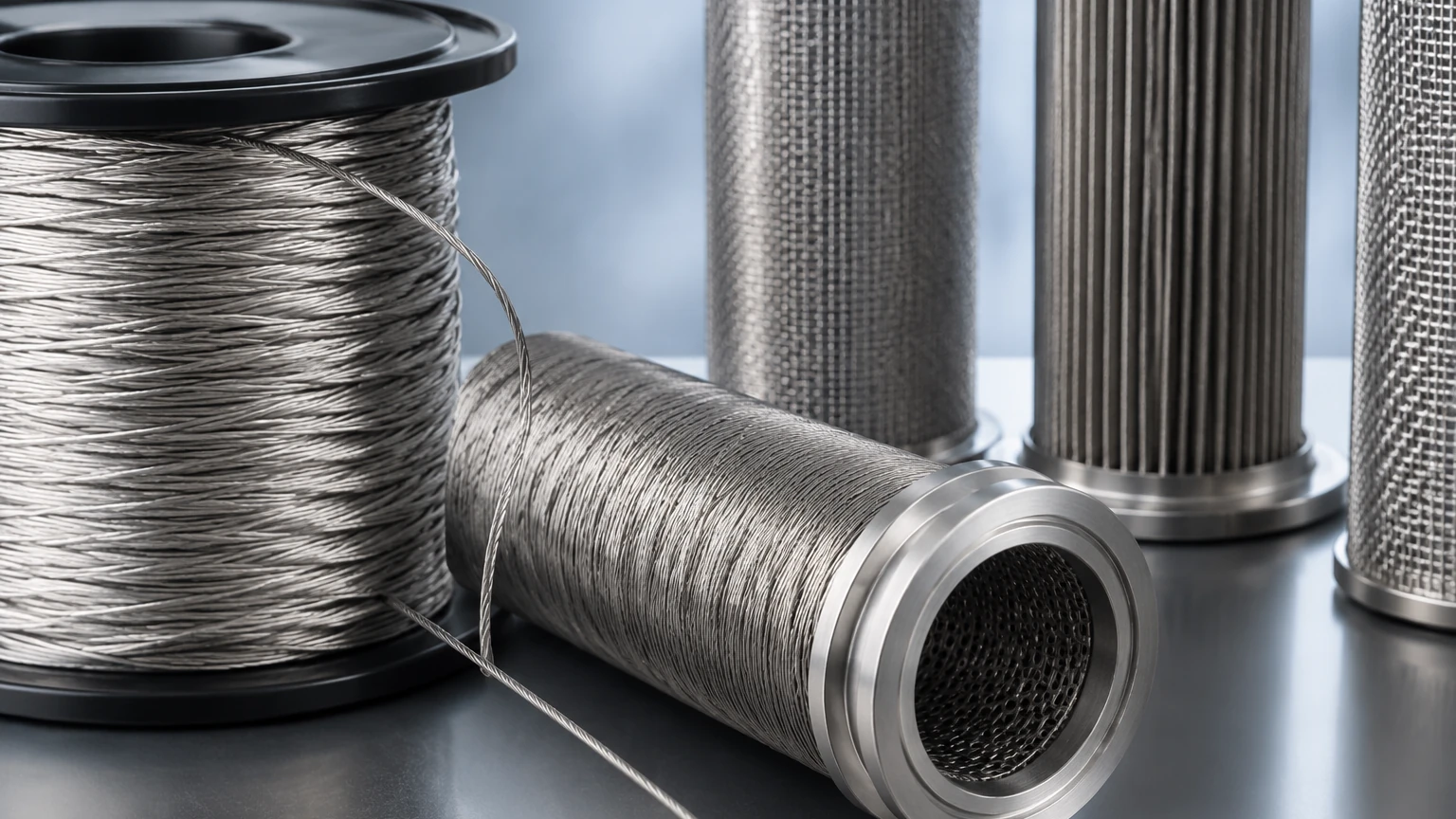
Comparing String Wound Filters to Stainless Steel Alternatives
While string wound filters are effective for many applications, there are scenarios where transitioning to stainless steel filtration components is more cost-effective in the long run.
| Feature | String Wound (Polymer/Cotton) | Stainless Steel Wire Mesh |
| :— | :— | :— |
| Filtration Type | Depth | Surface/Depth |
| Reusability | Disposable | Cleanable & Reusable |
| Temperature Limit | Low to Moderate | Very High (up to 1000°F+) |
| Chemical Resistance | Variable by Material | Excellent (304/316L) |
| Structural Strength | Moderate (Core Dependent) | High |
| Initial Cost | Low | High |
| Long-term Cost | High (Replacement/Disposal) | Low (Longevity) |
For high-viscosity fluids or high-temperature steam filtration, the limitations of string wound media become apparent. In these cases, custom stainless steel filter cartridges provide the necessary mechanical strength to withstand high differential pressures without media migration or bypass. For detailed specifications on these durable alternatives, refer to the Main Page for our technical catalog.
Maintenance and Operational Lifecycle Management
Effective maintenance of a filtration system involving string wound cartridges focuses on monitoring and timely replacement. Because these are depth filters, they cannot be effectively backwashed or cleaned once the internal matrix is saturated with contaminants.
Monitoring Differential Pressure
The most reliable way to manage string wound filters is through differential pressure gauges installed across the filter housing. Relying on a fixed time schedule for replacement can lead to either premature disposal (wasted money) or delayed replacement (reduced flow and potential media migration).
Preventing Media Migration
A common failure mode in low-quality string wound filters is media migration, where small fibers of the yarn break off and enter the downstream flow. This is often caused by high fluid velocity or chemical degradation of the yarn. Selecting high-quality, continuous-filament yarn and ensuring the filter is not operated beyond its rated flow capacity are the primary defenses against this issue.
Customization for Demanding Industrial Environments
In complex industrial environments, "off-the-shelf" solutions may not suffice. Customization of string wound filters often involves modifying the core and the end-cap configuration to fit existing housings or to provide extra reinforcement.
Custom Core Engineering
For applications involving hydraulic fluids or high-pressure chemical injection, standard plastic cores may flex or bypass. Kaifil provides custom stainless steel cores and support structures that can be integrated into specialized depth filtration products. These cores ensure that the filter maintains its geometric integrity even under fluctuating pressure conditions.
End-Cap Configurations
To ensure a leak-proof seal, string wound filters can be customized with various end-cap styles, including DOE (Double Open End), 222/Flat, or 226/Fin. The choice of gasket material (EPDM, Viton, Silicone, or PTFE) must also be aligned with the chemical profile of the process fluid.
Conclusion
The string wound filter remains a versatile and essential component in the industrial filtration toolkit. By understanding the relationship between winding patterns, material selection, and structural support, engineers can significantly improve the efficiency of their filtration processes. While these disposable depth filters are ideal for many pre-filtration and general-purpose tasks, demanding applications requiring extreme durability and reusability are better served by precision metal solutions.
For more information on selecting the right filtration components or to explore our range of custom stainless steel cartridges and wire mesh filters, please visit our Main Page. Our engineering team is available to assist with material selection and technical specifications to ensure your filtration system achieves optimal performance and reliability.
