


Titanium Fiber
In the landscape of advanced industrial materials, titanium fiber has emerged as a critical component for high-performance filtration, electrochemical energy conversion, and specialized aerospace applications. Unlike traditional metal meshes or powders, titanium fiber, particularly when processed into sintered felt, offers a unique combination of high porosity, mechanical strength, and exceptional chemical stability. For engineers and procurement specialists, understanding the technical nuances of this material is essential for optimizing system performance in environments where standard stainless steel or polymer-based solutions fail.
As a specialized manufacturer of stainless steel and precision metal filtration solutions, Kaifil recognizes the growing demand for titanium-based components in sectors ranging from hydrogen production to aggressive chemical processing. This guide provides a technical overview of titanium fiber properties, its primary industrial applications, and the engineering criteria necessary for selection.
Understanding Titanium Fiber and Sintered Felt Structures
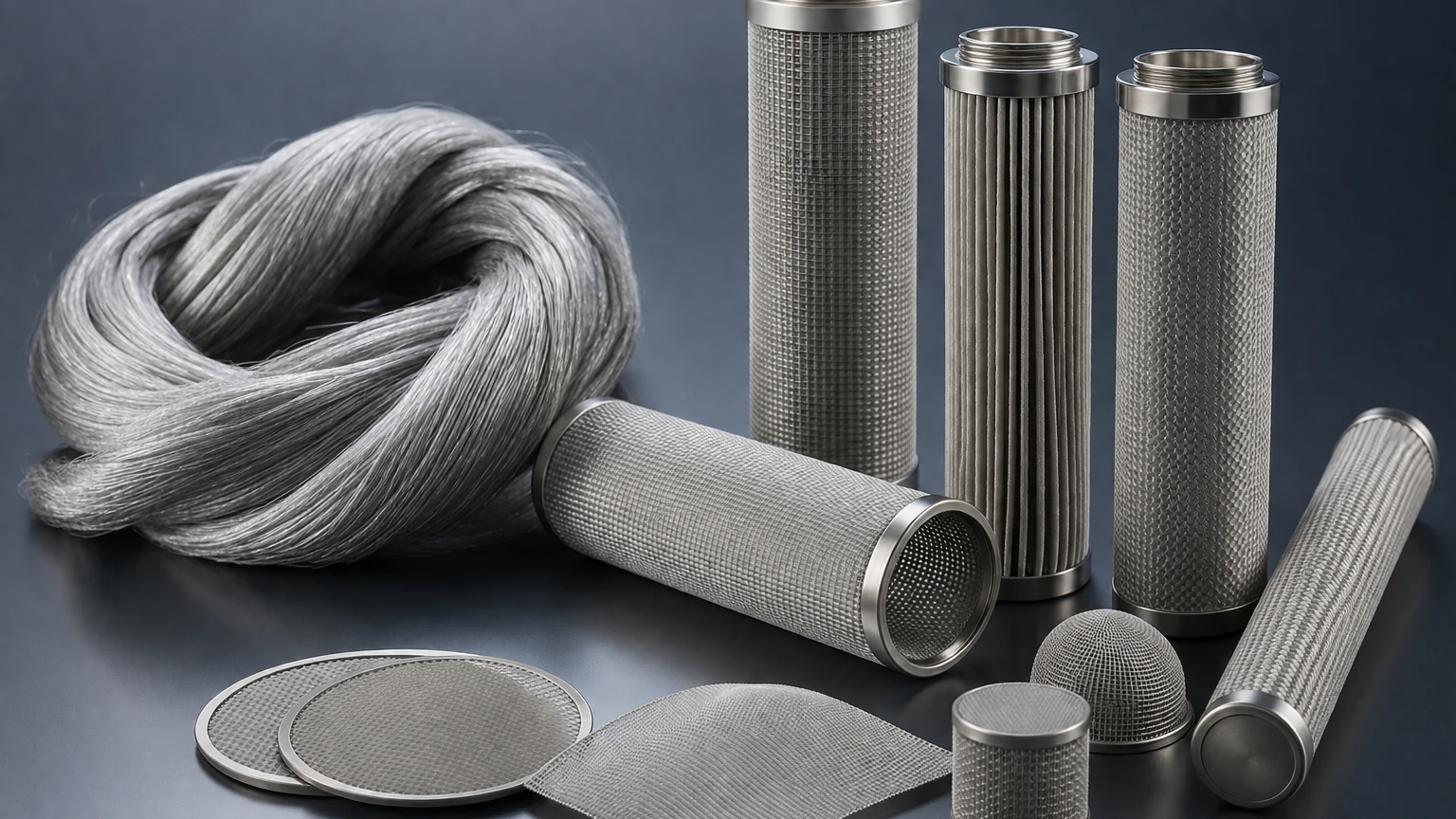
Titanium fiber is produced through specialized manufacturing techniques, such as bundle drawing or melt spinning, which result in metallic filaments with diameters typically ranging from 10 to 100 micrometers. While individual fibers have specific uses, the most common industrial form is sintered titanium fiber felt.
The Sintering Process
To create a functional filtration or diffusion medium, these fibers are laid in a non-woven, three-dimensional structure and subjected to high-temperature vacuum sintering. This process creates metallurgical bonds at every fiber contact point without the need for binders or adhesives. The result is a rigid, porous plate or sheet that maintains the inherent chemical properties of titanium while providing a high-void-volume structure.
Compared to sintered titanium powder, fiber-based structures offer significantly higher porosity (often between 60% and 80%) and better permeability. This structural advantage allows for lower pressure drops across the media, which is a critical factor in reducing energy consumption in fluid systems.
Key Performance Characteristics for Industrial Applications
The selection of titanium fiber over more common materials like 316L stainless steel is usually driven by specific environmental demands. Engineers must evaluate the following characteristics to determine if titanium is the appropriate choice for their application.
1. Superior Corrosion Resistance
Titanium naturally forms a stable, protective oxide layer when exposed to oxygen. This makes titanium fiber exceptionally resistant to corrosion in seawater, wet chlorine, and oxidizing acids (such as nitric or chromic acid). In applications where stainless steel would suffer from pitting or stress corrosion cracking, titanium remains inert, ensuring the purity of the process fluid and the longevity of the filter element.
2. High Porosity and Low Resistance
The three-dimensional network of titanium fiber felt provides a tortuous path for filtration while maintaining a high percentage of open space. This leads to high dirt-holding capacity and low flow resistance. In electrochemical applications, such as electrolysis, this porosity is vital for the efficient transport of gases and liquids.
3. Thermal Stability
Titanium maintains its mechanical integrity at temperatures significantly higher than most polymers and many aluminum alloys. While not as heat-resistant as certain nickel-based superalloys, it provides a stable solution for medium-to-high temperature filtration (up to 300°C-400°C in oxidizing atmospheres) where weight-to-strength ratios are a concern.
4. Biocompatibility
In the pharmaceutical and medical device industries, the biocompatibility of titanium is a major advantage. It does not leach toxic ions into the process stream, making it a preferred material for sterile filtration and pharmaceutical ingredient processing.
Critical Applications in Green Energy and Chemical Processing
The unique properties of titanium fiber have made it indispensable in several high-growth industrial sectors.
Hydrogen Production (PEM Electrolyzers)
One of the most significant applications for titanium fiber felt today is in Proton Exchange Membrane (PEM) water electrolyzers. It serves as the Liquid/Gas Diffusion Layer (LGDL) at the anode side. The LGDL must manage several tasks simultaneously: it must conduct electricity, allow water to reach the catalyst layer, and facilitate the removal of oxygen gas. Because the anode environment is highly acidic and operates at high voltages, stainless steel would corrode rapidly, poisoning the catalyst. Titanium fiber felt, often coated with platinum or iridium to further reduce contact resistance, provides the necessary durability and efficiency.
Aggressive Chemical Filtration
In the chemical industry, processes involving chloride ions or highly oxidizing fluids can destroy standard metal filters. Titanium fiber filters are used to remove particulates from these aggressive media, ensuring downstream equipment is protected and product quality is maintained. This is particularly relevant in the production of specialty chemicals and fine intermediates.
Aerospace and Defense
The high strength-to-weight ratio of titanium makes its fiber forms attractive for aerospace filtration and acoustic damping. In these sectors, reducing weight while maintaining the ability to withstand vibration and thermal cycling is paramount.
Engineering Considerations for Selection
When specifying titanium fiber components, engineers should look beyond the material type and focus on the structural parameters that will dictate performance. For customized filtration solutions, visit the Main Page to explore how these parameters can be tailored to specific needs.
Fiber Diameter and Pore Size
The diameter of the fibers used in the felt directly influences the pore size distribution. Finer fibers allow for smaller pores and higher filtration accuracy but may increase the pressure drop. Standard industrial titanium felts can achieve filtration ratings from 1 to 100 microns. It is critical to match the pore size to the particle size distribution of the contaminant to prevent premature blinding of the filter.
Thickness and Mechanical Strength
The thickness of the fiber felt affects both the filtration depth and the mechanical stability of the component. In high-pressure hydraulic or gas systems, the felt must be thick enough to resist deformation or be supported by a coarser mesh or perforated plate. Sintering the fiber felt to a titanium wire mesh (a process known as laminating) is a common way to enhance mechanical strength without sacrificing the filtration properties of the fine fiber layer.
Surface Treatments and Coatings
For certain applications, the native oxide layer of titanium can create high electrical contact resistance. In electrochemical cells, titanium fiber felt is often electroplated with noble metals like platinum. This treatment maintains the corrosion resistance of the titanium core while significantly improving electrical conductivity at the interface.
Maintenance, Durability, and Total Cost of Ownership
From a procurement perspective, titanium fiber represents a higher initial investment compared to stainless steel or disposable polymer filters. However, the total cost of ownership (TCO) often favors titanium in demanding environments.
Cleaning and Reusability
Unlike polymer filters, titanium fiber elements are cleanable and reusable. They can be subjected to backwashing, ultrasonic cleaning, or chemical cleaning (using compatible acids or bases) to remove accumulated debris. This reusability reduces the frequency of filter replacements and minimizes hazardous waste disposal costs.
Longevity
The extreme durability of titanium in corrosive environments means that the service life of a single titanium fiber element can often exceed the lifespan of dozens of lower-cost alternatives. In continuous process industries, the reduction in downtime associated with filter changes provides significant operational savings.
Sourcing and Customization with Kaifil
Selecting the right filtration medium requires a balance of material science and mechanical engineering. At Kaifil, we specialize in providing tailored filtration solutions that meet the rigorous demands of modern industry. Whether you are designing a new PEM electrolyzer stack or upgrading a corrosive fluid filtration system, the choice of titanium fiber must be backed by technical data and manufacturing precision.
When sourcing titanium fiber components, it is important to confirm the following with your manufacturer:
* Material Grade: Ensure the use of high-purity titanium (typically Grade 1 or Grade 2) to maximize corrosion resistance.
* Permeability Data: Request pressure drop vs. flow rate curves for the specific thickness and porosity being considered.
* Dimensional Tolerances: For integration into precision equipment like fuel cell stacks, tight tolerances on thickness and flatness are essential.
By focusing on these technical details, engineering teams can leverage the unique properties of titanium fiber to achieve reliable, long-term performance in the most challenging industrial environments. For more information on custom metal filtration components and engineering support, please refer to the resources available on our Main Page.
