


Tube Bundles
In the landscape of industrial fluid processing and thermal management, tube bundles represent a fundamental engineering solution for managing high-volume flow and heat transfer. For engineers and procurement specialists, selecting the right tube bundle configuration is not merely a matter of dimensional fit; it involves a complex evaluation of material science, fluid dynamics, and structural integrity. Whether integrated into heat exchangers or utilized as high-capacity filtration assemblies, these components must withstand rigorous operating conditions while maintaining precise performance standards.
As a manufacturer specializing in custom stainless steel filtration and precision metal components, Kaifil understands that the reliability of a system often hinges on the quality of its internal components. This guide provides a technical overview of tube bundles, focusing on design considerations, material selection, and the critical factors that influence their longevity and efficiency in industrial applications.
Understanding the Architecture of Tube Bundles
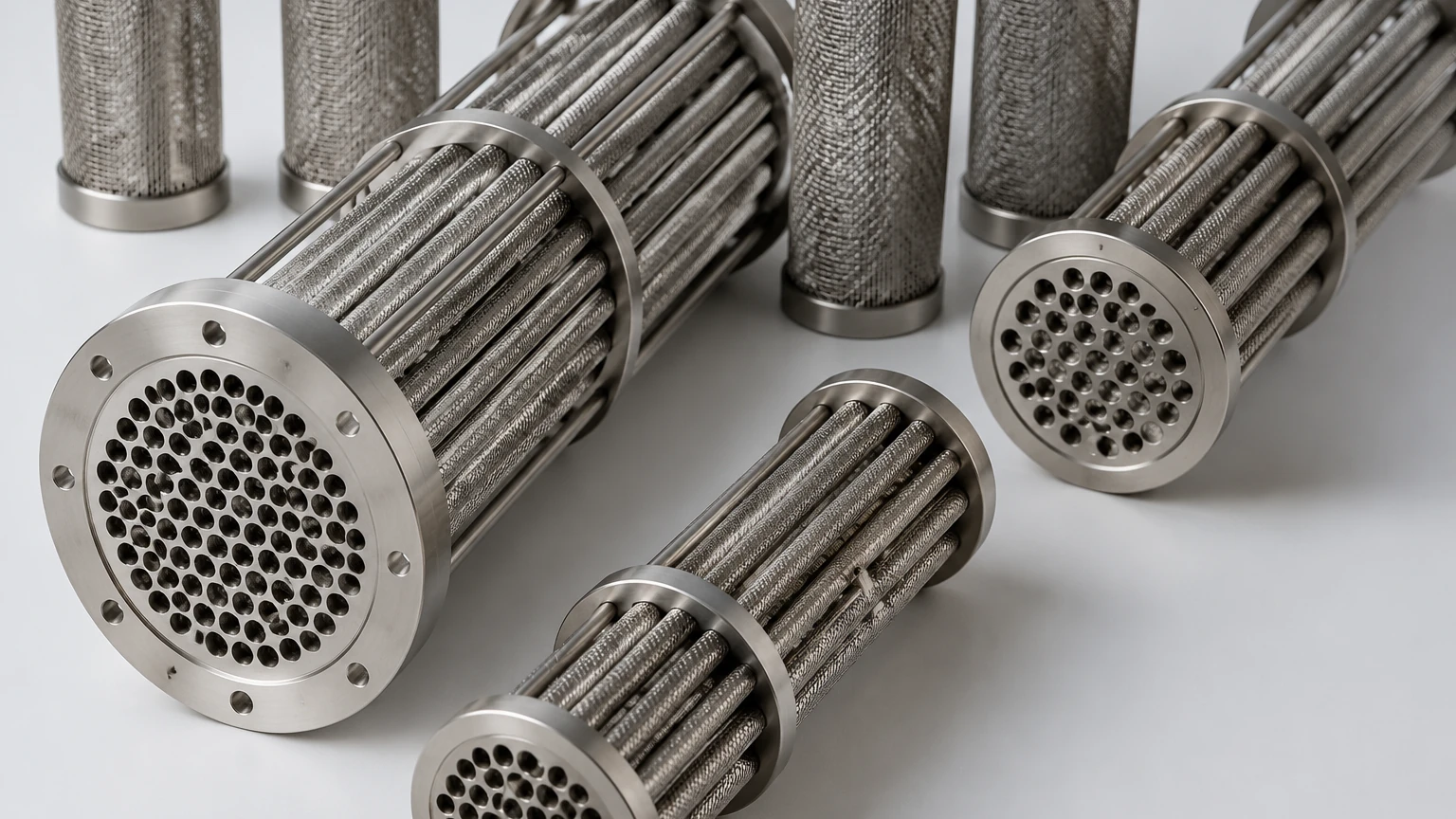
A tube bundle is a systematic assembly of tubes secured together to provide a large surface area within a compact footprint. In industrial filtration and heat exchange, this architecture is designed to facilitate the transfer of energy or the removal of contaminants from a process fluid. The primary components of a standard bundle include:
* Tubes: The individual conduits through which the process fluid flows. In filtration contexts, these may be perforated, wrapped in wire mesh, or constructed from sintered metal to act as the primary filter media.
* Tube Sheets: Thick metal plates that hold the tubes in place. The tubes are typically expanded or welded into holes drilled into the tube sheets, creating a seal that separates the tube-side fluid from the shell-side fluid.
* Baffles: Internal plates designed to support the tubes and direct the flow of fluid across the bundle. Baffles are critical for preventing vibration and ensuring optimal fluid contact with the tube surfaces.
* Tie Rods and Spacers: These components maintain the structural spacing between baffles and ensure the bundle remains rigid under high-pressure conditions.
For high-performance applications, the precision of the tube sheet drilling and the quality of the tube-to-tube-sheet joints are paramount. Any misalignment or weak weld can lead to bypass or cross-contamination, compromising the entire process.
Material Selection for Corrosive and High-Temperature Environments
The choice of material is perhaps the most significant factor in determining the lifecycle of tube bundles. Industrial processes often involve aggressive chemicals, high pressures, and fluctuating temperatures. Stainless steel is the industry standard due to its versatile mechanical properties and resistance to oxidation.
Stainless Steel Grades
* 304/304L: Suitable for general industrial applications where moderate corrosion resistance is required. It is cost-effective but may be susceptible to pitting in chloride-rich environments.
* 316/316L: The preferred choice for chemical processing, pharmaceuticals, and food and beverage industries. The addition of molybdenum enhances its resistance to chloride-induced corrosion and stress cracking.
* Duplex Stainless Steel: Used in highly demanding environments where both high strength and exceptional corrosion resistance are necessary. Duplex alloys provide better resistance to localized corrosion compared to standard austenitic grades.
Engineering Considerations for Material Choice
When specifying materials for tube bundles, engineers must consider the "Total Cost of Ownership" (TCO). While higher-grade alloys have a higher initial procurement cost, they often reduce long-term expenses by extending the replacement cycle and minimizing downtime caused by failure. Factors such as the concentration of corrosive agents, the presence of abrasive particles, and the maximum operating temperature must be mapped against the material's performance curves.
Design Parameters and Customization
Standardized tube bundles rarely meet the specific requirements of specialized industrial systems. Customization is often necessary to optimize flow rates and filtration efficiency. Key design parameters include:
Tube Diameter and Wall Thickness
Smaller diameter tubes increase the surface area for a given volume, improving heat transfer or filtration capacity, but they also increase the pressure drop across the system. Conversely, larger tubes are easier to clean and maintain but require a larger footprint. Wall thickness must be calculated based on the internal and external pressure differentials to prevent tube collapse or bursting.
Tube Pitch and Layout
The "pitch" refers to the distance between the centers of adjacent tubes. A triangular pitch layout allows for a higher density of tubes within a specific shell diameter, which is ideal for high-capacity requirements. A square pitch layout, while providing less surface area, is easier to clean mechanically on the shell side, making it suitable for fluids prone to fouling.
Filtration Accuracy and Media
In filtration-focused tube bundles, the tubes themselves may be replaced by filter cartridges or elements. Engineers must specify the required micron rating and the type of media (e.g., wedge wire, woven mesh, or sintered metal). The structural support of these elements within the bundle is crucial to prevent deformation under high differential pressure.
Performance Evaluation Criteria
Before finalizing a purchase or design for tube bundles, technical teams should evaluate performance through several lenses:
1. Pressure Drop ($ΔP$): Excessive pressure drop indicates inefficiency and can strain pumps and upstream equipment. The design should balance filtration/heat transfer efficiency with an acceptable $ΔP$.
2. Flow Velocity: Fluid velocity must be high enough to prevent stagnant zones where sediment can accumulate, but low enough to avoid erosion of the tube walls and vibration-induced fatigue.
3. Thermal Expansion: In systems with significant temperature fluctuations, the bundle must be designed to accommodate thermal expansion. This is often managed through floating tube sheets or U-tube designs.
4. Sealing Integrity: The method used to secure tubes to the tube sheet (e.g., hydraulic expansion vs. orbital welding) must be compatible with the operating pressure and the risk profile of the fluid.
Common Risks and Mitigation Strategies
Industrial tube bundles are subject to several failure modes that can lead to costly repairs and production halts. Understanding these risks is the first step in effective preventive maintenance.
Fouling and Scaling
Fouling occurs when particles, minerals, or biological matter accumulate on the tube surfaces. This creates an insulating layer that reduces heat transfer efficiency and increases pressure drop. Mitigation involves selecting smooth-bore tubes, implementing regular Clean-in-Place (CIP) cycles, and ensuring the fluid velocity remains within the design range.
Vibration-Induced Fatigue
High-velocity flow can cause tubes to vibrate against baffles or each other. Over time, this leads to mechanical wear and eventual tube failure. Engineers mitigate this by optimizing baffle spacing and using impingement plates to protect the bundle from direct fluid impact at the inlet.
Erosion and Corrosion
Erosion is common in systems handling abrasive slurries, while corrosion is a chemical process. Both result in the thinning of tube walls. Regular ultrasonic thickness testing and the use of corrosion-resistant coatings or higher-grade alloys are standard industry practices to manage these risks.
Procurement and Technical Confirmation
When sourcing tube bundles for a new project or as replacement components, the procurement process should be guided by a detailed technical specification sheet. Engineers should confirm the following with the manufacturer:
* Compliance Standards: Ensure the bundle meets relevant codes such as ASME Section VIII or TEMA (Tubular Exchanger Manufacturers Association) standards.
* Testing Protocols: Confirm that the manufacturer performs hydrostatic testing, pneumatic testing, or non-destructive testing (NDT) like X-ray or dye penetrant inspection on welds.
* Customization Capabilities: Verify that the manufacturer can handle specific requirements such as non-standard tube lengths, specialized mesh overlays, or unique tube sheet configurations.
* Lead Times and Logistics: In replacement scenarios, downtime is the primary cost driver. Clear communication on production timelines is essential.
For organizations looking to optimize their industrial filtration or fluid management systems, partnering with a manufacturer that offers both engineering expertise and precision production is vital. To explore specific configurations and technical support for your filtration needs, you can Review product options and application support on our Main Page.
Maintenance and Replacement Cycles
The longevity of a tube bundle is heavily dependent on its maintenance regime. In many industrial settings, bundles are treated as semi-consumable components with a defined service life. However, proactive maintenance can significantly extend this period.
* Inspection Intervals: Regular visual inspections and pressure testing should be scheduled based on the aggressiveness of the process fluid. For high-purity applications, such as in the pharmaceutical industry, more frequent inspections are required to ensure no bacterial growth or material degradation.
* Cleaning Procedures: Mechanical cleaning (using brushes or high-pressure water jets) and chemical cleaning (using specialized solvents) are the two primary methods. The choice depends on the nature of the fouling and the material of the tubes.
* When to Replace: A bundle should be considered for replacement if the number of plugged tubes (tubes taken out of service due to leaks) exceeds 10-15% of the total capacity, as this significantly impacts the system's efficiency.
Conclusion
Tube bundles are complex, high-performance components that require a deep understanding of mechanical engineering and material science. By focusing on precision design, appropriate material selection, and rigorous performance evaluation, industrial operators can ensure their systems run at peak efficiency with minimal risk of failure. Whether you are designing a new system or upgrading an existing one, the integration of high-quality stainless steel components is a proven strategy for achieving durable and cost-effective performance in demanding industrial environments.
