


Turbine Filter Element
In the demanding environment of power generation and industrial propulsion, the turbine filter element serves as a critical line of defense for high-value rotating equipment. Turbines—whether gas, steam, or hydro—rely on precision-engineered lubrication and control systems to maintain operational stability. Even microscopic particulate contamination can lead to catastrophic component failure, unplanned downtime, and significant financial loss.
For engineers and procurement specialists, selecting the correct turbine filter element is not merely a matter of finding a replacement part; it is an exercise in fluid dynamics, material science, and risk management. This article examines the technical requirements of turbine filtration, the engineering considerations behind material selection, and the criteria for evaluating high-performance filtration components in industrial applications.
The Critical Role of Filtration in Turbine Systems
Turbines operate under extreme conditions, including high rotational speeds, elevated temperatures, and high pressures. These conditions necessitate ultra-clean fluids for three primary subsystems: lubrication, hydraulic control, and fuel delivery.
Lubrication Systems
Turbine bearings support shafts rotating at thousands of RPMs. The oil film thickness in these bearings is often only a few microns. If a turbine filter element fails to capture particles larger than this film thickness, abrasive wear occurs, leading to bearing scoring and eventual failure. Furthermore, the lubrication system often serves as a coolant; if filters are clogged or inefficient, thermal regulation is compromised.
Hydraulic Control Systems (EHC)
Electro-hydraulic control (EHC) systems manage the turbine's valves and safety mechanisms. These systems operate at high pressures and require extremely high cleanliness levels (often ISO 4406 15/13/10 or better). Contamination in EHC fluids can cause valve sticking or "stiction," preventing the turbine from responding correctly to load changes or emergency trip signals.
Fuel Filtration
For gas turbines, the fuel—whether liquid or gas—must be free of particulates and moisture to prevent nozzle erosion and combustion instability. A robust turbine filter element ensures that the fuel delivery system remains unobstructed, maintaining the efficiency of the combustion process.
Technical Parameters: Micron Ratings and Beta Ratios
When evaluating a turbine filter element, engineers must look beyond nominal ratings. The performance of a filter is defined by its ability to remove specific particle sizes under dynamic flow conditions.
Absolute vs. Nominal Ratings
A nominal rating is an empirical value indicating the filter's ability to retain a percentage of particles of a certain size. However, it does not guarantee 100% efficiency. In contrast, an absolute rating signifies the diameter of the largest hard spherical particle that will pass through the filter under specified test conditions. For critical turbine components, absolute-rated elements are standard to ensure predictable protection.
The Beta Ratio (β)
Following the ISO 16889 multi-pass test standard, the Beta Ratio is the most reliable indicator of filter efficiency. It is calculated by dividing the number of particles of a given size upstream of the filter by the number of particles of the same size downstream. For example, a β10 = 1000 rating means that for every 1,000 particles of 10 microns entering the filter, only one passes through. This represents 99.9% efficiency. High-performance turbine filter elements typically aim for Beta ratios of 200, 400, or 1000 at their target micron rating.
Material Engineering: The Case for Stainless Steel
While fiberglass and cellulose media are common in general industrial applications, stainless steel wire mesh and metal fiber felt are often the preferred materials for demanding turbine environments. As a professional manufacturer, Kaifil emphasizes the structural and chemical advantages of metal filtration media.
Durability and Fatigue Resistance
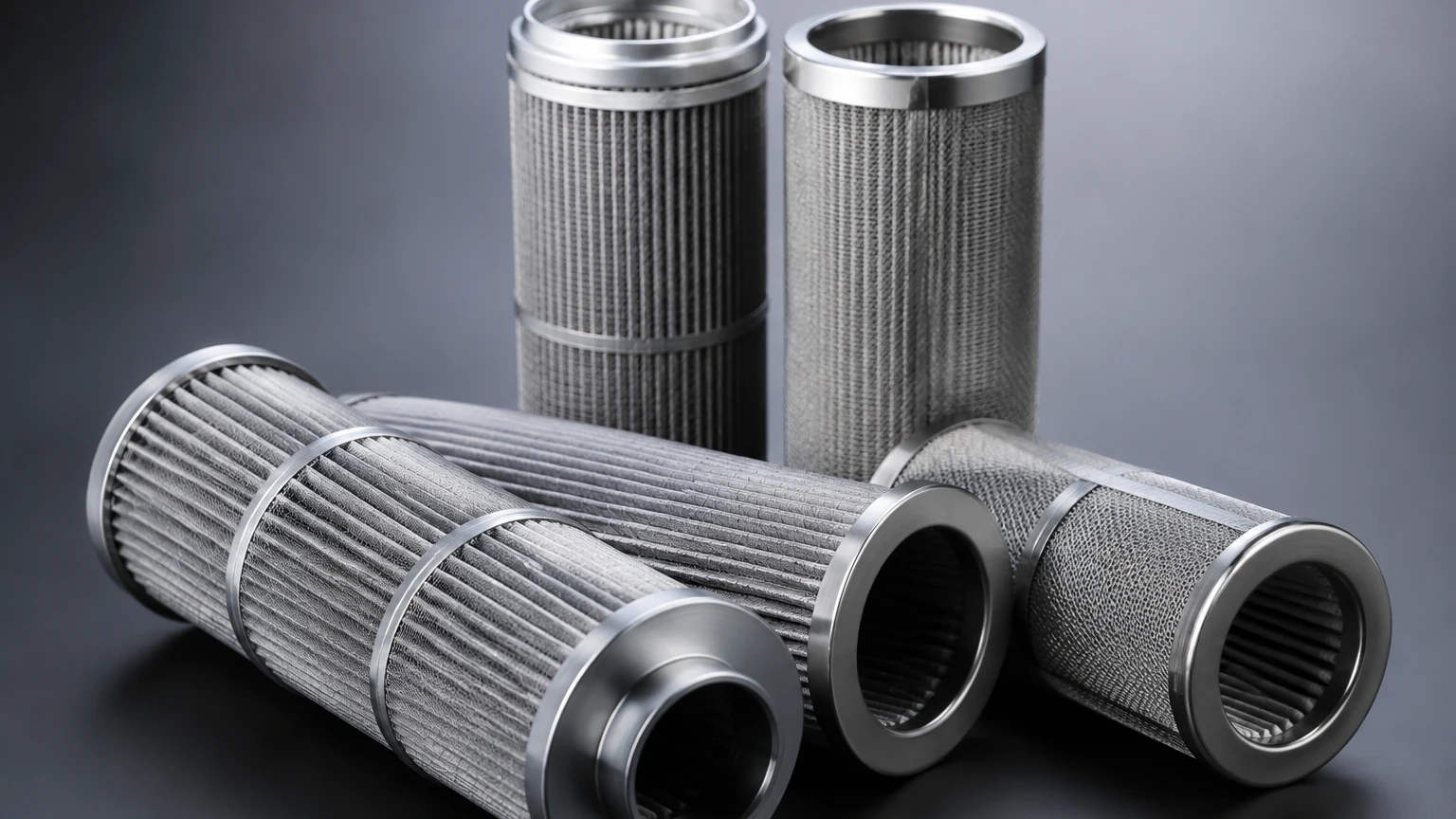
Turbine systems often experience flow surges during startup or load shifts. Synthetic media can suffer from "media migration" or pleat collapse under these stresses. Stainless steel wire mesh, particularly when reinforced with internal support cores and external shrouds, maintains its structural integrity even under high differential pressures. This durability is essential for preventing the filter itself from becoming a source of contamination.
Chemical and Thermal Compatibility
Turbine oils, especially synthetic flame-resistant fluids used in EHC systems, can be chemically aggressive toward certain polymers and adhesives. Stainless steel is inert to most industrial lubricants and can withstand the high operating temperatures found near the turbine housing without degrading.
Cleanability and Life Cycle Cost
Unlike disposable synthetic elements, many stainless steel turbine filter elements are designed to be cleaned and reused. Through ultrasonic cleaning or backflushing, the accumulated contaminants can be removed, restoring the element's original pressure drop characteristics. This not only reduces the total cost of ownership but also aligns with industrial sustainability goals by reducing waste. For further technical specifications on material grades, engineers can consult the Main Page for detailed alloy comparisons.
Evaluating Structural Integrity and Pressure Drop
A critical engineering consideration in filter design is the balance between filtration efficiency and pressure drop (ΔP). Every filter introduces a restriction to the flow, and excessive pressure drop can lead to pump cavitation or the opening of bypass valves, which allows unfiltered oil to reach sensitive components.
Pleat Geometry and Surface Area
To minimize pressure drop while maintaining high efficiency, manufacturers use pleated designs. Pleating significantly increases the effective filtration surface area within a compact footprint. However, the pleat density must be carefully engineered; if pleats are too tight, the fluid cannot reach the bottom of the pleat, leading to "blind spots" and an actual reduction in effective area. High-quality turbine filter elements utilize specialized support layers to keep pleats open and uniform during operation.
Collapse Pressure
In the event of a cold start or a sudden surge in contamination, the differential pressure across the filter can rise rapidly. The collapse pressure rating of the element must exceed the maximum pressure the system pump can generate, or at least be significantly higher than the bypass valve setting. Precision-welded stainless steel components provide the high collapse ratings required for high-pressure hydraulic loops.
Maintenance Protocols and ISO Cleanliness Standards
Effective filtration is a continuous process that requires diligent monitoring. The industry standard for measuring fluid cleanliness is ISO 4406, which uses a three-digit code to represent the number of particles >4µm, >6µm, and >14µm per milliliter of fluid.
Monitoring Differential Pressure
Most turbine systems are equipped with differential pressure transducers. A steady increase in ΔP indicates that the turbine filter element is successfully capturing contaminants. A sudden drop in ΔP, however, is a red flag, suggesting either a ruptured element or a bypass valve that has failed in the open position.
Oil Analysis
Regular oil analysis complements filter monitoring. By analyzing the types of particles trapped in the filter or suspended in the oil (using ferrography or spectroscopy), engineers can identify the source of wear—such as bronze from a failing bushing or steel from a gear—before a major failure occurs.
Replacement Cycles
While the life of a turbine filter element depends on the environment, scheduled replacements are typically dictated by the ΔP reaching a terminal limit (e.g., 25-50 psi depending on the system). In systems using stainless steel elements, this is the point where the element is removed for professional cleaning and inspection.
Customization for Specialized Turbine Applications
No two industrial facilities are identical, and often, legacy turbine systems require filtration upgrades that do not fit standard off-the-shelf specifications. Customization is a core capability for manufacturers like Kaifil, providing solutions where standard components fall short.
Retrofitting and OEM Compatibility
When upgrading a filtration system for better efficiency, the new turbine filter element must interface perfectly with existing housings. Custom engineering allows for the modification of end caps, seals (such as Viton or EPDM), and overall dimensions to ensure a leak-proof fit. This is particularly important when switching from disposable media to permanent stainless steel solutions.
Specialized Flow Requirements
In high-flow applications, such as main lubrication lines for large steam turbines, the filter must handle thousands of gallons per minute without causing significant energy loss. Custom-designed elements with optimized mesh counts and wire diameters can be tailored to these specific flow regimes, ensuring that the filtration system does not become a bottleneck for the entire power plant.
Conclusion: Selecting the Right Partner
The selection of a turbine filter element is a technical decision that directly impacts the reliability and longevity of a turbine. Engineers must prioritize absolute filtration ratings, high Beta ratios, and structural materials that can withstand the rigors of industrial service. Stainless steel filtration solutions offer the durability, chemical resistance, and long-term cost benefits required for these critical applications.
By understanding the relationship between micron ratings, pressure drop, and material integrity, purchasing teams can make informed decisions that protect their infrastructure. For organizations seeking precision-engineered components and customized filtration support, exploring the capabilities of a specialized manufacturer is the first step toward optimized system performance. To learn more about customized metal filtration components and industrial applications, visit the Main Page for comprehensive product data and engineering support.
