


Type 1 Pool Filter
In the landscape of industrial and specialized water treatment, the type 1 pool filter represents the entry-level standard for cartridge-based mechanical filtration. While often associated with residential and light-commercial above-ground pool systems, the engineering principles governing these filters are rooted in the same fundamental physics as high-capacity industrial filtration systems. For engineers, facility managers, and OEM designers, understanding the technical specifications, material limitations, and performance metrics of a type 1 pool filter is essential when selecting components for low-flow water purification or pre-filtration stages.
Industrial filtration relies on precision and durability. When evaluating a type 1 pool filter, technical professionals must look beyond the basic dimensions to assess the media integrity, pleat geometry, and chemical compatibility. This guide provides a technical overview of these components, offering an industrial perspective on their application and the advantages of transitioning to high-performance materials like stainless steel for demanding environments.
Engineering Specifications of Type 1 Filtration
The type 1 pool filter is defined by its physical dimensions and its nominal filtration capability. Typically, these cartridges measure approximately 3.1 inches in diameter and 3.5 inches in height, though slight variations exist between manufacturers. Despite their small footprint, the internal architecture is designed to maximize the surface area available for particulate capture.
From an engineering standpoint, the most critical specification is the micron rating. Most standard type 1 filters offer nominal filtration in the range of 20 to 50 microns. This is sufficient for removing visible debris, sediment, and larger organic particulates. However, in B2B applications where higher purity is required—such as in closed-loop cooling systems or specialized industrial wash-down stations—the efficiency of the media at specific particle sizes becomes the primary performance indicator. Engineers must evaluate the "Beta Ratio" of the filter if they are using it in a process where specific particulate counts must be maintained.
Another key specification is the flow rate capacity. Because of the limited surface area of a type 1 pool filter, these units are generally rated for low-flow pumps. Exceeding the recommended flow rate can lead to high differential pressure, which may cause the media to collapse or allow "bypass"—where unfiltered water escapes around the end caps.
Material Selection: Synthetic Fibers vs. Stainless Steel Alternatives
Standard type 1 filters are typically constructed using non-woven polyester or paper media bonded to plastic end caps. While cost-effective for short-term use in benign environments, these materials face significant limitations in industrial settings.
1. Chemical Resistance: Polyester media can degrade when exposed to high concentrations of certain chemicals or extreme pH levels. In industrial water treatment, where ozone, high chlorine levels, or specialized biocides are present, the structural integrity of the synthetic fibers can be compromised.
2. Temperature Limits: Synthetic filters often have a maximum operating temperature of around 100°F to 120°F. For applications involving heated process water, these filters are unsuitable.
3. Mechanical Strength: Under high-pressure pulses, synthetic media can flex, widening the pores and allowing contaminants to pass through.
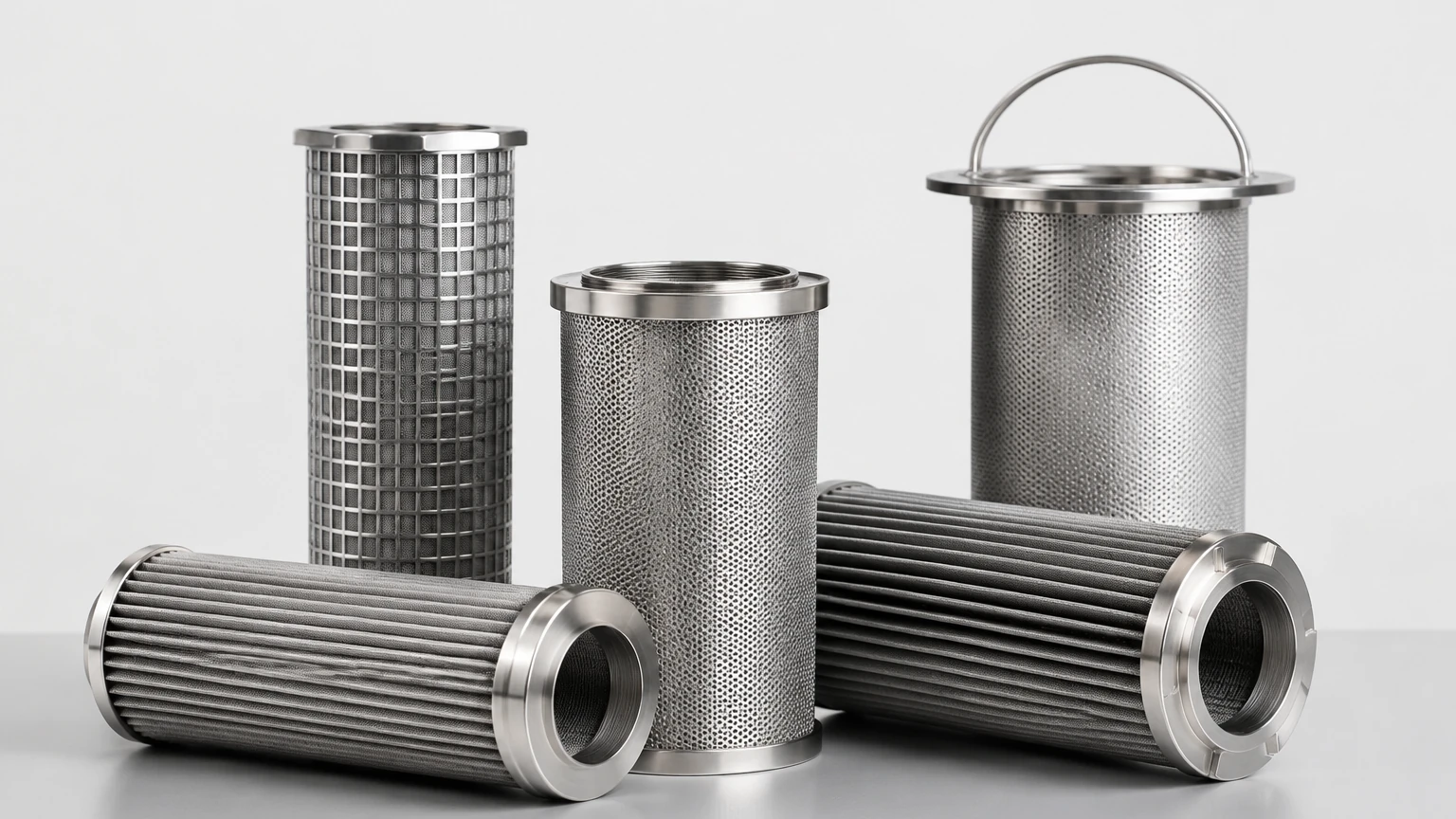
For industrial applications requiring the same form factor as a type 1 pool filter, many engineers turn to custom-manufactured stainless steel wire mesh cartridges. Stainless steel (typically Grade 304 or 316L) offers superior chemical resistance, can withstand temperatures exceeding 500°F, and is physically robust enough to prevent media migration. Furthermore, stainless steel filters are cleanable and reusable, providing a significantly lower total cost of ownership in the long run. To explore advanced material options and custom filtration engineering, professionals can consult the Main Page for detailed technical data.
Performance Metrics and Flow Dynamics
Evaluating a type 1 pool filter requires an understanding of fluid dynamics, specifically the relationship between flow velocity and pressure drop (Delta P). As fluid passes through the filter media, resistance is created. A clean filter should have a minimal initial pressure drop to ensure pump efficiency.
Dirt-Holding Capacity (DHC)
As the filter captures particulates, the available flow paths through the media decrease, causing the differential pressure to rise. The Dirt-Holding Capacity is a measure of how much contaminant the filter can retain before reaching a terminal pressure drop. In a type 1 pool filter, the pleat density—the number of folds per inch—is the primary driver of DHC. Higher pleat density increases the surface area, allowing for longer service intervals.
Filtration Efficiency
Efficiency is often expressed as a percentage of particles of a certain size that the filter can capture. For a standard type 1 cartridge, the efficiency might be 80% at 20 microns. In precision industrial applications, this may be insufficient. Designers must confirm whether the application requires absolute filtration (where 99.9% of particles at the rated micron size are removed) or if nominal filtration is acceptable.
Maintenance and Longevity: Industrial Best Practices
In a professional or industrial context, the maintenance of a type 1 pool filter is not merely about water clarity but about protecting downstream equipment such as heat exchangers, spray nozzles, and sensitive sensors.
Monitoring Pressure Gauges
The most reliable method for determining when a filter requires attention is monitoring the pressure differential. A rise of 8-10 PSI over the clean starting pressure typically indicates that the cartridge is saturated. Relying on visual inspections of the water is often misleading, as microscopic particulates can clog a filter long before the water appears turbid.
Cleaning vs. Replacement
Synthetic type 1 filters are generally considered disposable. While they can be rinsed to remove surface debris, deep-seated particulates trapped within the fibers are difficult to dislodge. Over-cleaning can also wear down the fibers, reducing filtration efficiency. In contrast, industrial-grade metal filters designed for the same applications can be ultrasonically cleaned or backwashed, restoring them to near-original performance levels. This reduces waste and ensures consistent filtration quality over hundreds of cycles.
Customization and OEM Solutions for Specialized Filtration
Many B2B customers find that off-the-shelf type 1 filters do not meet their specific technical requirements. This is where custom manufacturing becomes vital. OEM designers often require filters that fit the type 1 envelope but feature specialized characteristics:
* Reinforced Cores: To handle high-viscosity fluids or high-pressure systems, a perforated stainless steel core can be added to prevent cartridge collapse.
* Custom Micron Ratings: While standard filters are 20+ microns, custom wire mesh can provide precision filtration down to 5 microns or up to 500 microns depending on the application.
* Gasket Materials: Standard filters use basic foam or PVC gaskets. For industrial use, Viton, EPDM, or Silicone gaskets may be required to ensure a leak-proof seal in the presence of oils or solvents.
By working with a specialist manufacturer like Kaifil, companies can develop bespoke filtration components that integrate seamlessly into their equipment while providing the durability required for industrial environments. For more information on specialized filtration components and custom designs, visit the Main Page.
Critical Factors in Filter Selection for Engineers
Before procuring a type 1 pool filter or its industrial equivalent, purchasing teams and engineers should confirm several critical factors to ensure system compatibility and performance:
1. Fluid Compatibility: Beyond just the water, consider any additives, minerals, or cleaning agents that will pass through the filter. Ensure the media and end caps are chemically inert to these substances.
2. Operating Pressure: Confirm the maximum system pressure. If the system experiences water hammer or high-pressure spikes, a standard synthetic filter may fail catastrophically.
3. Target Particle Profile: What is the specific contaminant being targeted? If the goal is to remove fine silts or bacteria, a type 1 filter may only serve as a pre-filter for a more fine-tuned secondary stage.
4. Regulatory Compliance: In industries such as food and beverage or pharmaceuticals, filters must meet specific FDA or NSF standards. Confirm that the materials used in the filter construction are food-grade and non-leaching.
Total Cost of Ownership (TCO) Considerations
While the initial purchase price of a standard type 1 pool filter is low, the total cost of ownership can be high in an industrial setting due to frequent replacements, labor costs for maintenance, and the potential for system downtime. A technical analysis often reveals that investing in a high-quality, durable filtration solution—such as a custom stainless steel cartridge—yields better long-term value.
Reducing the frequency of filter changes not only saves on component costs but also minimizes the risk of environmental contamination and reduces the volume of waste generated by the facility. For organizations focused on sustainability and operational efficiency, moving away from disposable synthetic filters toward permanent, cleanable solutions is a strategic engineering decision.
Conclusion
The type 1 pool filter serves as a foundational component in many water circulation systems. However, its transition from a consumer product to an industrial tool requires a deep understanding of material science and fluid dynamics. By evaluating the specific needs of an application—including flow rates, chemical exposure, and particulate size—engineers can determine whether a standard cartridge is sufficient or if a custom-engineered solution is necessary to ensure system reliability. For those seeking to optimize their filtration processes with precision-manufactured components, reviewing professional product options on the Main Page is the recommended next step in achieving superior filtration performance.
