


Vacuum Pump Inline Filter
In industrial vacuum systems, the integrity of the vacuum pump is paramount to the continuity of the entire production line. Whether in chemical processing, pharmaceutical manufacturing, or food and beverage packaging, a vacuum pump inline filter serves as the primary line of defense against contaminants that can lead to mechanical failure, oil contamination, and process inefficiency. Selecting the correct filtration component requires a deep understanding of vacuum dynamics, material compatibility, and engineering specifications.
Industrial vacuum pumps are designed to move gases, but they are often inadvertently exposed to particulates, liquid droplets, and corrosive vapors. Without a robust vacuum pump inline filter, these contaminants enter the pump chamber, causing abrasive wear on vanes, rotors, and seals. For engineers and procurement teams, the challenge lies in balancing filtration efficiency with the need to maintain high system conductance and minimal pressure drop.
The Critical Role of Inline Filtration in Vacuum Systems
The primary function of a vacuum pump inline filter is to protect the pump from the process and, in some cases, protect the process from the pump. In many industrial applications, the gas stream being evacuated contains dust, debris, or chemical byproducts. If these materials reach the pump, they can mix with the vacuum oil (in oil-sealed pumps) or damage the tight tolerances of dry pumps.
Conversely, "backstreaming" is a common concern in high-vacuum applications. This occurs when pump oil vapors migrate backward into the vacuum chamber, potentially contaminating sensitive products like semiconductors or pharmaceutical batches. A properly engineered inline filter, often utilizing specialized stainless steel mesh or adsorbent media, acts as a barrier to these vapors, ensuring a clean vacuum environment.
Technical Engineering Considerations for Vacuum Environments
Designing a vacuum pump inline filter is significantly different from designing a standard pressure filter. In a positive pressure system, the density of the gas provides a medium that can be pushed through dense filter media. In a vacuum, the gas is rarefied, and the available pressure differential to move gas through the filter is limited. This introduces several engineering constraints:
1. System Conductance
Conductance is the measure of how easily gas flows through a component. In vacuum systems, any restriction—including a filter—reduces the effective pumping speed at the chamber. Engineers must select a filter with a high surface area and an optimized pore structure to minimize the reduction in pumping speed. A filter that is too restrictive will result in longer pump-down times and higher energy consumption.
2. Outgassing and Seal Integrity
Materials used in vacuum filtration must have low outgassing rates. If the filter housing or the element itself releases trapped gases under vacuum, it becomes impossible to reach the desired base pressure. This is why high-quality stainless steel and specialized elastomers (like Viton) are preferred over lower-grade plastics or standard rubbers.
3. Vacuum Tightness
The housing of a vacuum pump inline filter must be leak-tight to a high degree, typically measured in mbar·l/s. Even a microscopic leak at a filter flange can introduce atmospheric air, moisture, and contaminants, compromising the vacuum level and potentially reacting with process chemicals.
Material Selection: Why Stainless Steel is the Standard
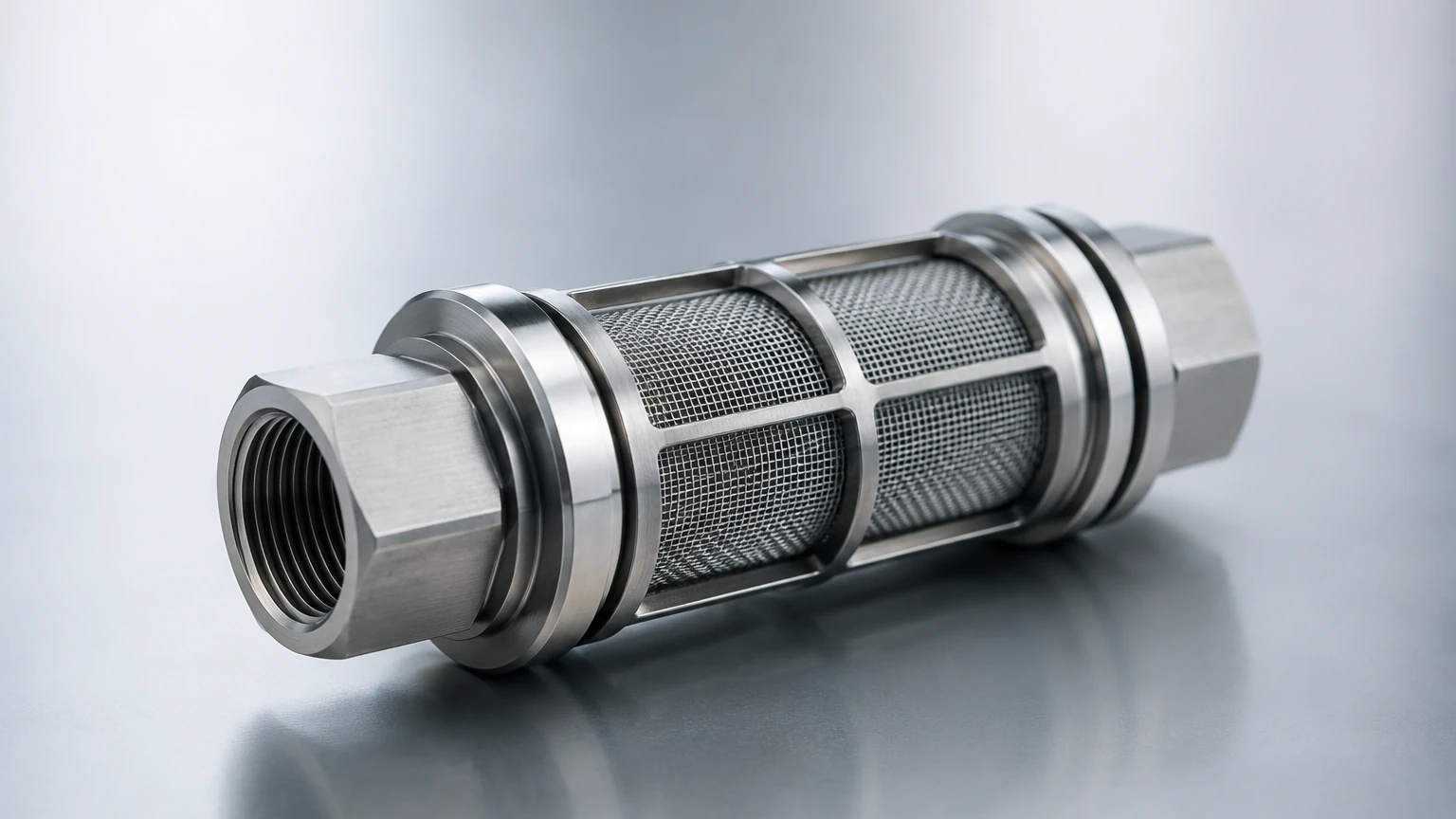
For demanding industrial applications, stainless steel (typically 304 or 316L) is the material of choice for both the filter housing and the internal mesh elements. As a manufacturer specializing in custom filtration solutions, Kaifil emphasizes the use of stainless steel due to its unique combination of properties:
* Corrosion Resistance: In chemical processing and pharmaceutical applications, the gas stream often contains acidic or alkaline vapors. Stainless steel resists chemical attack, preventing the filter from becoming a source of contamination itself.
* Thermal Stability: Vacuum processes often operate at elevated temperatures or involve hot gas streams. Stainless steel maintains its structural integrity and filtration accuracy across a wide temperature range, unlike polymer-based filters.
* Durability and Reusability: Stainless steel wire mesh filters are mechanically robust. They can withstand pressure surges and can often be cleaned and reused, providing a lower total cost of ownership compared to disposable paper or fiberglass elements.
* Precision Filtration: Advanced weaving techniques allow for the creation of stainless steel mesh with highly accurate micron ratings. This ensures that the filter captures specific particle sizes while maintaining the necessary open area for gas flow.
Evaluating Performance: Filtration Efficiency vs. Micron Rating
When specifying a vacuum pump inline filter, engineers must distinguish between nominal and absolute micron ratings. A nominal rating refers to the filter's ability to retain the majority of particles of a certain size, while an absolute rating indicates that 99.9% or more of particles above that size will be captured.
In vacuum applications, the particle size distribution of the contaminant is critical. For example, in a wood processing vacuum system, the particles might be large and fibrous, requiring a coarse mesh (e.g., 50 to 100 microns). In a pharmaceutical freeze-drying process, the contaminants may be microscopic biological fragments or chemical crystals, requiring high-precision filtration down to 1 micron or less.
Furthermore, the "holding capacity" of the filter must be considered. A filter with high efficiency but low holding capacity will clog quickly, leading to frequent maintenance intervals and system downtime. Increasing the surface area through pleated mesh designs is a common engineering solution to extend the service life of the filter element.
Common Risks of Inadequate Vacuum Filtration
Neglecting the selection or maintenance of a vacuum pump inline filter can lead to several costly consequences:
1. Pump Seizure: Solid particulates can jam the internal moving parts of a pump, leading to catastrophic failure and expensive repairs.
2. Oil Degradation: In oil-lubricated pumps, particulates act as catalysts for oil oxidation. This turns the oil into a sludge-like consistency, reducing its lubricating and sealing properties.
3. Increased Energy Costs: As a filter clogs, the pump must work harder to maintain the vacuum level, leading to increased power consumption and heat generation.
4. Product Contamination: If a filter fails or is bypassed, contaminants can reach the end product, potentially leading to the loss of an entire production batch, particularly in the food and pharmaceutical sectors.
Maintenance Protocols and Replacement Indicators
To ensure the longevity of both the filter and the vacuum pump, a proactive maintenance schedule is essential. The most effective way to monitor filter health is by measuring the pressure differential (ΔP) across the filter. A significant increase in ΔP indicates that the filter element is becoming loaded with contaminants and needs to be cleaned or replaced.
In many industrial setups, vacuum gauges are installed on both the inlet and outlet sides of the filter. If the pressure on the pump side is significantly lower than the pressure on the process side, the filter is obstructing flow. For stainless steel mesh filters, cleaning can often be performed using ultrasonic baths, solvent cleaning, or back-flushing, depending on the nature of the contaminant.
Customization Options for Specialized Industrial Applications
Standard off-the-shelf filters often fall short in specialized industrial environments. Customization allows engineers to tailor the filtration solution to the specific needs of the process. Key areas for customization include:
* Flange Configurations: Vacuum systems use various connection standards, such as KF (NW), ISO-K, ISO-F, and CF flanges. A custom filter housing can be designed to integrate seamlessly into existing piping without the need for adapters that could introduce leak points.
* Housing Geometry: In space-constrained installations, custom-angled housings (e.g., 90-degree elbows) or compact designs can be engineered to fit the available footprint.
* Multi-Stage Filtration: For complex gas streams, a single filter might not be sufficient. Custom units can incorporate multiple stages, such as a coarse pre-filter followed by a fine high-efficiency element, or a liquid trap combined with a particulate filter.
* Specialized Media: Beyond standard mesh, filters can be designed with sintered metal fibers or porous metal plates for applications requiring extreme mechanical strength or specific pore geometries.
Conclusion: Selecting the Right Partner for Vacuum Filtration
The selection of a vacuum pump inline filter is a technical decision that impacts the reliability and efficiency of industrial operations. By focusing on material quality, engineering precision, and application-specific requirements, companies can protect their capital equipment and ensure product quality.
Kaifil provides a comprehensive range of stainless steel filtration solutions designed to meet the rigorous demands of modern industry. From material selection to custom design and production, our expertise ensures that your vacuum system operates at peak performance. To explore our full range of products and technical capabilities, visit our Main Page and consult with our engineering team to develop a filtration solution tailored to your specific application requirements.
