


Vane Separator
In industrial process engineering, the separation of liquid droplets from gas or vapor streams is a critical requirement for protecting downstream equipment, ensuring product purity, and maintaining system efficiency. The vane separator, also known as a chevron or profile plate mist eliminator, is a high-capacity device designed to remove entrained liquids through the principle of inertial impingement. Unlike mesh pads that may be prone to fouling in high-solids environments, vane separators offer a robust, low-pressure-drop solution for demanding industrial applications.
Understanding the technical nuances of vane separator design, material selection, and operational limits is essential for engineers and procurement teams. This guide examines the engineering principles, performance variables, and selection criteria necessary for optimizing gas-liquid separation in chemical processing, power generation, and general industrial sectors.
Principles of Operation: How Vane Separators Work
The fundamental mechanism of a vane separator relies on the difference in inertia between gas molecules and liquid droplets. As a gas stream containing entrained liquid enters the separator, it is forced to navigate a series of parallel, zigzagging blades or "vanes."
Because liquid droplets have significantly higher mass and density than the surrounding gas, they cannot change direction as rapidly as the gas phase. When the gas stream makes a sharp turn around the vane profile, the momentum of the liquid droplets carries them forward until they strike the surface of the vane.
Upon impact, the droplets adhere to the vane surface and coalesce into a thin film. As more liquid accumulates, the film flows downward under the influence of gravity or is pushed into specialized drainage pockets. These pockets are strategically placed in the "low-velocity" zones of the vane profile to prevent the gas stream from picking the liquid back up—a phenomenon known as re-entrainment. The collected liquid eventually drains into a sump or collection vessel for removal or recycling.
Key Engineering Specifications and Design Variables
To specify a vane separator that meets the performance requirements of a specific process, several design variables must be calculated and balanced. These factors directly influence both the removal efficiency and the operational lifespan of the component.
Blade Profile and Spacing
The geometry of the vane blades—including the number of bends, the angle of the turns, and the presence of drainage hooks—determines the separation efficiency. A more complex profile with multiple sharp turns increases the likelihood of droplet impingement but also increases the pressure drop across the unit. Blade spacing typically ranges from 10mm to 50mm, depending on the required flow capacity and the allowable pressure differential.
Gas Velocity and the Critical Velocity Limit
Velocity is perhaps the most critical parameter in vane separator design. If the gas velocity is too low, the droplets may lack sufficient inertia to strike the vanes, passing through the system instead. Conversely, if the velocity exceeds a certain threshold (the critical velocity), the shear force of the gas becomes strong enough to strip the liquid film off the vanes and carry it downstream. Engineers must design the separator to operate within a specific "velocity window" to ensure stable performance.
Droplet Size Distribution
Vane separators are generally most effective at removing droplets larger than 10 to 20 microns. For applications requiring the removal of sub-micron mists, a vane separator may be used as a primary stage followed by a secondary fine-mesh filter. Understanding the particle size distribution of the entrained liquid is vital for determining if a vane-type system is the correct technical choice.
Vane Separator vs. Mesh Mist Eliminators
When selecting a separation technology, engineers often compare vane separators with wire mesh mist eliminators. While both serve similar purposes, their mechanical properties lead to different application strengths.
1. Fouling Resistance: Vane separators feature an open, non-clogging design. This makes them significantly better suited for gas streams that contain solids, waxes, or viscous liquids that would quickly plug a fine wire mesh.
2. Pressure Drop: Due to the streamlined flow path, vane separators exhibit a much lower pressure drop than mesh pads. This is particularly beneficial in low-pressure systems or applications where minimizing energy consumption is a priority.
3. Flow Capacity: Vanes can handle gas velocities roughly double those of mesh pads. This allows for the use of smaller vessel diameters for the same volumetric flow rate, potentially reducing the overall footprint and material cost of the installation.
4. Efficiency: Wire mesh pads generally offer higher removal efficiency for very small droplets (down to 3-5 microns). If the process requires high-purity gas with minimal micron-level carryover, mesh may be preferred, provided the stream is clean.
Material Selection and Durability in Corrosive Environments
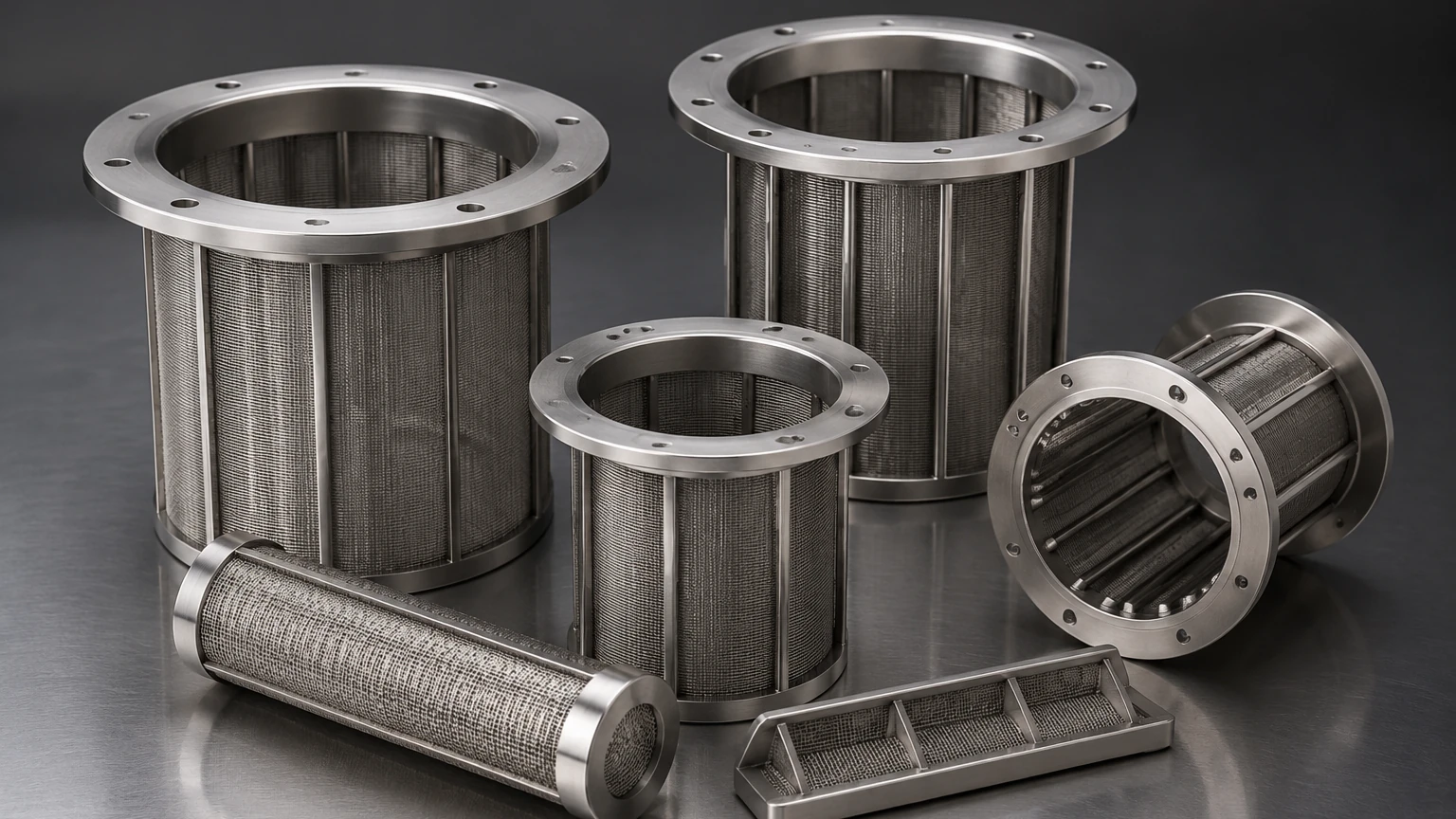
Industrial filtration components must withstand harsh chemical environments, high temperatures, and mechanical stress. Material selection is a cornerstone of ensuring long-term reliability. As a specialist in stainless steel filtration, Kaifil emphasizes the use of high-grade alloys to prevent premature failure due to corrosion or erosion.
* Stainless Steel 304/304L: The standard choice for general industrial applications, offering good corrosion resistance and structural integrity.
* Stainless Steel 316/316L: Preferred for chemical processing and marine environments due to the addition of molybdenum, which enhances resistance to chloride-induced pitting.
* Duplex and Super Duplex: Utilized in highly aggressive environments, such as offshore oil and gas or desalination plants, where high mechanical strength and extreme corrosion resistance are required.
For engineers looking to integrate these components into larger systems, reviewing the Main Page of a technical manufacturer can provide insights into available alloy grades and custom fabrication capabilities that align with specific site conditions.
Performance Evaluation: Pressure Drop and Efficiency
The total cost of ownership for a vane separator is not just the initial purchase price, but also the energy cost associated with the pressure drop it creates. A high pressure drop forces compressors or fans to work harder, increasing utility costs over time.
Efficiency is typically measured by the "cutoff" size—the smallest droplet diameter that the separator can remove with a specific percentage of certainty (usually 99%). In a well-designed vane separator, the pressure drop is often less than 250 Pa (1 inch of water column), making it one of the most energy-efficient separation technologies available. Engineers should request performance curves that plot efficiency and pressure drop against gas velocity to ensure the unit will perform as expected during both peak and turndown flow conditions.
Customization and OEM Solutions for Industrial Applications
Standard, off-the-shelf vane separators rarely meet the exact needs of specialized industrial processes. Customization is often required to fit existing vessel dimensions, accommodate non-standard nozzle orientations, or meet specific flow dynamics.
Housing and Configuration
Vane separators can be configured for horizontal or vertical gas flow. In vertical flow (upward), the liquid must drain against the direction of the gas, which requires careful design of the drainage channels to prevent re-entrainment. In horizontal flow, gravity assists the drainage perpendicular to the gas flow, often allowing for higher velocities.
Integration with Other Filtration Stages
In complex chemical reactors or steam drums, a vane separator may be integrated into a multi-stage system. For example, a coarse vane separator might remove the bulk of the liquid, followed by a precision stainless steel filter cartridge to capture any remaining fine particulates or aerosols. This staged approach protects sensitive downstream components while extending the maintenance intervals of the finer filter media.
Maintenance and Longevity Considerations
One of the primary advantages of the vane separator is its low maintenance requirement. Because there are no moving parts and the flow paths are relatively large, mechanical wear is minimal. However, regular inspection is still necessary to ensure optimal performance:
* Inspection for Erosion: In high-velocity streams containing abrasive particles, the leading edges of the vanes may experience erosion over several years of operation.
* Cleaning Protocols: If the process involves sticky or polymerizing substances, a periodic wash-down system (spray nozzles) can be integrated into the separator housing to clean the vanes online, preventing any buildup that could alter the flow profile.
* Structural Integrity: Ensure that the support grids and hold-down bars remain secure, as vibration from high-velocity gas can lead to mechanical fatigue if the unit is not properly anchored.
Conclusion: Selecting the Right Separation Solution
The selection of a vane separator requires a thorough understanding of the fluid dynamics within the process stream. By focusing on droplet size, gas velocity, and material compatibility, engineers can implement a solution that provides high separation efficiency with minimal operational impact.
When evaluating suppliers, it is important to partner with manufacturers who understand the technical demands of industrial filtration. From material selection to precision manufacturing of complex vane profiles, the right partner ensures that the filtration component contributes to the overall stability and safety of the industrial process. For more information on custom stainless steel filtration solutions and engineering support, technical teams are encouraged to consult with experts in the field to refine their specifications and achieve the highest possible performance standards.
