


Coalescing Filter Media
Coalescing filtration is a critical process in industrial fluid management, designed to separate two non-miscible phases, typically liquid droplets from a gas stream or one liquid from another (such as oil from water). Unlike standard particulate filtration, which relies on mechanical straining to trap solid contaminants, coalescing filter media are engineered to facilitate the merging of small droplets into larger ones, which can then be removed by gravity. This technical guide explores the engineering principles, material considerations, and selection criteria for coalescing filter media in demanding B2B industrial environments.
Understanding the Principles of Coalescing Filtration
The effectiveness of coalescing filter media depends on three primary physical mechanisms: direct impaction, interception, and Brownian diffusion. These mechanisms work in tandem to capture fine aerosols or droplets suspended in a continuous phase.
Direct Impaction
Direct impaction occurs when larger droplets (typically those greater than 1 micron) possess enough inertia to break away from the fluid flow lines. As the fluid navigates the tortuous path of the filter media, these droplets strike the fibers or wires and adhere to them. This is the dominant mechanism for high-velocity gas streams containing relatively large liquid particles.
Interception
Interception happens when a droplet follows a streamline that brings it within one droplet radius of a fiber surface. Because the droplet makes physical contact with the media, it becomes attached. This mechanism is crucial for mid-sized droplets where inertia is lower but the physical dimensions of the droplet still lead to contact with the media structure.
Brownian Diffusion
For extremely small sub-micron droplets, Brownian motion—the random movement of particles caused by collisions with fluid molecules—increases the probability that the droplets will contact the coalescing filter media. Once contact is made, surface tension forces hold the droplet in place, allowing it to merge with other captured liquid.
Key Characteristics of Coalescing Filter Media
When evaluating coalescing filter media for industrial applications, engineers must consider several technical characteristics that dictate performance and longevity. The media must not only capture droplets but also allow for efficient drainage.
Surface Tension and Wettability
The relationship between the liquid being removed and the filter media surface is defined by wettability. In a coalescing system, the media is often designed to be "lyophilic" (attracting the dispersed phase). For example, in an oil-from-air application, the media should be oleophilic. As droplets accumulate on the fibers, they spread and coat the media, eventually forming larger droplets at the junctions of the fibers. Once these droplets reach a critical mass where the gravitational force exceeds the drag force of the fluid flow, they drain away from the media.
Porosity and Void Volume
High porosity is essential for coalescing filter media to minimize pressure drop while providing sufficient surface area for droplet capture. A high void volume ensures that the media does not become prematurely blinded by liquid saturation, allowing for a continuous "steady-state" operation where the rate of coalescing and drainage matches the rate of droplet arrival.
Gradient Density Structures
Advanced coalescing elements often utilize a gradient density structure. The upstream layers are typically more open to handle larger droplets and provide initial capture, while the downstream layers are denser to catch finer aerosols. This graduated approach prevents surface loading and extends the service life of the filter element.
Material Selection for Industrial Coalescing Media
The choice of material for coalescing filter media is governed by chemical compatibility, operating temperature, and the physical nature of the fluids involved. As a specialized manufacturer, Kaifil provides various material options to meet these industrial demands.
Stainless Steel Wire Mesh and Fibers
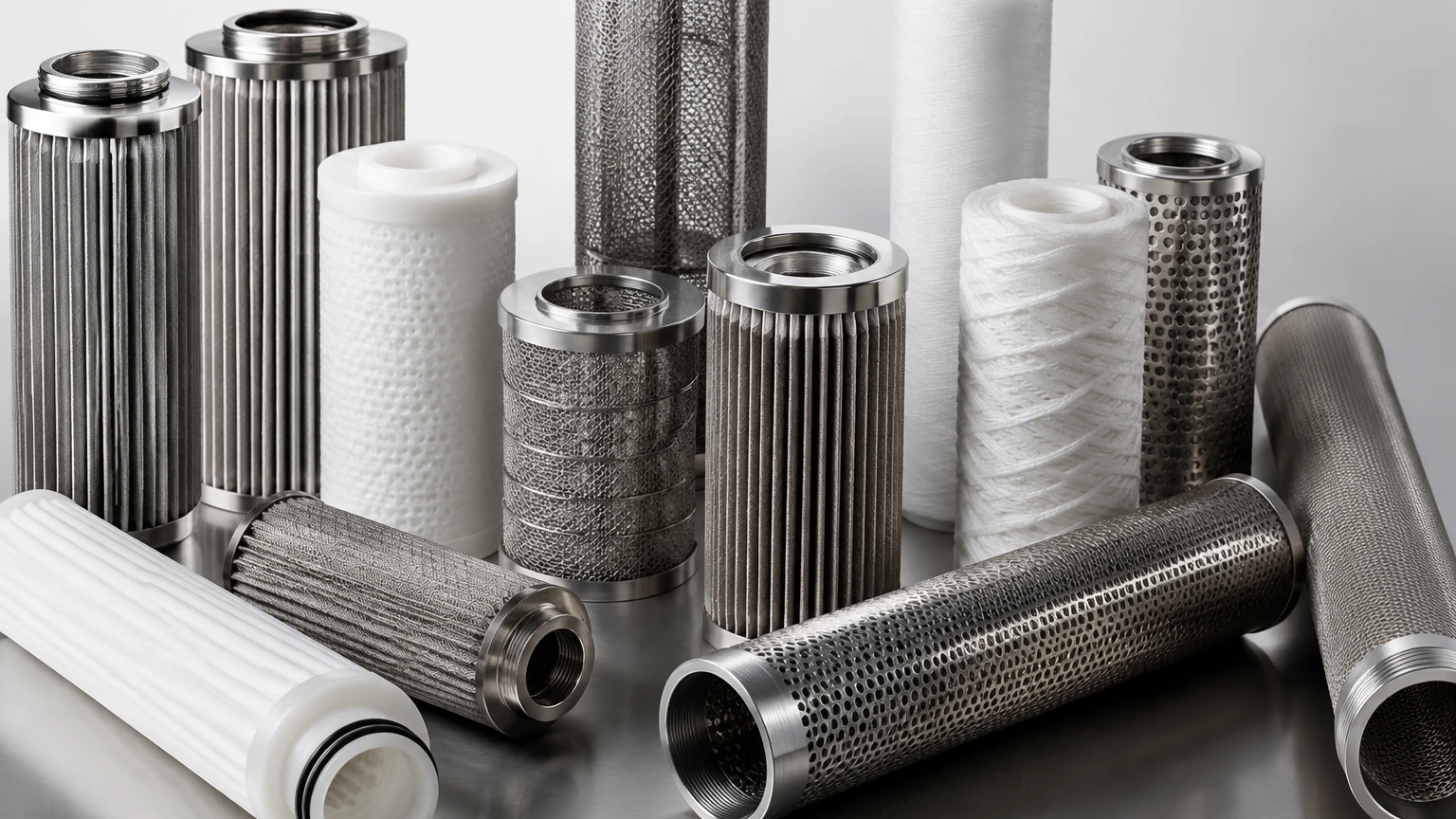
Stainless steel (primarily 304 and 316L) is a preferred material for harsh industrial environments. Stainless steel coalescing media offer excellent thermal stability and resistance to corrosive chemicals. In applications involving high-pressure steam, aggressive solvents, or high temperatures, metal fibers provide a robust alternative to synthetic materials. These can be manufactured as pleated cartridges or cylindrical elements to maximize surface area.
Borosilicate Glass Microfibers
Glass fiber is widely used in gas-liquid coalescing due to its fine fiber diameter, which provides a high surface-area-to-volume ratio. These fibers are often treated with fluorocarbon resins to enhance their oleophobic or hydrophobic properties, depending on the specific separation requirement.
Synthetic Polymers
Materials such as polyester and polypropylene are common in lower-temperature applications, particularly in water-oil separation. While cost-effective, they lack the temperature and chemical resistance of stainless steel components and are typically replaced rather than cleaned.
Critical Performance Metrics for Engineering Teams
To ensure the efficiency of an industrial filtration system, engineering teams must evaluate coalescing filter media based on quantifiable performance metrics. For more detailed technical specifications and to Review product options and application support, engineers should consult with the manufacturer during the design phase.
Filtration Efficiency and Micron Rating
Coalescing efficiency is often expressed as the percentage of the dispersed phase removed or the maximum size of droplets that can pass through the media. High-performance coalescers can achieve efficiencies of 99.9% or higher, reducing downstream oil carryover in compressed air systems to less than 0.01 ppm.
Differential Pressure (Delta P)
Pressure drop is a significant factor in the total cost of ownership. A coalescing filter operates in a "saturated" state, meaning a certain amount of liquid is always held within the media. Engineers must account for the "wet" pressure drop, which is higher than the "dry" pressure drop of a new filter. Excessive Delta P can lead to energy loss and, in extreme cases, structural failure of the filter media.
Flow Velocity and Flux Rates
Coalescing is a velocity-sensitive process. If the fluid velocity is too high, the drag forces may re-entrain the coalesced droplets back into the stream before they can drain. Conversely, if the velocity is too low, the impaction mechanism is weakened. Proper sizing of the filter housing and media area is essential to maintain the optimal flux rate.
Common Challenges and Failure Modes in Coalescing Systems
Understanding the risks associated with coalescing filter media is vital for maintaining system uptime and protecting downstream equipment.
Solid Contaminant Fouling
Coalescing media are not designed to handle high loads of solid particulates. If solids enter the coalescer, they can clog the small interstitial spaces between fibers, leading to a rapid increase in pressure drop and preventing the drainage of coalesced liquid. Implementing a particulate pre-filter upstream is a standard engineering practice to protect the more expensive coalescing media.
Media Saturation and Breakthrough
If the rate of droplet arrival exceeds the drainage capacity of the media, the filter becomes over-saturated. This leads to "breakthrough," where liquid is pushed through the media and re-atomized on the downstream side, defeating the purpose of the filtration system.
Chemical Incompatibility
Exposure to incompatible chemicals can cause synthetic fibers to swell, soften, or degrade. In the chemical processing industry, this often necessitates the use of stainless steel coalescing media, which maintain structural integrity even when exposed to aggressive hydrocarbons or acidic environments.
Specifying Custom Coalescing Solutions for OEM Applications
For many industrial equipment manufacturers (OEMs), standard off-the-shelf coalescing filters may not meet specific space constraints or performance requirements. Customization of coalescing filter media allows for optimized performance in niche applications such as hydraulic systems, turbine lube oil filtration, and natural gas processing.
When specifying a custom solution, engineers should provide the following data points to the manufacturer:
- Fluid Properties: Density, viscosity, and surface tension of both the continuous and dispersed phases.
- Operating Conditions: Minimum and maximum flow rates, operating pressure, and temperature range.
- Target Cleanliness: The required parts-per-million (ppm) or ISO cleanliness code for the effluent.
- Housing Constraints: Physical dimensions and connection types required for integration into the larger system.
Kaifil specializes in the production of precision metal filtration components, offering the expertise needed to develop custom stainless steel filter cartridges and wire mesh configurations. By focusing on the material science and mechanical design of the coalescing filter media, Kaifil helps industrial clients achieve reliable and cost-effective separation results in demanding environments.
Maintenance and Replacement Cycles
While some metal-based coalescing filter media can be cleaned using ultrasonic baths or chemical cleaning agents, many high-efficiency coalescers are designed as consumable components. The replacement cycle is typically determined by the differential pressure. Once the Delta P reaches a predetermined limit (often 10-15 psi depending on the system), the element should be replaced to prevent energy waste and potential bypass. Regular monitoring of the drainage system (drains and traps) is also necessary to ensure that removed liquid is being evacuated from the filter housing correctly.
In conclusion, selecting the right coalescing filter media requires a deep understanding of the fluid dynamics and material interactions involved in the separation process. By prioritizing technical specifications such as wettability, gradient density, and chemical resistance, engineering teams can ensure the long-term efficiency of their industrial filtration systems.
