


Vertical Cyclone Separator
In industrial process engineering, the efficient separation of solids from gas or liquid streams is a fundamental requirement for protecting downstream equipment, ensuring product purity, and maintaining environmental compliance. The vertical cyclone separator stands as one of the most reliable and cost-effective technologies for primary separation. Operating on the principle of centrifugal sedimentation, these devices utilize fluid dynamics rather than moving parts to isolate particulate matter. For engineers and procurement teams, understanding the mechanical nuances, design variables, and integration strategies of a vertical cyclone separator is essential for optimizing the performance of a complete filtration system.
While high-efficiency cyclones are capable of removing a significant percentage of bulk solids, they are often used as a pre-filtration stage. In many demanding applications, such as chemical processing or food production, the cyclone captures the majority of the particulate load, allowing secondary precision components—such as those found on the Main Page of specialized manufacturers—to focus on fine polishing and absolute filtration. This multi-stage approach extends the service life of expensive filter cartridges and reduces the total cost of ownership.
Principles of Operation: The Mechanics of Centrifugal Separation
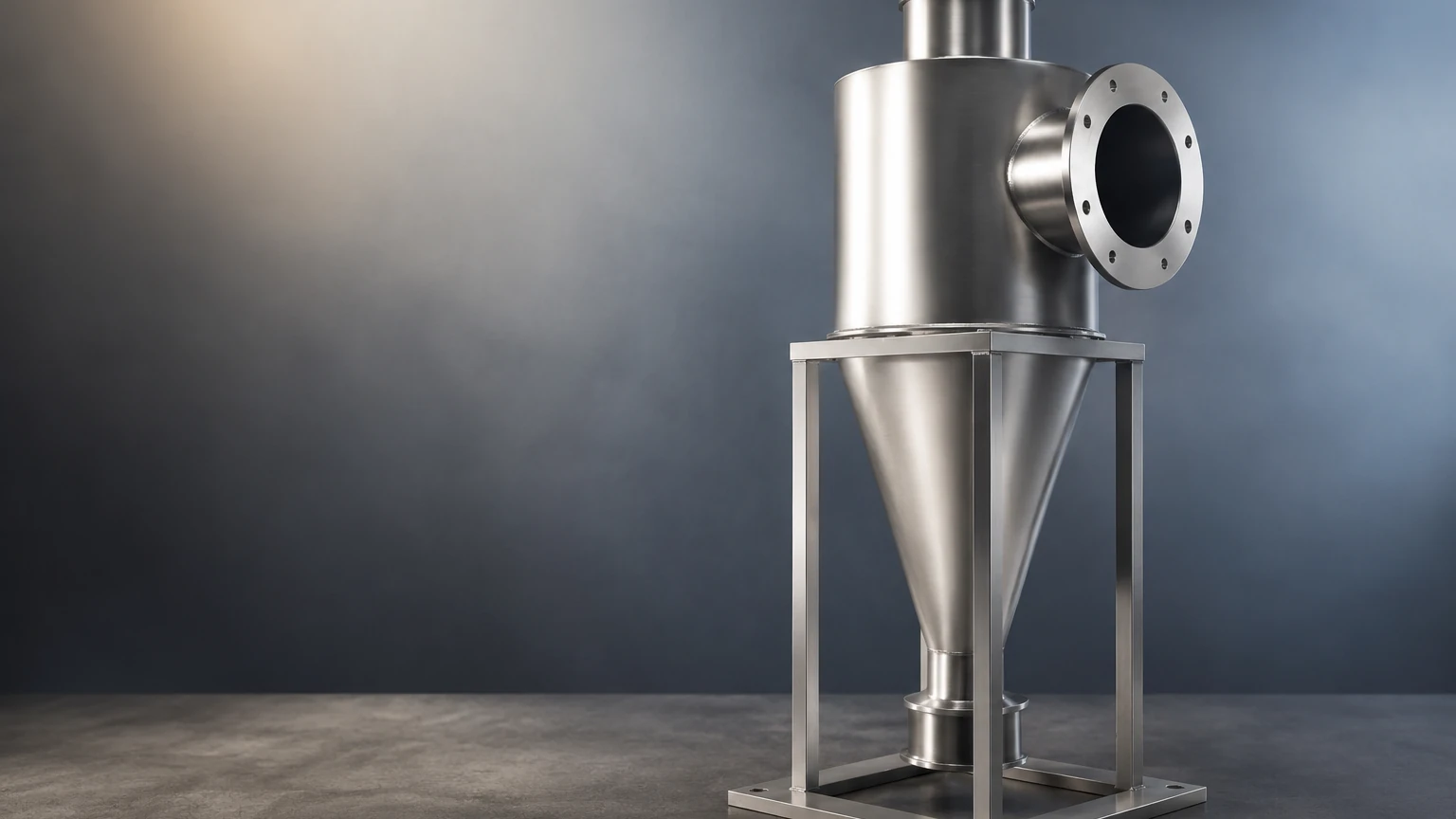
The vertical cyclone separator operates by transforming the linear velocity of an incoming fluid stream into a high-speed tangential whirl. This is typically achieved through a tangential inlet or a series of stationary vanes. As the fluid enters the cylindrical body of the separator, it is forced into a downward spiral, commonly referred to as the "outer vortex."
Centrifugal Force and Particle Migration
As the fluid rotates, centrifugal force acts upon the suspended particles. Because the particles are denser than the carrier fluid (whether gas or liquid), they possess greater inertia and are flung toward the outer wall of the cyclone body. Once the particles strike the wall, they lose their kinetic energy and begin to descend toward the conical section of the separator under the influence of gravity.
The Inner Vortex and Clean Fluid Discharge
The conical shape at the bottom of the separator serves a dual purpose: it accelerates the fluid velocity to maintain centrifugal force and eventually forces the fluid to reverse its direction. The fluid, now largely stripped of its heavier particulate load, forms a smaller, tighter "inner vortex" that travels upward through the center of the cyclone. This clean fluid exits through a central discharge pipe at the top, often called the vortex finder.
Key Engineering Design Parameters
Designing or selecting a vertical cyclone separator requires a deep dive into several critical engineering parameters. A mismatch between the separator’s design and the process conditions can lead to excessive pressure drop or poor separation efficiency.
1. Cyclone Diameter and Length
The diameter of the cyclone body is the primary factor determining the centrifugal force generated. Smaller diameters generally yield higher centrifugal forces and better separation of fine particles, but they also result in higher pressure drops and lower volumetric capacities. The length of the cylindrical and conical sections determines the residence time of the fluid, which influences the probability of a particle reaching the wall before the fluid reverses direction.
2. Inlet Velocity and Pressure Drop
Separation efficiency is directly proportional to the inlet velocity. However, as velocity increases, so does the pressure drop ($ΔP$). Engineers must balance the need for high-efficiency separation with the energy costs associated with overcoming the pressure drop. A typical industrial vertical cyclone separator is designed to operate within a specific flow range to maintain the stability of the vortex.
3. The Cut Point ($d_{50}$)
The performance of a cyclone is often defined by its "cut point," which is the particle size at which 50% of the particles are collected and 50% are lost to the overflow. Factors such as fluid viscosity, particle density, and temperature all affect the $d_{50}$. In applications involving high-viscosity liquids or very fine dust, the cut point may be higher, necessitating secondary filtration stages using stainless steel wire mesh or sintered metal elements.
Material Selection and Durability
In industrial environments, the vertical cyclone separator is often subjected to abrasive particles, corrosive chemicals, and high temperatures. Material selection is therefore a critical decision for longevity.
* Stainless Steel (304/316L): This is the standard for most chemical, pharmaceutical, and food-grade applications. Stainless steel provides excellent corrosion resistance and can withstand the rigorous cleaning protocols (CIP/SIP) required in hygienic industries.
* Abrasion-Resistant Linings: In mining or heavy industrial applications where the particulate is highly abrasive, the internal walls of the cyclone may be lined with ceramics or specialized hardened alloys to prevent premature wall thinning.
* Surface Finish: For the food and beverage industry, the internal surface roughness (Ra) must be minimized to prevent bacterial growth and ensure easy cleaning. Electropolishing is often employed to achieve a mirror-like finish.
Integration with Secondary Filtration Systems
A vertical cyclone separator is rarely a standalone solution for sub-micron filtration. Its primary role is to protect and optimize the performance of downstream precision filters. By removing 90% to 99% of the bulk solids, the cyclone prevents the "blinding" or rapid clogging of fine filter cartridges.
Protecting Stainless Steel Filter Cartridges
When a process stream contains a high concentration of solids, a direct-to-cartridge approach is often inefficient. The cartridges would require frequent replacement or cleaning, leading to significant downtime. Integrating a vertical cyclone separator upstream allows the secondary stainless steel filters—such as pleated wire mesh or sintered metal cartridges—to operate at a much lower differential pressure for longer periods. This synergy is a hallmark of well-engineered industrial filtration systems.
Applications in Specific Industries
* Chemical Processing: Separating catalysts from reaction streams or removing precipitates from liquid solutions.
* Food and Beverage: Primary removal of pulp, seeds, or grains before fine clarification.
* Oil and Gas: Removing sand and proppants from produced water or gas streams to protect compressors and pumps.
* Hydraulic Systems: Acting as a pre-filter for heavy-duty hydraulic fluids in systems exposed to high environmental contamination.
Evaluation Criteria and Common Risks
When evaluating a vertical cyclone separator for a specific project, engineers must account for potential failure modes and operational risks.
1. Particle Re-entrainment
If the dust collection hopper at the bottom of the cyclone is allowed to overfill, or if there is a leak in the discharge valve, the high-velocity vortex can "pick up" previously separated particles and carry them out through the clean fluid outlet. This is known as re-entrainment and can catastrophically impact downstream filtration stages.
2. Erosion and Wall Thinning
Because the separation mechanism relies on particles striking the outer wall, erosion is an inherent risk. Regular ultrasonic thickness testing of the cyclone walls is recommended, especially in high-velocity applications. Choosing a manufacturer that utilizes high-quality stainless steel and precision welding ensures structural integrity under these abrasive conditions.
3. Turndown Ratio Limitations
Cyclones are sensitive to changes in flow rate. If the flow drops significantly below the design point, the centrifugal force weakens, and separation efficiency plummets. If the process requires variable flow rates, a multi-cyclone arrangement (multiple small cyclones in parallel) may be more effective than a single large unit.
Technical Confirmation Before Purchase
Before finalizing the procurement of a vertical cyclone separator, the following technical data points should be confirmed with the manufacturer:
1. Fluid Characteristics: Confirm the viscosity, density, and temperature of the carrier fluid at operating conditions.
2. Particle Profile: Provide the particle size distribution (PSD) and the specific gravity of the solids to be removed.
3. Efficiency Requirements: Define the required collection efficiency for the target particle size.
4. Connection Standards: Ensure the inlet and outlet flanges match existing piping (e.g., ANSI, DIN, or JIS standards).
5. Regulatory Compliance: Confirm if the vessel needs to meet specific pressure vessel codes such as ASME Section VIII or PED.
Conclusion
The vertical cyclone separator remains a cornerstone of industrial separation technology due to its simplicity, lack of moving parts, and ability to handle high solids loads. By effectively managing the bulk of the particulate separation, it creates a stable environment for secondary, high-precision filtration components. For engineers seeking to optimize their filtration processes, the combination of robust cyclone design and high-quality stainless steel filtration media provides a reliable path toward operational efficiency. When selecting these components, focusing on material quality, precise engineering of the vortex dynamics, and clear performance expectations will ensure the long-term success of the filtration system.
