


Vertical Pressure Vessel
In industrial fluid processing, the vertical pressure vessel serves as the primary containment unit for high-pressure filtration, separation, and storage operations. Unlike horizontal configurations, vertical vessels are often preferred in facilities where floor space is at a premium or where gravity-assisted drainage and sediment collection are critical to the process. For engineers and procurement teams, selecting or designing a vertical pressure vessel requires a deep understanding of mechanical design codes, material compatibility, and the specific requirements of the internal filtration media.
As a specialized manufacturer, Kaifil provides the precision-engineered internals—such as stainless steel wire mesh filters and filter cartridges—that define the performance of these vessels. To understand how to optimize a filtration system, one must first evaluate the structural and functional parameters of the vessel itself. For more detailed technical specifications on filtration components, you may visit the Main Page of our technical resource center.
Engineering Principles of Vertical Pressure Vessels
The design of a vertical pressure vessel is governed by international standards, most notably the ASME Boiler and Pressure Vessel Code (Section VIII). These standards ensure that the vessel can withstand internal or external pressures without failure.
Structural Orientation and Footprint
The vertical orientation is fundamentally driven by spatial and process logic. In chemical plants and pharmaceutical cleanrooms, vertical vessels minimize the "footprint" or the floor area required for installation. From a process perspective, the vertical arrangement allows for a clear separation of phases (gas/liquid or liquid/solid) through gravity. Heavier particles or contaminants naturally settle at the bottom of the vessel, where they can be purged through a conical or dished head drainage port.
Head Design and Pressure Distribution
The geometry of the vessel ends, known as heads, significantly impacts the pressure rating and cost. Common types include:
- Ellipsoidal Heads: These offer a balance between thickness and strength, making them common for high-pressure applications.
- Torispherical Heads: Often used for lower pressure ranges, they are more economical to manufacture but require thicker walls to handle the same pressure as ellipsoidal designs.
- Hemispherical Heads: The strongest shape, allowing for thinner walls, though they are more difficult and expensive to produce.
Material Selection for Industrial Filtration
Material integrity is the most critical factor in ensuring the longevity of a vertical pressure vessel, especially when handling corrosive fluids or operating under extreme temperatures.
Stainless Steel 304 and 316L
For the majority of industrial filtration applications, stainless steel is the standard.
- Type 304: Suitable for general industrial use, providing excellent strength and basic corrosion resistance. It is frequently used in water treatment and non-corrosive chemical processing.
- Type 316L: The "L" denotes low carbon, which helps prevent sensitization during welding. 316L contains molybdenum, significantly increasing its resistance to chlorides and pitting. This makes it the preferred choice for pharmaceutical, food and beverage, and marine applications where sanitary conditions and chemical stability are paramount.
Surface Finish and Sanitary Requirements
In the food and pharmaceutical sectors, the internal surface finish of the vertical pressure vessel is as important as the material itself. Surfaces are often polished to a specific Ra (Roughness Average) value, such as 0.4 μm or 0.8 μm, to prevent bacterial growth and ensure effective Clean-in-Place (CIP) procedures. Electropolishing is also utilized to create a passive, ultra-smooth surface that resists contamination.
Integrating Filtration Components into Vertical Vessels
A vertical pressure vessel is often just the housing for the actual filtration workhorse: the filter element. The efficiency of the system depends on how well the vessel design accommodates the flow dynamics of these internals.
Filter Cartridges and Wire Mesh Elements
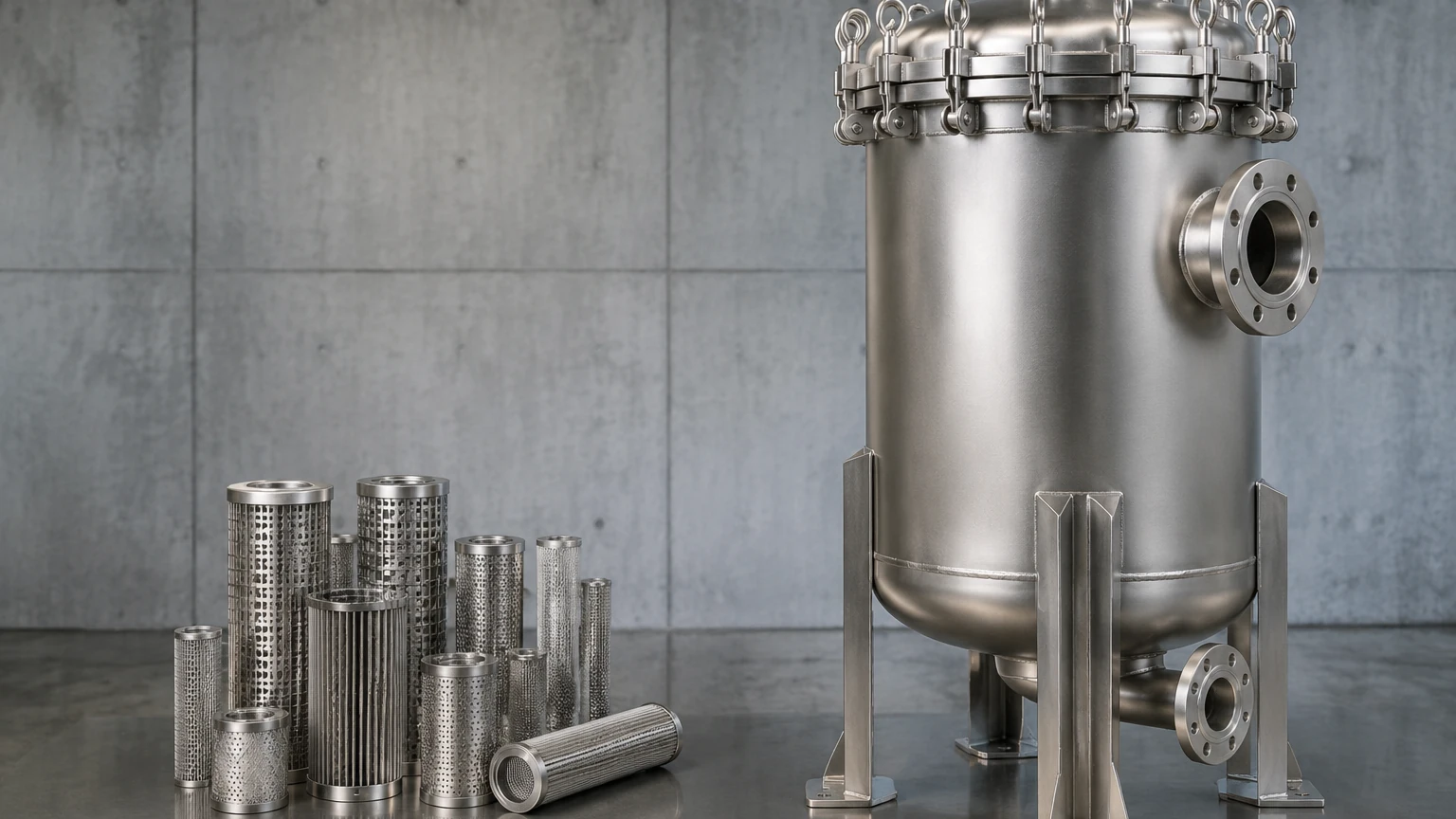
Inside a vertical vessel, filter cartridges are typically arranged in a multi-round configuration, supported by a tube sheet. The fluid enters the vessel, passes through the media (from outside to inside), and exits through the common header.
- Stainless Steel Wire Mesh: For high-temperature or high-viscosity fluids, wire mesh filters provide a robust, cleanable solution. They are capable of handling high differential pressures that would collapse standard polymer cartridges.
- Sintered Metal Filters: These provide extreme precision and are used when the vertical pressure vessel must operate in highly aggressive environments where fiber migration must be zero.
Flow Dynamics and Pressure Drop
Engineers must calculate the total pressure drop (ΔP) across the system, which includes the vessel's inlet/outlet losses and the resistance of the filter media. A vertical pressure vessel allows for a "top-in, bottom-out" or "side-in, bottom-out" flow pattern. The latter is often preferred as it allows for easier access to the top cover for filter replacement without disconnecting the main piping.
Key Evaluation Criteria for Procurement
When specifying a vertical pressure vessel for a filtration project, several technical variables must be confirmed to ensure safety and performance.
1. Design Pressure and Temperature: The vessel must be rated for the maximum possible surge pressure, not just the operating pressure. This includes accounting for temperature-induced fluctuations that can affect the tensile strength of the stainless steel.
2. Corrosion Allowance: Even with stainless steel, engineers often factor in a corrosion allowance—a sacrificial thickness of metal—to ensure the vessel remains within safety limits over its 10-to-20-year lifespan.
3. Sealing Mechanisms: The closure of the vessel (the lid or manway) must be sealed with gaskets or O-rings compatible with the process fluid. Common materials include EPDM, Viton (FKM), and PTFE-encapsulated silicone. The choice depends on the chemical aggressiveness and temperature of the fluid.
4. Nozzle Configuration: The size and placement of inlet, outlet, vent, and drain nozzles are critical. Improperly sized nozzles can lead to high fluid velocity, causing erosion or turbulence that disrupts the filtration cake on the internal elements.
Operational Safety and Maintenance
Safety is paramount when dealing with pressurized equipment. A vertical pressure vessel must be equipped with several safety features to protect personnel and the environment.
Pressure Relief and Venting
Every vessel should have a dedicated port for a pressure relief valve (PRV). Additionally, because air can become trapped in the top of a vertical vessel during filling, a manual or automatic air vent is necessary. Trapped air can compress and lead to dangerous pressure spikes or reduced filtration efficiency due to "air binding" of the filter media.
Maintenance Access
For larger vessels, a manway is essential for internal inspection and cleaning. In filtration applications, the "quick-opening closure" is a valuable feature. Instead of traditional bolted flanges, which are time-consuming to remove, swing-bolt closures or clamp-style lids allow maintenance teams to replace filter cartridges rapidly, minimizing downtime.
Monitoring Instrumentation
To track the performance of the internal filters, differential pressure gauges should be installed across the vessel's inlet and outlet. A rise in differential pressure indicates that the filter elements are becoming loaded with contaminants and require cleaning or replacement. Integrating these gauges into a central control system allows for predictive maintenance.
Customization and OEM Solutions
Standard off-the-shelf vessels rarely meet the specific needs of complex industrial processes. Customization is often required to optimize the interaction between the vessel and the filtration media.
At Kaifil, we specialize in the engineering and manufacture of the internal components that make a vertical pressure vessel functional. Whether it is a custom-designed support basket for a wire mesh filter or a high-precision tube sheet for a multi-cartridge housing, the synergy between the vessel and the internals is what determines the total cost of ownership.
Customization options often include:
- Variable Micron Ratings: Tailoring the internal mesh to capture specific particle sizes while maintaining flow.
- Internal Linings: For extremely corrosive acids where even 316L stainless steel may struggle, internal fluoropolymer linings can be applied.
- Support Structures: Heavy-duty internal grids to support the weight of the filter media when fully loaded with solids.
Conclusion
The vertical pressure vessel is a cornerstone of industrial filtration, providing a safe and efficient environment for fluid purification. By prioritizing high-grade materials like 316L stainless steel and adhering to rigorous design codes, engineers can ensure long-term reliability. However, the vessel is only as effective as the filtration elements it contains.
Understanding the relationship between vessel geometry, flow dynamics, and filter media selection is essential for achieving optimal process results. For technical professionals seeking to enhance their filtration systems, reviewing the options for custom wire mesh and cartridge solutions is the next logical step. You can explore our full range of capabilities and engineering support on our Main Page. By focusing on precision manufacturing and application-specific designs, industrial operators can reduce maintenance costs, improve product purity, and ensure the safety of their pressurized systems.
