


Waste Water Filter
In industrial environments, the selection of a waste water filter is a critical decision that impacts operational efficiency, equipment longevity, and regulatory compliance. Industrial wastewater often contains a complex mixture of suspended solids, corrosive chemicals, and abrasive particulates that can quickly degrade standard filtration components. As a specialized manufacturer, Kaifil provides custom stainless steel filtration solutions designed to meet the rigorous demands of these applications. This guide explores the engineering considerations, material science, and performance metrics essential for selecting the right filtration components for industrial wastewater treatment.
Engineering Foundations for Industrial Wastewater Filtration
Industrial wastewater treatment is rarely a one-size-fits-all process. The effectiveness of a waste water filter depends heavily on its ability to handle specific influent characteristics while maintaining a consistent flow rate. Engineers must evaluate the nature of the contaminants—whether they are organic, inorganic, fibrous, or granular—to determine the appropriate filtration mechanism.
Mechanical filtration in wastewater typically involves surface filtration or depth filtration. Surface filtration, often achieved through fine wire mesh or wedge wire screens, captures particles on the upstream side of the media. This is ideal for applications where the solids loading is high and frequent cleaning or backwashing is required. Depth filtration, utilizing sintered metal or multi-layered mesh, allows particles to be trapped within the thickness of the media, offering higher dirt-holding capacity for finer particulates.
For engineers looking to integrate these components into larger systems, understanding the mechanical interface is vital. By visiting our Main Page, technical teams can review product options and application support to ensure that the chosen filter geometry aligns with existing housing specifications and fluid dynamics.
Material Selection: Why Stainless Steel is Essential for Wastewater
When specifying a waste water filter, material durability is the primary factor in determining the total cost of ownership. While plastic or disposable polymer filters may have lower initial costs, they often fail under the thermal and chemical stresses of industrial wastewater. Stainless steel, particularly grades 304 and 316L, is the industry standard for several reasons:
1. Corrosion Resistance: Industrial wastewater can have fluctuating pH levels and high concentrations of chlorides. 316L stainless steel, with its molybdenum content, provides superior resistance to pitting and crevice corrosion compared to standard carbon steels or lower-grade alloys.
2. Thermal Stability: Many industrial processes discharge wastewater at elevated temperatures. Stainless steel maintains its structural integrity and filtration accuracy at temperatures that would cause polymer filters to soften or deform.
3. Mechanical Strength: High-pressure wastewater systems, such as those found in hydraulic return lines or high-head pumping stations, require filters that can withstand significant differential pressure (ΔP) without collapsing or bypassing.
Kaifil’s expertise in material selection ensures that each filter component is matched to the specific chemical profile of the waste stream, preventing premature failure and reducing maintenance downtime.
Evaluating Filtration Accuracy and Micron Ratings
One of the most common points of confusion in specifying a waste water filter is the difference between nominal and absolute micron ratings. For critical industrial applications, relying on a nominal rating can be risky. A nominal rating indicates the filter's ability to retain a majority of particles of a certain size, but it does not guarantee 100% efficiency.
In contrast, an absolute micron rating is determined through rigorous testing (such as the glass bead test) and indicates the largest particle that can pass through the filter media. In wastewater applications where downstream equipment—such as high-pressure nozzles or sensitive membranes—must be protected, absolute-rated stainless steel mesh is often the preferred choice.
Engineers must also consider the "open area" of the filter. A higher open area reduces the initial pressure drop and extends the time between cleaning cycles. However, increasing the open area often requires thinner wire diameters, which can affect the mechanical strength of the mesh. Balancing these two factors is a core part of the custom design process at Kaifil.
Structural Design and Customization for OEM Applications
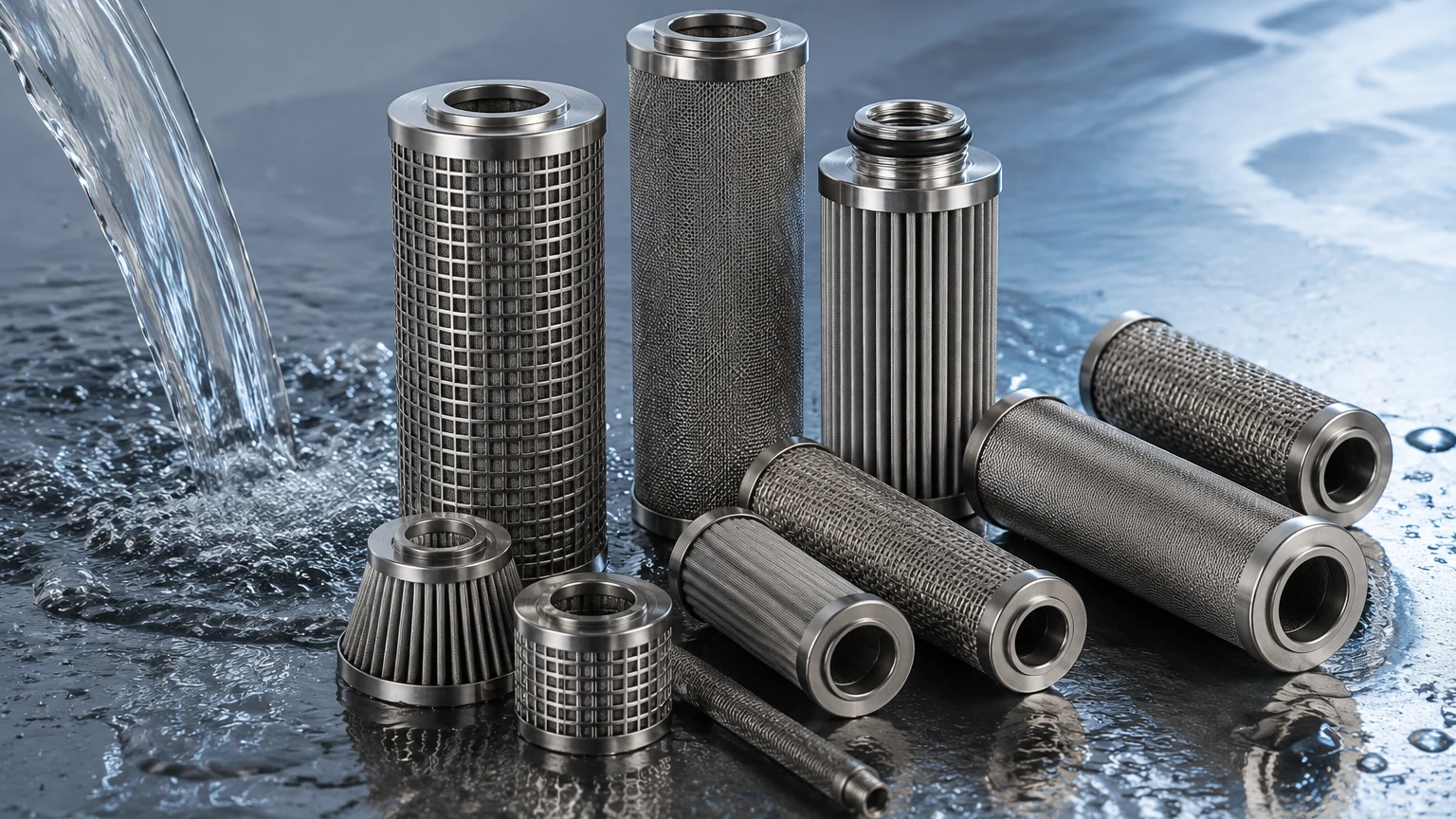
Standard off-the-shelf filters rarely meet the precise needs of specialized industrial machinery. Customization is often necessary to optimize the performance of a waste water filter within a specific footprint. As an OEM partner, Kaifil focuses on providing tailored solutions that include:
* Custom Dimensions: Tailoring the length, diameter, and fitting types (such as NPT, flange, or DOE) to fit proprietary filter housings.
* Reinforced Structures: For high-viscosity wastewater or high-pressure surges, filters can be designed with internal support cores or external perforated cages to prevent media migration or structural collapse.
* Pleated Designs: To increase the effective filtration area (EFA) without increasing the overall size of the filter, pleating the stainless steel mesh can provide up to 3-5 times the surface area of a cylindrical filter. This significantly lowers the flux rate (flow per unit area), leading to longer service life and better particulate retention.
Operational Considerations: Flow Rate, Pressure Drop, and Cleaning
The performance of a waste water filter is measured by its impact on the system's energy consumption and maintenance schedule. The two most important metrics are the clean pressure drop and the terminal pressure drop.
* Clean Pressure Drop: This is the resistance to flow when the filter is new or freshly cleaned. It is influenced by the fluid's viscosity, the flow velocity, and the filter's open area.
* Terminal Pressure Drop: This is the point at which the filter is considered "blinded" or full, and must be cleaned or replaced. In automated wastewater systems, this is usually the trigger for a backwash cycle.
Stainless steel filters offer a distinct advantage in cleanability. Unlike disposable cartridges, stainless steel wire mesh and sintered components can be cleaned using backpulsing, ultrasonic baths, or chemical cleaning (CIP). This reusability is a major factor in reducing the environmental impact and operational costs of industrial water treatment.
Total Cost of Ownership and Long-Term Performance
When purchasing a waste water filter, procurement teams often focus on the unit price. However, a technical B2B perspective requires looking at the Total Cost of Ownership (TCO). The TCO includes the initial purchase price, the cost of downtime for replacements, the labor costs for maintenance, and the disposal costs of spent filter media.
Stainless steel filters from Kaifil are designed for longevity. By choosing a durable, cleanable metal filter, facilities can eliminate the recurring cost of purchasing and disposing of thousands of polymer cartridges over the equipment's lifespan. Furthermore, because stainless steel filters do not shed fibers (a common issue with felt or string-wound filters), they ensure the purity of the effluent and protect downstream processes from secondary contamination.
Selecting the Right Filter for Specific Industrial Contaminants
The nature of the waste stream dictates the filter configuration. For example:
* Food & Beverage Wastewater: Often contains organic fats and oils. Here, a smooth-surface wedge wire or a specific Dutch weave mesh is used to prevent the "sticky" particles from becoming permanently embedded in the media.
* Chemical Processing: May involve highly acidic or alkaline streams. Utilizing 316L or even specialized alloys ensures the filter does not leach metal ions into the fluid or succumb to chemical erosion.
* Pharmaceutical: Requires high precision and easy-to-sanitize components. Sintered mesh filters with high-quality surface finishes are typically specified to meet stringent hygiene standards.
Conclusion: Specifying Your Waste Water Filter Requirements
Choosing the correct industrial waste water filter is a balance of material science, mechanical engineering, and operational strategy. Engineers should begin the selection process by defining the maximum allowable particle size, the expected solids loading, the chemical composition of the wastewater, and the desired cleaning interval.
Kaifil’s manufacturing capabilities allow for the development of high-performance filtration components that are both reliable and cost-effective. Whether you are designing a new treatment system or looking to optimize an existing process, understanding the technical nuances of stainless steel filtration is the first step toward achieving efficient and durable performance. For more information on our custom manufacturing and to view our full product range, please refer to our Main Page.
