


Water Filtration for Beer Production
Water is the primary ingredient in beer, typically comprising over 90% of the final product's volume. Beyond its role as a solvent for malt sugars and hop compounds, water acts as a critical chemical component that influences enzymatic activity during mashing, yeast health during fermentation, and the ultimate sensory profile of the beverage. For commercial breweries, achieving a consistent flavor profile across different batches requires rigorous control over water quality. This is where high-performance water filtration for beer production becomes an essential engineering requirement rather than a secondary utility.
From an industrial perspective, water filtration is not merely about removing visible debris; it is a multi-stage process designed to eliminate chlorine, organic contaminants, microorganisms, and specific ions that could negatively impact the brewing process. Choosing the correct filtration hardware—ranging from stainless steel wire mesh filters to precision cartridges—is vital for maintaining operational efficiency and protecting downstream equipment like reverse osmosis (RO) membranes and heat exchangers.
The Critical Role of Water Quality in Brewing
In the context of modern brewing, water serves several distinct functions, each requiring a specific level of purity. The "liquor," as brewers refer to it, is categorized into brewing water (used for mashing and sparging), cooling water, and cleaning water. Each of these streams demands different filtration strategies.
Effective water filtration for beer production addresses three primary categories of contaminants:
1. Physical Particulates: Sand, grit, and pipe scale can damage valves and clog spray balls. Mechanical filtration using stainless steel mesh is the first line of defense.
2. Chemical Contaminants: Chlorine and chloramines, often added by municipal water providers for disinfection, can react with malt phenols to create chlorophenols, which impart a medicinal, plastic-like off-flavor even at very low concentrations.
3. Biological Contaminants: While the boiling process sterilizes the wort, the water used for post-boil dilutions or equipment rinsing must be free of spoilage organisms like wild yeast or lactic acid bacteria.
By implementing a robust filtration system, breweries can ensure that their base ingredient is a "blank canvas," allowing the brewmaster to precisely adjust mineral content to suit specific beer styles, such as the soft water required for Pilsners or the gypsum-rich water favored for West Coast IPAs.
Engineering Specifications for Industrial Filtration Components
When designing a system for water filtration for beer production, engineers must look beyond basic flow rates and consider the material science and mechanical integrity of the filter components. Stainless steel is the industry standard for brewery filtration due to its superior durability and hygienic properties.
Material Selection: 304 vs. 316L Stainless Steel
For most brewery water applications, Grade 304 stainless steel provides adequate corrosion resistance. However, in environments where the water has high chloride levels or where aggressive cleaning agents are used, Grade 316L is preferred. 316L contains molybdenum, which significantly enhances resistance to pitting and crevice corrosion. Utilizing high-quality metal components from a professional manufacturer ensures that the filtration system does not introduce metallic off-flavors or leach impurities into the water stream.
Micron Ratings and Filtration Efficiency
Filtration efficiency is defined by the micron rating, which indicates the size of particles the filter can capture. In a brewery setting, filtration is usually staged:
* Coarse Pre-filtration (50–100 microns): Removes large sediment and protects downstream carbon blocks or RO membranes.
* Fine Filtration (5–10 microns): Targets smaller particulates and some organic matter.
* Sub-micron Filtration (0.2–0.45 microns): Used for sterile filtration of water that will come into contact with cold-side beer, ensuring no microbial cross-contamination occurs.
For more information on the technical specifications of these components, engineers can visit the Main Page to review various stainless steel filter configurations and material options.
Primary Filtration Stages in the Brewery
A comprehensive approach to water filtration for beer production typically involves a series of specialized stages, each optimized for a specific task. Relying on a single filter to handle all contaminants often leads to premature clogging and inconsistent water quality.
Sediment and Particle Removal
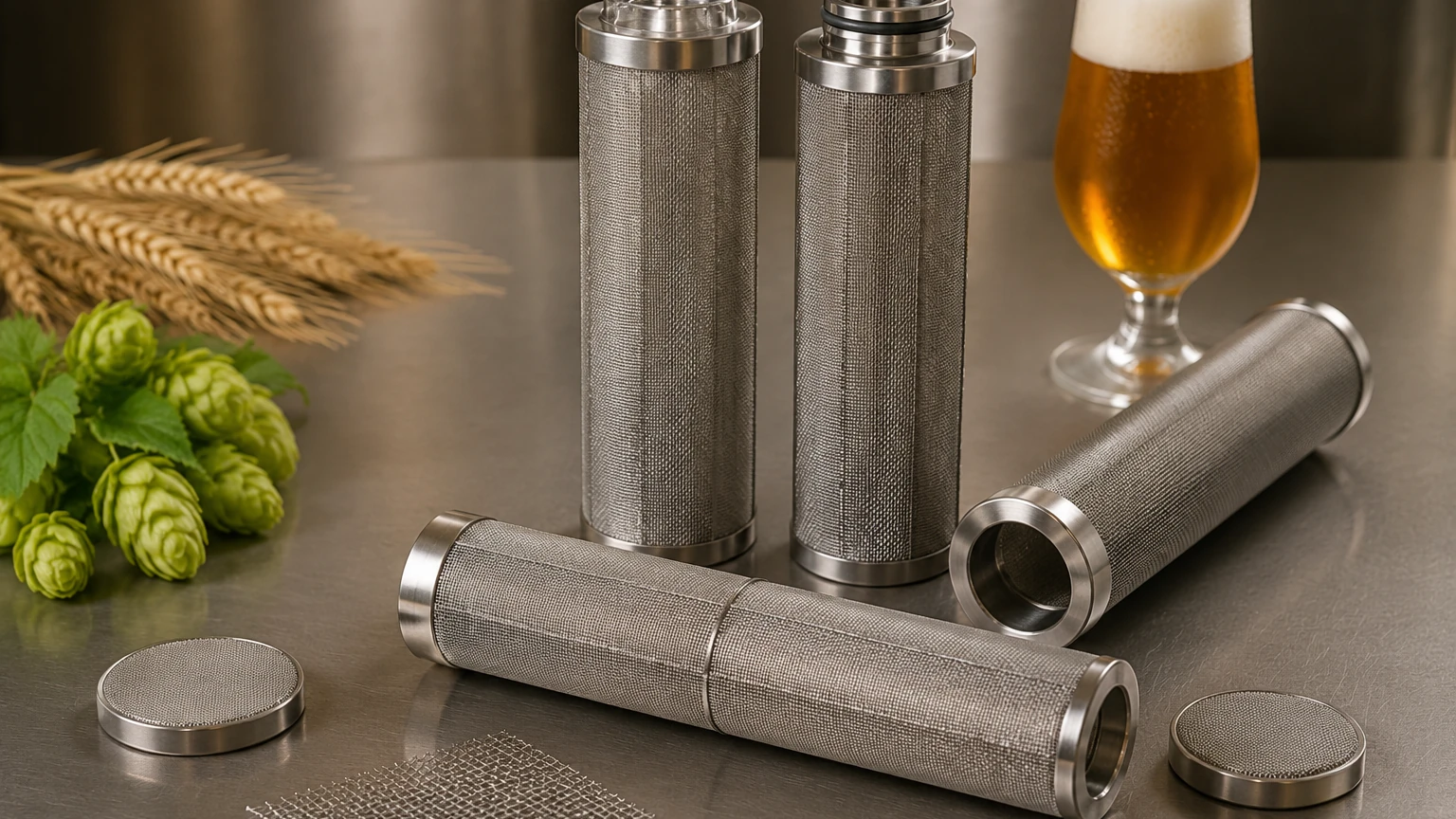
The initial stage involves mechanical filtration to remove suspended solids. Stainless steel wire mesh filters are ideal here because they are cleanable and reusable, offering a lower total cost of ownership compared to disposable polypropylene cartridges. These filters are designed to handle high flow rates and high pressure drops without compromising structural integrity.
Dechlorination and Organic Removal
Once particulates are removed, the water must be treated to remove chlorine and chloramines. Activated carbon filtration is the standard method for this. However, carbon beds can become breeding grounds for bacteria if not managed correctly. Therefore, placing a fine stainless steel filter downstream of the carbon block is a common engineering practice to prevent "carbon fines" from entering the brewing liquor tanks.
Membrane Protection
If a brewery utilizes Reverse Osmosis (RO) to strip minerals from the water, the pre-filtration stage is critical. RO membranes are sensitive to fouling from both particulates and chemical oxidants. High-precision stainless steel filter cartridges provide the necessary protection to extend the lifespan of expensive RO membranes, ensuring the system operates at peak permeate flux.
Maintenance, Cleaning, and Total Cost of Ownership
In an industrial B2B environment, the performance of a filtration system is measured not just by its initial output, but by its reliability over thousands of hours of operation. One of the primary advantages of using stainless steel filtration components in water filtration for beer production is their compatibility with Cleaning-in-Place (CIP) protocols.
Cleaning-in-Place (CIP) Compatibility
Unlike plastic or paper filters, stainless steel components can withstand high temperatures and caustic cleaning solutions. This allows breweries to integrate the filters into their existing CIP loops, ensuring that the filtration housing and the media itself remain sanitary. The ability to backwash wire mesh filters also extends the service life between deep cleanings, reducing downtime.
Evaluating Replacement Cycles
While the initial capital expenditure for stainless steel filter cartridges may be higher than for disposable alternatives, the long-term savings are significant. Engineers should calculate the total cost of ownership (TCO) by considering:
* Consumable costs: The price and frequency of replacing disposable filters.
* Labor costs: The time required for staff to change out filters and sanitize housings.
* Waste disposal: The environmental and financial cost of disposing of used filter media.
* Yield loss: Pressure drops caused by clogged filters can slow down production, leading to lost revenue.
By choosing durable, cleanable metal filters, breweries can achieve a more sustainable and cost-effective filtration process.
Customization and OEM Solutions for Brewery Equipment
No two breweries are identical. Factors such as source water chemistry, production volume, and facility layout necessitate customized filtration solutions. For original equipment manufacturers (OEMs) building brewhouses or water treatment skids, the ability to source custom-dimensioned filter components is essential.
Customization options often include:
* End-cap Configurations: Ensuring compatibility with existing piping through DOE (Double Open End), Code 7, or threaded connections.
* Bespoke Micron Ratings: Engineering specific mesh weaves to target unique particulate profiles found in certain municipal water supplies.
* Housing Integration: Designing filter elements that fit into compact footprints for mobile brewing units or pilot systems.
Working with a manufacturer that understands these engineering nuances allows brewery technical teams to develop filtration systems that are perfectly matched to their specific flow requirements and water quality targets. For those seeking specialized components or custom designs, exploring the options available on the Main Page provides a starting point for technical collaboration.
Conclusion: Achieving Consistency Through Precision Filtration
In the competitive landscape of craft and industrial brewing, consistency is the hallmark of quality. Water filtration for beer production is the foundational technology that enables this consistency. By removing the variables associated with fluctuating source water quality, breweries can ensure that every pint meets the intended flavor profile.
From a technical standpoint, the selection of filtration media, the engineering of the filter structure, and the implementation of robust maintenance protocols are the keys to success. Stainless steel filtration solutions offer the durability, heat resistance, and precision required to meet the demanding standards of the food and beverage industry. By investing in high-quality filtration components, breweries protect their equipment, optimize their processes, and ultimately deliver a superior product to the consumer.
