


Wedge Wire Filter
In the landscape of industrial liquid-solid separation, the wedge wire filter stands as one of the most robust and efficient solutions available to engineers. Unlike traditional woven wire mesh or perforated plates, wedge wire is a precision-engineered product designed to handle high-pressure differentials, abrasive materials, and demanding flow rates. Its unique structural design, characterized by a V-shaped profile wire, provides a combination of mechanical strength and non-clogging performance that is essential in critical sectors such as chemical processing, water treatment, and food production.
For technical professionals and procurement teams, selecting the right filtration medium involves balancing initial capital expenditure with long-term operational efficiency. Understanding the engineering principles, material science, and customization options behind wedge wire technology is the first step toward optimizing filtration systems. As a specialized manufacturer, Kaifil provides comprehensive support for these components, which can be explored further on our Main Page.
Engineering Principles of Wedge Wire Construction
The fundamental advantage of a wedge wire filter lies in its geometry. It is constructed by wrapping a continuous profile wire around longitudinal support rods. Each intersection where the wire meets a rod is fusion-welded using advanced resistance welding techniques. This process creates a rigid, one-piece structure that maintains its integrity under significant mechanical stress.
The V-Shaped Profile
The "wedge" in wedge wire refers to the triangular or V-shaped cross-section of the surface wire. When the filter is in operation, the flat side of the V-shape faces the incoming flow. This configuration creates a slot that widens inwardly. In practice, this means that any particle small enough to pass through the narrowest opening at the surface will continue to move through the widening gap without becoming lodged. This "two-point contact" principle is what gives wedge wire its superior non-clogging characteristics compared to square-weave mesh, where particles often become trapped within the apertures.
Structural Integrity and Support Rods
The support rods provide the internal framework for the filter. Depending on the application—whether it is a cylindrical cartridge, a flat screen, or a curved sieve bend—the spacing and shape of these rods are customized to withstand specific collapse or burst pressures. For high-pressure hydraulic or chemical applications, the density of support rods is increased to ensure the filter does not deform under the weight of the filter cake or the force of the pump.
Key Performance Advantages in Industrial Applications
When evaluating filtration components, engineers typically prioritize three metrics: flow efficiency, durability, and ease of cleaning. The wedge wire filter excels in all three areas due to its unique physical properties.
High Open Area and Low Pressure Drop
Because the slot openings are continuous and precise, wedge wire filters offer a high percentage of open area relative to their surface size. This results in a significantly lower pressure drop across the filter medium. In large-scale industrial processes, reducing the pressure drop directly translates to lower energy consumption for pumps and more efficient throughput.
Mechanical Durability
Unlike polymer-based filters or thin metal meshes, wedge wire is inherently rigid. It can withstand high temperatures, corrosive environments, and abrasive media without tearing or losing its micronic rating. This durability makes it the preferred choice for "set-and-forget" installations where downtime for filter replacement is costly.
Superior Backwashing Efficiency
The V-shaped slot is particularly effective during backwashing or CIP (Clean-in-Place) cycles. When the flow is reversed, the widening gap allows the fluid to accelerate through the slot, creating a "venturi effect" that effectively dislodges accumulated solids from the surface. This ensures that the filter returns to its original clean pressure drop more effectively than other media.
Material Selection and Corrosion Resistance
Material science plays a critical role in the longevity of a wedge wire filter. Given that these components are often exposed to aggressive chemicals or high-salinity environments, selecting the correct alloy is paramount.
1. Stainless Steel 304: The standard choice for general industrial use, offering good corrosion resistance and excellent mechanical properties for water treatment and non-acidic food processing.
2. Stainless Steel 316L: Containing molybdenum, 316L provides enhanced resistance to pitting and crevice corrosion, making it suitable for pharmaceutical applications and chemical processing involving chlorides.
3. Duplex Stainless Steels: For extreme environments, such as offshore oil and gas or highly acidic chemical plants, Duplex alloys offer superior yield strength and exceptional resistance to stress corrosion cracking.
4. Specialty Alloys: In cases of extreme temperature or specific chemical sensitivities, materials like Monel or Hastelloy can be utilized to ensure the filter does not degrade prematurely.
Engineers must also consider the surface finish. Electropolishing is often applied to wedge wire filters used in the pharmaceutical and food industries to reduce surface roughness, which further prevents bacterial growth and improves cleanability.
Technical Selection Criteria for Engineers
Specifying a wedge wire filter requires more than just choosing a slot size. To ensure the component performs as expected, several technical variables must be confirmed during the design phase.
Slot Size and Tolerance
The slot size (the distance between the profile wires) determines the filtration rating. Wedge wire can be manufactured with slots as small as 20 microns up to several millimeters. It is vital to specify the tolerance required; for precision applications, a tight tolerance ensures that oversized particles do not bypass the filter.
Flow Direction
Wedge wire filters can be designed for flow from "out-to-in" (FOTI) or "in-to-out" (FITO). In a FOTI configuration, the profile wire is on the outside of the support rods, and the solids accumulate on the exterior surface. This is common in intake screens and standard cartridges. In a FITO configuration, the profile wire is on the inside, which is often used in screw press separators or internal-feed rotary screens.
Loading and Differential Pressure
Engineers must calculate the maximum expected differential pressure ($ΔP$). This occurs when the filter is loaded with contaminants. The wedge wire structure must be designed to handle this load without collapsing. If the process involves high-viscosity fluids, the structural requirements become even more stringent.
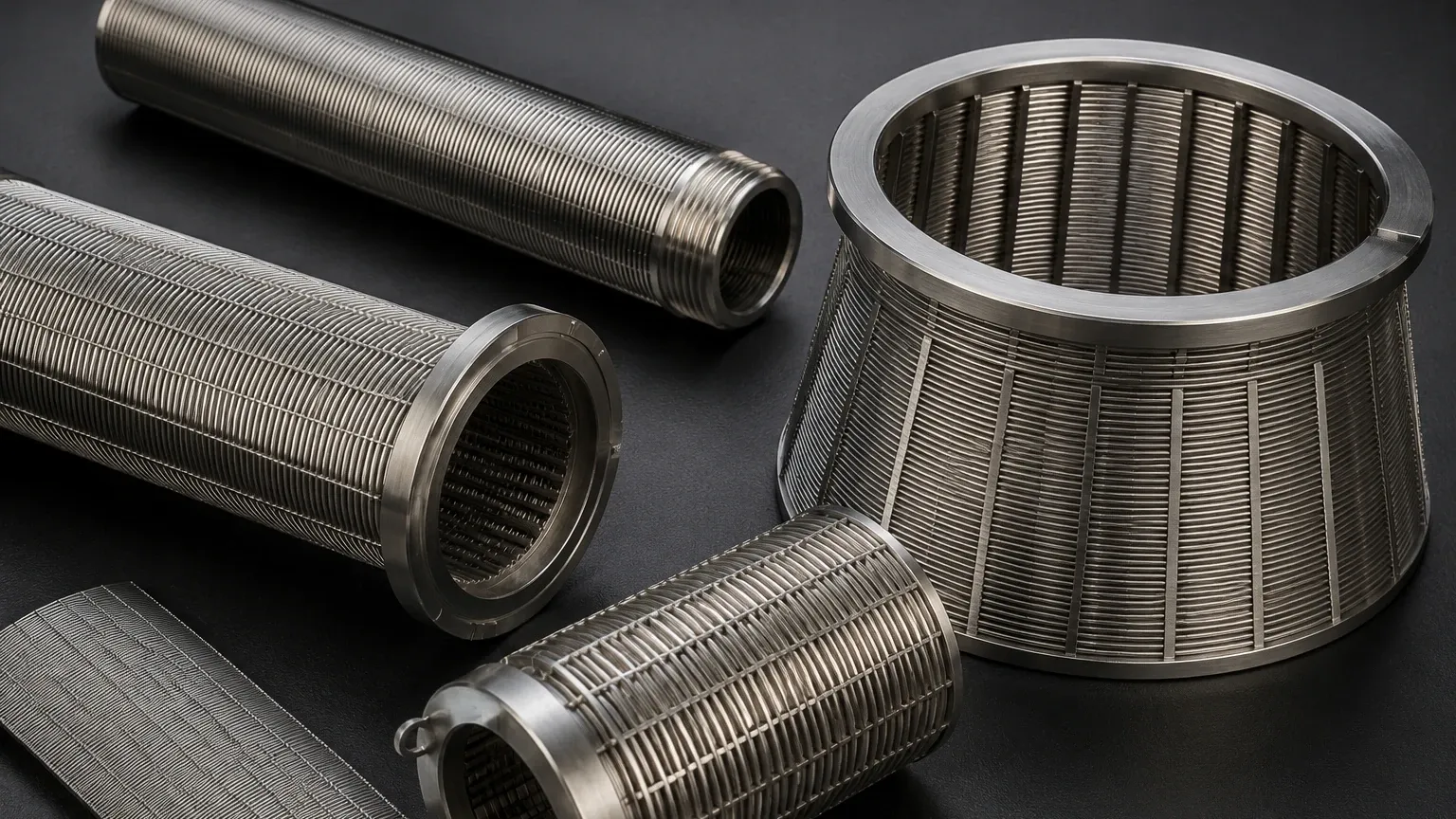
Common Applications Across Key Industries
The versatility of the wedge wire filter allows it to be integrated into various stages of production. Its ability to be formed into different shapes—cylinders, cones, flat panels, and baskets—makes it a universal solution for separation challenges.
* Water Treatment: Used in intake screens for power plants and desalination facilities to protect downstream equipment from debris and aquatic life. They are also used in resin traps to prevent the loss of expensive ion-exchange resins.
* Food and Beverage: In breweries, wedge wire is the standard for lauter tun bottoms, where it supports the grain bed while allowing the wort to flow through. In the sugar industry, it is used for juice filtration and centrifugal liners.
* Petrochemical and Chemical: Utilized as catalyst support grids in reactors and as internal components in separators. The ability to withstand high temperatures and aggressive solvents is critical here.
* Pulp and Paper: Essential in dewatering processes and fiber recovery, where the non-clogging nature of the wire prevents the build-up of organic fibers.
Total Cost of Ownership and Maintenance
While the initial cost of a stainless steel wedge wire filter may be higher than disposable cartridges or woven mesh, the total cost of ownership (TCO) is often much lower. The longevity of the product—often lasting years or even decades—offsets the frequent replacement costs associated with other media.
Maintenance requirements are minimal. Because the structure is metallic and welded, it can be cleaned using aggressive chemical agents, high-pressure steam, or mechanical brushing without risk of damage. For automated systems, the predictability of the backwashing cycle allows for optimized pump operation and reduced water or solvent waste.
Partnering with a Manufacturer for Custom Solutions
Every industrial process has unique variables, from the specific gravity of the suspended solids to the chemical volatility of the carrier fluid. A "one-size-fits-all" approach rarely provides the efficiency required in modern manufacturing. This is where the expertise of a dedicated manufacturer becomes invaluable.
At Kaifil, we specialize in translating complex filtration requirements into high-performance metal components. Whether you need a custom-dimensioned wedge wire filter for a legacy system or an OEM component for a new product line, our engineering team focuses on precision and durability. We assist in material selection, structural design, and filtration accuracy to ensure your system operates at peak performance.
Before finalizing a purchase, engineers should confirm the exact chemical composition of their process fluid, the maximum flow rate, and the cleaning protocols intended for the site. By addressing these factors early, you can ensure that the filtration solution provided is both cost-effective and technically sound. To explore our full range of custom stainless steel filtration solutions, including wire mesh and precision metal components, please visit our Main Page.
