


What Is a Wedge Wire Screen
In the realm of industrial filtration and separation, efficiency and durability are the primary metrics for performance. Engineers and procurement teams often encounter various filtration media, but few offer the structural integrity and precision of the wedge wire screen. Understanding what is a wedge wire screen involves looking beyond its surface to the engineering principles that allow it to outperform standard wire mesh in demanding environments.
As a specialized manufacturer of stainless steel filtration solutions, Kaifil provides a wide range of custom-engineered components. For those seeking a comprehensive overview of available filtration technologies, visiting our Main Page offers a deeper look into the manufacturing capabilities that support these critical industrial components.
The Engineering Fundamentals of Wedge Wire
A wedge wire screen, also known as a profile wire screen, is a metallic filter element constructed by resistance-welding V-shaped stainless steel wires onto support rods. Unlike woven wire mesh, which relies on the interlacing of wires, wedge wire is a rigid, welded structure.
The "wedge" refers to the cross-sectional shape of the surface wire. These V-shaped wires are arranged in parallel, creating precise slot openings. The support rods are typically oriented perpendicular to the surface wires, providing the necessary framework to withstand high pressure and mechanical stress. Every intersection where a profile wire meets a support rod is fused through advanced resistance welding, ensuring a robust, single-piece construction that does not shift or vibrate under load.
Why the V-Shape Matters: Non-Clogging Principles
The most significant technical advantage of a wedge wire screen is its non-clogging characteristic. When asking what is a wedge wire screen, one must focus on the "two-point contact" geometry.
In standard square mesh or perforated plates, particles that are slightly larger than the opening can easily become wedged or "blinded" within the aperture, significantly reducing flow and increasing pressure drop. In contrast, the V-shape of wedge wire creates a slot that widens inwardly. This means that any particle able to pass through the narrowest point at the surface will easily clear the rest of the screen without getting stuck. This design ensures a continuous flow and simplifies the cleaning process, whether through manual scraping or automated backwashing systems.
Material Selection and Corrosion Resistance
Industrial filtration often occurs in aggressive chemical environments or high-temperature settings. Consequently, the material used in wedge wire construction is critical. Most industrial wedge wire screens are manufactured from high-grade stainless steel, such as:
* Grade 304: Suitable for general-purpose applications where cost-effectiveness and standard corrosion resistance are required.
* Grade 316L: The preferred choice for pharmaceutical, food and beverage, and chemical processing due to its superior resistance to chlorides and pitting.
* Duplex Stainless Steel: Used in highly corrosive marine or petrochemical environments where both high strength and extreme corrosion resistance are mandatory.
Kaifil focuses on these high-performance alloys to ensure that the filter elements can withstand the specific chemical and thermal demands of the application, thereby extending the replacement cycle and reducing the total cost of ownership.
Technical Specifications and Selection Criteria
Selecting the correct wedge wire screen requires a detailed analysis of several engineering parameters. Engineers must confirm these specifications before moving forward with a custom design:
1. Slot Size (Aperture)
Slot sizes can range from as small as 20 microns to several millimeters. The precision of this slot determines the filtration accuracy. It is essential to balance the required particle retention with the desired flow rate.
2. Open Area Percentage
The open area is calculated using the formula:
`Open Area % = [Slot Width / (Slot Width + Wire Width)] x 100`.
A higher open area reduces the pressure drop and increases the flow capacity, but it may also impact the structural strength of the screen if the wire width is too narrow.
3. Flow Direction
Wedge wire screens can be engineered for two primary flow patterns:
* Flow-Out-to-In (FOTI): The filtration occurs on the outer surface, and the filtrate moves toward the center.
* Flow-In-to-Out (FITO): The filtration occurs on the inner surface, often used in rotary drum screens or internal pipe filters.
4. Structural Loading
The screen must be designed to handle the differential pressure (ΔP) across the media. This involves selecting the appropriate support rod spacing and profile wire dimensions to prevent collapse or bursting during peak flow or cleaning cycles.
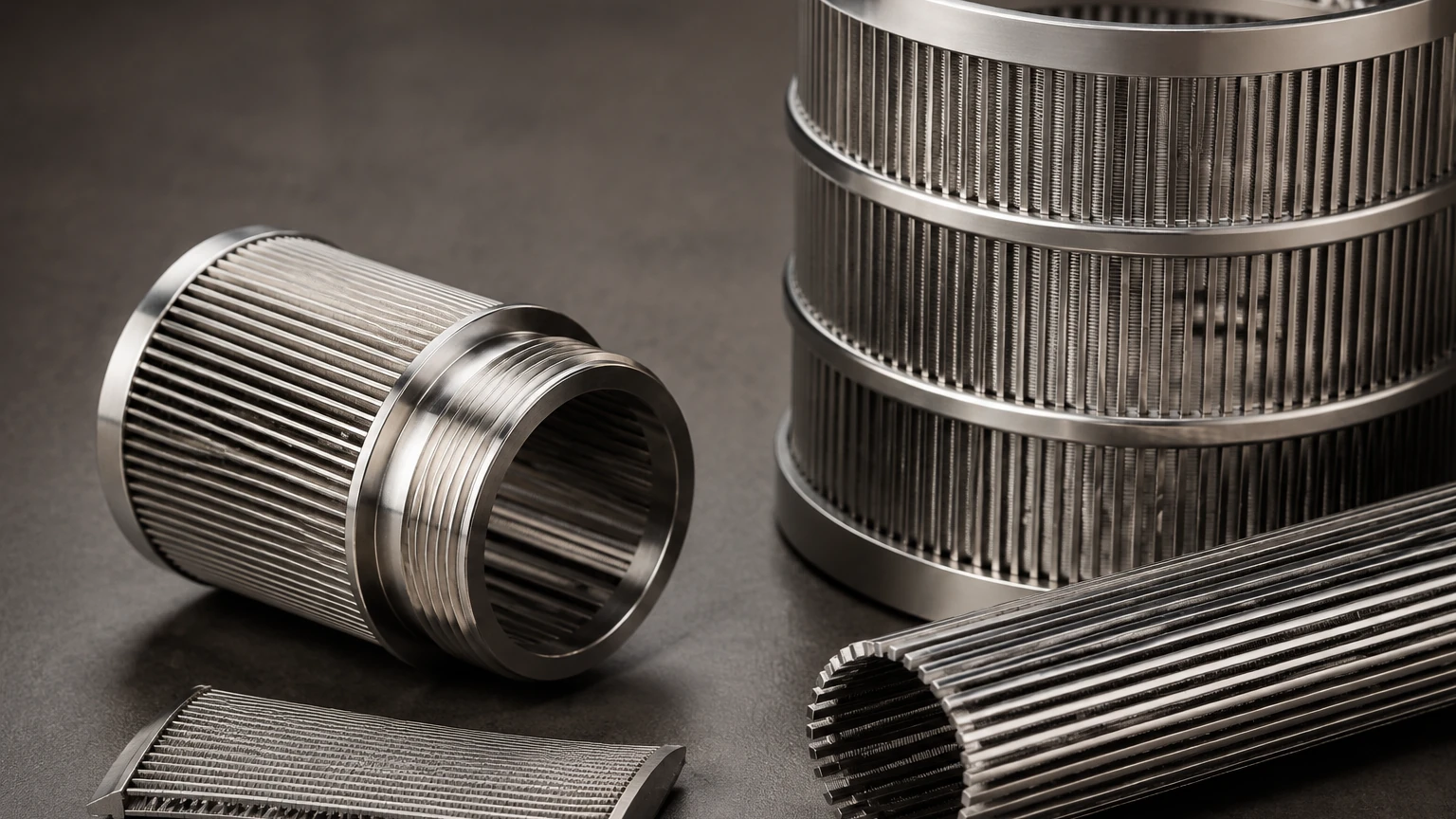
Common Configurations and Geometries
One of the reasons wedge wire is so prevalent in B2B industrial sectors is its versatility in form. It is not limited to flat panels; it can be fabricated into various geometries to suit specific machinery:
* Cylindrical Filter Cartridges: Used in pressurized liquid filtration and water treatment. These can be designed with reinforced end fittings, flanges, or threaded connections.
* Flat Panels: Commonly found in vibrating screens for mining or architectural grates.
* Sieve Bends (DSM Screens): Curved screens used for dewatering and sizing in the coal, mineral, and food industries. The curvature utilizes centrifugal force to enhance separation efficiency.
* Support Grates: Large-diameter wedge wire discs used in chemical reactors to support catalyst beds while allowing gas or liquid to pass through with minimal resistance.
Industrial Applications Across Sectors
Understanding what is a wedge wire screen also involves recognizing its ubiquity across diverse industries. Its unique properties solve specific engineering challenges in the following fields:
Food and Beverage Processing
In sugar refining, starch production, and brewery mash tuns, wedge wire provides a sanitary, easy-to-clean surface that meets strict hygiene standards. The smooth surface prevents bacterial buildup and allows for efficient Clean-in-Place (CIP) procedures.
Water Treatment and Intake
Wedge wire is the industry standard for well screens and intake screens in rivers or oceans. Its high open area allows for low-velocity intake, which protects aquatic life (fish diversion) while preventing debris from entering pumps and treatment systems.
Chemical and Petrochemical
In these sectors, wedge wire is used for resin traps, catalyst baskets, and center pipes in reactors. The ability to withstand high temperatures and corrosive fluids while maintaining precise slot integrity is vital for process safety and efficiency.
Pulp and Paper
Screening and cleaning fiber suspensions require a media that can handle high volumes and resist wear from abrasive particles. Wedge wire’s durability makes it ideal for pressure screens and dewatering presses in paper mills.
Maintenance, Cleaning, and Longevity
Compared to polymer-based filters or thin wire cloths, wedge wire screens offer a much longer service life. Because the structure is metallic and welded, it can be cleaned repeatedly using aggressive methods that would destroy other media.
Backwashing: In automated systems, a reverse flow of fluid can dislodge accumulated solids. The widening slot of the wedge wire ensures that these solids are released instantly.
Mechanical Cleaning: Scrapers or brushes can be used on the smooth surface of the profile wires without the risk of tearing the media.
Ultrasonic Cleaning: For fine-micron applications, ultrasonic baths can remove sub-visible particles from the slots, restoring the screen to its original flow capacity.
When evaluating the total cost of ownership, the initial investment in a high-quality stainless steel wedge wire screen is often offset by the reduction in downtime, the elimination of frequent filter replacements, and the lower energy costs associated with a lower pressure drop.
Conclusion: Confirming Requirements for Custom Solutions
Determining what is a wedge wire screen for your specific application requires more than just a general understanding of the technology. It requires a partnership with a manufacturer that understands the nuances of metallurgy and fluid dynamics. Before finalizing a purchase, technical teams should confirm the exact fluid composition, operating temperature, maximum pressure, and the specific solids being targeted for removal.
At Kaifil, we specialize in translating these technical requirements into high-performance filtration components. Whether you need a standard cylindrical cartridge or a highly customized lateral assembly, our engineering team is equipped to provide the necessary support. For more information on our full range of stainless steel filtration products and OEM capabilities, please visit our Main Page to explore how we can optimize your industrial processes.
