


What Is Oil Filtration
In industrial engineering and maintenance, the question of what is oil filtration extends far beyond simple debris removal. It is a critical process of fluid conditioning designed to maintain the physical and chemical properties of lubricating, hydraulic, and process oils. By systematically removing insoluble contaminants—such as metal wear particles, silica, carbon soot, and environmental ingress—oil filtration ensures the longevity of precision components and the stability of industrial operations.
For engineers and procurement professionals, understanding the technical nuances of oil filtration is essential for optimizing system reliability and reducing the total cost of ownership (TCO). This guide explores the mechanical principles, media selection criteria, and performance metrics that define effective oil filtration in demanding B2B environments.
The Fundamental Mechanics of Oil Filtration
To define what is oil filtration from a mechanical perspective, one must look at the interaction between the fluid medium and the filter element. The primary goal is to interrupt the cycle of wear by capturing particles that are equal to or smaller than the dynamic clearances between moving parts, such as those found in hydraulic valves, bearings, and gear sets.
Filtration typically occurs through several distinct mechanisms:
1. Direct Interception (Sieving): This occurs when a particle is larger than the pore size of the filter media. The particle is physically blocked at the surface. This is the primary mechanism for stainless steel wire mesh filters.
2. Inertial Impaction: As oil flows through a tortuous path in depth media, heavier particles cannot follow the fluid streamlines and instead strike the filter fibers, where they are trapped.
3. Adsorption: Molecular attraction (Van der Waals forces) causes fine particles to adhere to the surface of the filter media even if they are smaller than the physical pores.
4. Diffusion (Brownian Movement): Extremely small particles move erratically within the fluid stream, eventually making contact with and sticking to the filter media fibers.
In high-pressure industrial systems, the choice of mechanism often dictates the structure of the filter element. For instance, surface filtration using precision metal mesh is preferred when consistent pore size and reusability are prioritized, whereas depth filtration is often used for high dirt-holding capacity in single-use applications.
Why Oil Filtration is Critical for Industrial Equipment
Understanding what is oil filtration also requires an appreciation of the consequences of filtration failure. Contamination is the leading cause of hydraulic and lubrication system failures. Without effective filtration, a "chain reaction of wear" occurs: initial wear particles act as abrasives, generating more particles, which further accelerate component degradation.
Protection of Precision Clearances
Modern industrial machinery operates with extremely tight tolerances. In high-pressure hydraulic systems, clearances can be as small as 1 to 5 microns. If the filtration system cannot capture particles in this size range, the particles will enter the clearances, causing silt-lock in valves and scoring on cylinder walls.
Extension of Fluid Life
Oil does not "wear out" in the traditional sense; rather, it becomes contaminated or its additive package becomes depleted. Effective filtration removes the catalysts for oxidation, such as fine metal fines (copper and iron), which can significantly extend the interval between oil changes. This reduces both fluid procurement costs and environmental disposal fees.
Thermal Stability and Efficiency
Contaminated oil can lead to increased friction, which generates excess heat. High operating temperatures accelerate the breakdown of the oil's viscosity index and can lead to the formation of varnish and sludge. By maintaining fluid cleanliness, filtration indirectly supports the thermal efficiency of the entire system.
Evaluating Filter Media: The Case for Stainless Steel
When addressing what is oil filtration in harsh environments—such as chemical processing or high-temperature manufacturing—the material of the filter element becomes the deciding factor in performance. While cellulose and synthetic fibers are common, stainless steel filtration solutions offer distinct engineering advantages.
Durability and Pressure Resistance
Stainless steel wire mesh and sintered metal cartridges can withstand significantly higher differential pressures (ΔP) compared to disposable media. This is crucial in hydraulic systems where cold starts or pressure surges can cause non-metallic filters to collapse or bypass, leading to catastrophic downstream contamination.
Chemical and Thermal Compatibility
In industries like pharmaceutical or food and beverage processing, the oil used may be specialized or subjected to extreme temperatures. Stainless steel (typically 304 or 316L) is inert to most industrial lubricants and can operate at temperatures exceeding 500°F (260°C), where organic fibers would carbonize or melt.
Cleanability and Sustainability
One of the most significant B2B considerations is the shift toward reusable components. Stainless steel filters can be cleaned via ultrasonic baths, backflushing, or chemical cleaning and returned to service. This eliminates the recurring cost of replacement elements and reduces the waste stream associated with used oil filters.
Key Performance Metrics for Engineers
To accurately specify an oil filtration solution, engineers must look past generic labels and evaluate specific performance data. When reviewing product options on the Main Page, the following metrics are paramount:
Micron Rating: Absolute vs. Nominal
A nominal rating refers to a filter's ability to retain a major weight percentage of a certain size of particles (e.g., 90% of 10-micron particles). However, in critical applications, an absolute rating is required. An absolute rating indicates the diameter of the largest hard spherical particle that will pass through the filter under specified test conditions. For precision metal mesh, the absolute rating is a function of the weave geometry.
Beta Ratio (β)
The Beta Ratio is a measure of filtration efficiency derived from multi-pass testing (ISO 16889). It is the ratio of the number of particles of a given size upstream of the filter to the number of particles of the same size downstream. For example, a β10 = 200 means that for every 200 particles of 10 microns entering the filter, only one passes through (99.5% efficiency).
Dirt-Holding Capacity (DHC)
DHC defines the total amount of contaminant a filter can retain before reaching a terminal differential pressure. A higher DHC means longer service intervals. While stainless steel surface filters may have lower initial DHC than thick depth filters, their ability to be cleaned and reused often provides a better long-term value proposition.
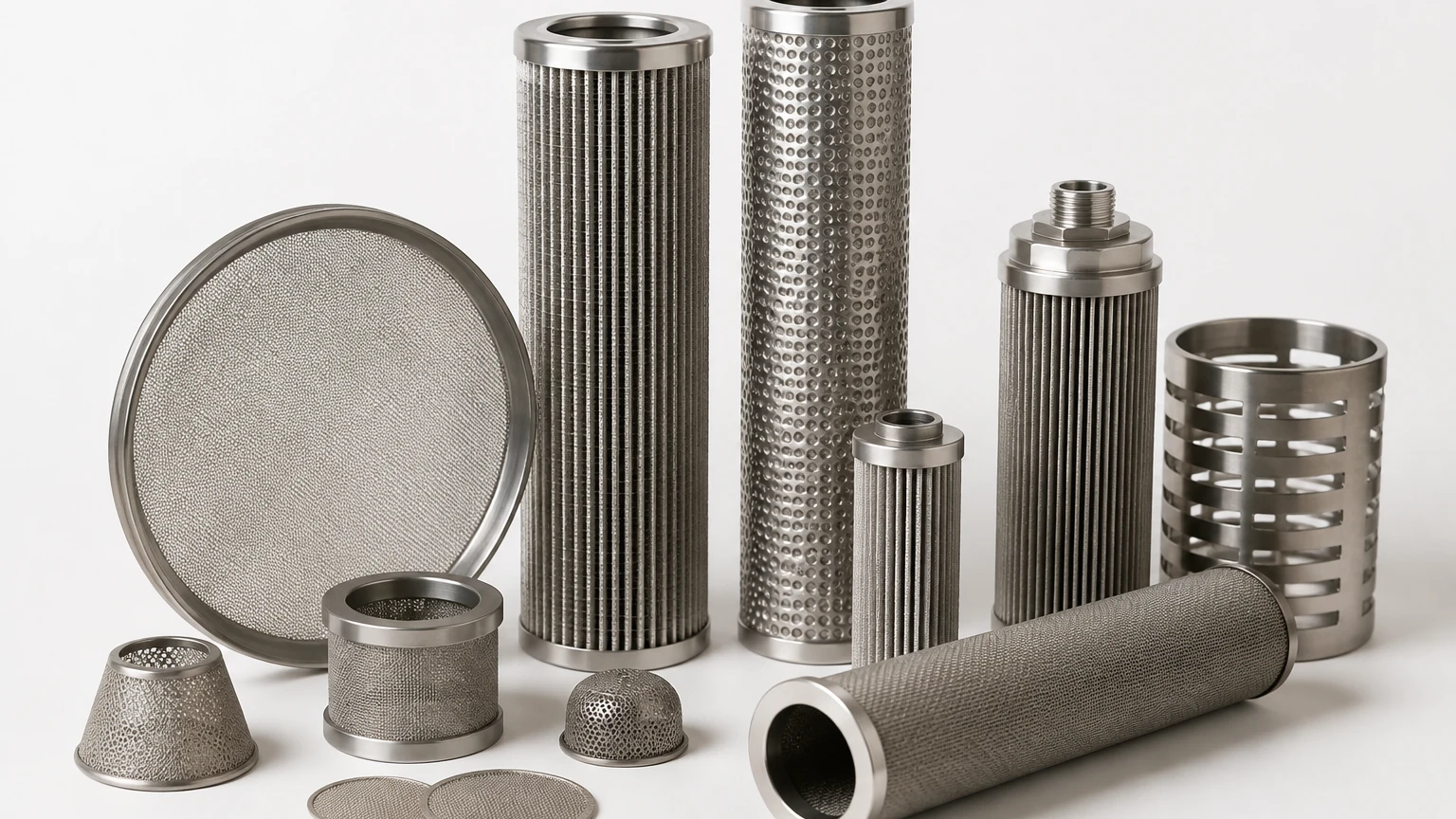
Selection Criteria for Industrial Oil Filtration Systems
Selecting the right filtration system requires a comprehensive analysis of the operating environment. Engineers should confirm the following variables before finalizing a design:
* Fluid Viscosity: High-viscosity oils (like gear oils) require larger filter surface areas or coarser mesh to prevent excessive pressure drop, especially in cold-weather starts.
* Flow Rate: The filter housing and element must be sized to handle the maximum system flow without exceeding the recommended initial clean pressure drop (typically 2-5 psi for suction lines and 5-10 psi for pressure lines).
* Operating Pressure: High-pressure lines require robust housings and reinforced filter elements to prevent structural failure.
* Contaminant Type: Is the contamination primarily hard particulate (wear metals), soft particulate (varnish), or environmental (dust/water)? This dictates whether a standard mesh or a specialized sintered media is appropriate.
Maintenance and Monitoring: Beyond the Filter
Defining what is oil filtration must also include the monitoring of the process. A filter is only effective if it is serviced before it goes into bypass mode. Most industrial filter housings are equipped with differential pressure indicators (visual or electrical). These devices alert maintenance teams when the element is loaded with contaminants and needs cleaning or replacement.
Furthermore, oil analysis programs should be used in conjunction with filtration. Regular sampling of the oil (upstream and downstream of the filter) provides data on the ISO Cleanliness Level (ISO 4406) and helps identify if a specific component is wearing prematurely, allowing for predictive maintenance rather than reactive repairs.
Conclusion
Oil filtration is a sophisticated engineering discipline that serves as the primary defense mechanism for industrial machinery. By understanding the mechanical principles of particle capture, the technical advantages of materials like stainless steel, and the critical importance of micron ratings and Beta ratios, professionals can make informed decisions that enhance system uptime.
For those seeking customized filtration components tailored to specific industrial requirements, exploring professional manufacturing capabilities is the next logical step. High-performance stainless steel cartridges and precision wire mesh filters provide the durability and accuracy needed for the most demanding applications. To learn more about customized filtration components and technical specifications, visit the Main Page for comprehensive product information and application support.
