


What Size Filter for My Pool
In the context of commercial aquatic facilities, industrial water features, and large-scale public swimming pools, the question of "what size filter for my pool" shifts from a simple residential concern to a complex engineering requirement. Selecting the correct filtration system is not merely about keeping water clear; it is about ensuring hydraulic efficiency, meeting health and safety regulations, and minimizing the total cost of ownership through durable material selection. For engineers and facility managers, the sizing process involves precise calculations of flow rates, turnover times, and the physical properties of the filtration media.
At Kaifil, we specialize in high-performance stainless steel filtration solutions designed to withstand the demanding environments of industrial water treatment. When determining the appropriate scale for a filtration system, technical professionals must look beyond nominal ratings and evaluate the specific hydraulic demands of the application.
Understanding Turnover Rates and Flow Requirements
The foundation of determining what size filter for my pool lies in the turnover rate. In a commercial or industrial setting, the turnover rate is the period of time required to circulate the entire volume of the pool through the filtration system. Regulatory standards often dictate these rates based on the pool type—for instance, public swimming pools may require a 6-hour turnover, while high-occupancy wading pools might require a turnover every 1 to 2 hours.
To calculate the required flow rate in Gallons Per Minute (GPM), use the following formula:
Flow Rate (GPM) = Pool Volume (Gallons) / (Turnover Rate (Hours) × 60)
For example, a 100,000-gallon commercial pool requiring a 6-hour turnover would need a flow rate of approximately 277 GPM. This flow rate is the primary metric used to size the filter housing and the internal filtration elements. If the filter is undersized for this flow, the velocity of the water passing through the media will be too high, leading to "channeling" in sand filters or premature bypass and structural failure in cartridge systems.
Calculating the Required Filtration Area
Once the flow rate is established, the next step in answering what size filter for my pool is determining the required filtration surface area. Different types of media have different "flux rates" (the amount of water that can safely pass through one square foot of filter area per minute).
1. High-Rate Sand Filters: Typically operate at 15–20 GPM per square foot.
2. Diatomaceous Earth (DE): Usually rated at 1.5–2 GPM per square foot.
3. Cartridge Filters: Generally rated between 0.375 and 1 GPM per square foot, depending on the pleated media density.
For industrial-grade stainless steel wire mesh filters, the effective filtration area is calculated based on the open area of the mesh. Stainless steel elements offer a distinct advantage because they can handle higher differential pressures and flow velocities than synthetic fabrics. When engineering a custom solution, Kaifil evaluates the particle load and the desired micron rating to ensure the surface area is sufficient to prevent rapid blinding (clogging) of the mesh.
Material Considerations: The Case for Stainless Steel
When evaluating what size filter for my pool, material durability is as critical as physical dimensions. Most residential filters utilize fiberglass or plastic housings. However, in industrial and high-traffic commercial applications, these materials often fail due to UV degradation, chemical embrittlement from high chlorine levels, or mechanical stress from pressure surges.
Stainless steel (specifically Grades 304 and 316L) is the gold standard for industrial filtration. It provides superior resistance to corrosion and can be manufactured to precise tolerances. A stainless steel filter cartridge or wire mesh element maintains its structural integrity under high-pressure backwashing cycles, which is a common requirement in large-scale systems. Furthermore, stainless steel components allow for a more compact filter footprint. Because the material is stronger, housings can be designed to handle higher internal pressures, allowing for more efficient flow through a smaller physical unit compared to bulky plastic alternatives.
For those seeking technical specifications on high-durability filtration components, you can Review product options and application support on our Main Page to see how custom metal filters integrate into large-scale water systems.
Engineering Factors: Pressure Drop and Pump Compatibility
A common mistake in sizing is ignoring the "Clean Pressure Drop" (ΔP). Every filter introduces resistance into the hydraulic circuit. As the filter collects debris, this resistance increases. If you are asking what size filter for my pool, you must also ask if your pump can handle the Total Dynamic Head (TDH) of the system.
An undersized filter will reach its maximum pressure drop much faster, requiring frequent cleaning or backwashing. In a B2B context, this translates to increased labor costs and system downtime. By oversized the filtration area—often referred to as "safety factor sizing"—engineers can significantly extend the time between maintenance cycles. For instance, increasing the filtration area by 20% beyond the calculated minimum can sometimes double the cycle time between cleanings, drastically reducing the operational cost over the life of the facility.
Selecting the Right Filtration Micron Rating
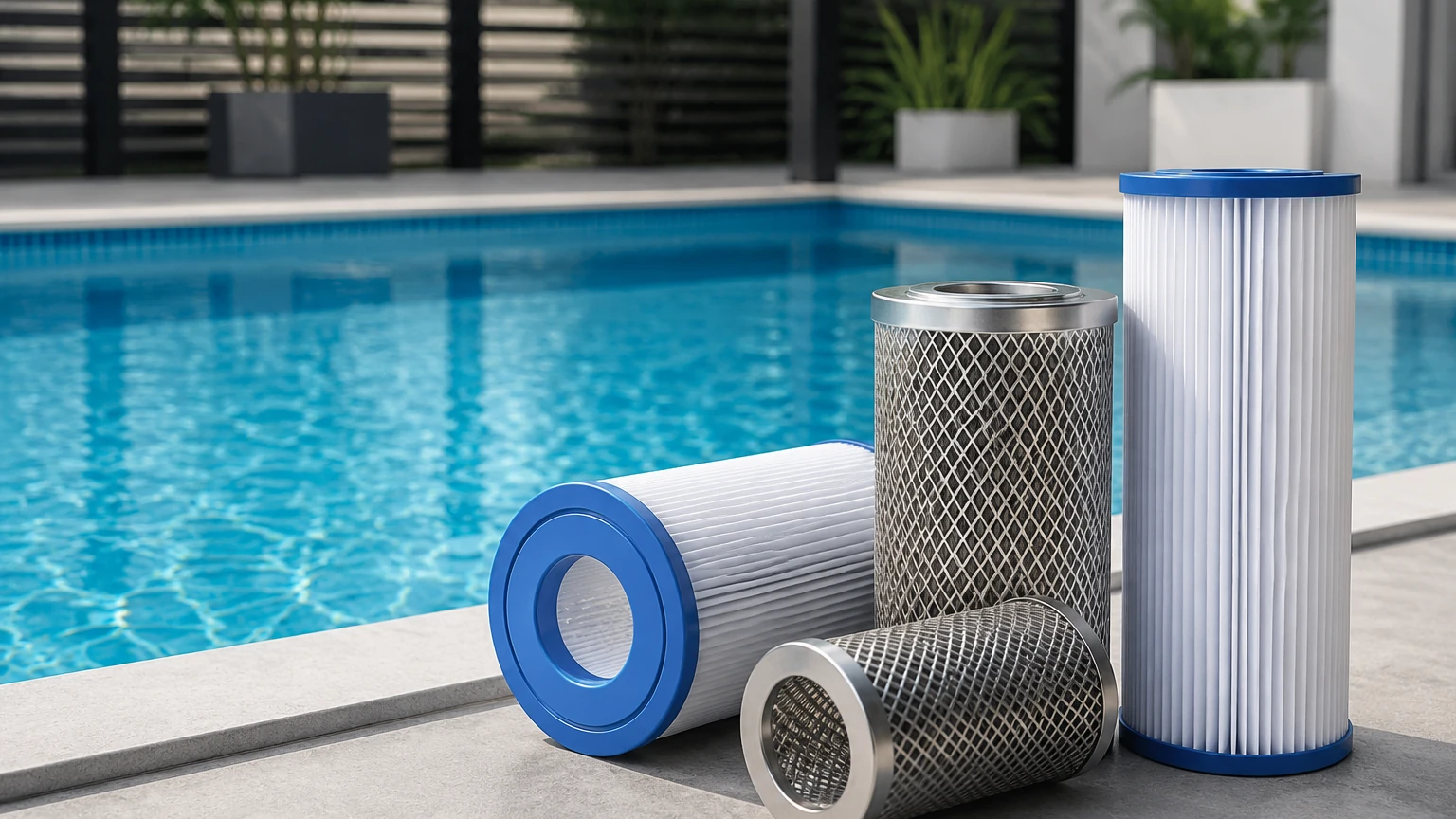
The "size" of a filter also refers to the size of the particles it can remove, measured in microns. Standard sand filters typically remove particles down to 20–40 microns. Cartridge filters can reach 10–15 microns, and DE filters can go as low as 1–5 microns.
In industrial water loops or high-end aquatic displays, a specific micron rating is often required to protect downstream equipment or ensure extreme water clarity. Stainless steel wire mesh filters provide absolute filtration ratings, meaning they are manufactured with precise pore sizes that do not stretch or bypass under pressure. This precision is vital when the pool water is part of a larger industrial process or when chemical treatment efficiency depends on the removal of specific organic loads.
When determining what size filter for my pool in terms of micron rating, consider the following:
* Source Water Quality: High turbidity requires staged filtration (coarse mesh followed by fine mesh).
* Bather Load: High organic loading requires finer filtration to reduce the demand on chemical disinfectants.
* System Protection: If the water feeds into a heat exchanger or UV sterilizer, a finer micron rating is necessary to prevent fouling of those components.
Maintenance and Longevity in Commercial Applications
The total cost of ownership (TCO) is a major factor for purchasing teams. A filter that is perfectly sized for flow but made of inferior materials will require frequent replacement of internal elements. Synthetic cartridges often need to be replaced every 1–2 years in commercial settings. In contrast, a custom-engineered stainless steel filter element can last for a decade or more if maintained correctly.
When sizing the system, consider the ease of access for maintenance. Large-scale filters should feature quick-opening mechanisms and modular internal components. This allows a single technician to perform inspections or cleaning without specialized heavy lifting equipment. At Kaifil, our design philosophy emphasizes the use of precision metal components that are easy to clean and chemically resistant, ensuring that the "size" of the filter remains an asset to the system's efficiency rather than a maintenance bottleneck.
Summary of Selection Criteria
To accurately answer what size filter for my pool in a professional capacity, follow this checklist:
1. Confirm Total Volume: Include surge tanks and piping volume for a complete calculation.
2. Determine Required Turnover: Refer to local health codes or process requirements.
3. Calculate GPM: Use the volume and turnover time.
4. Select Media Type: Balance filtration fineness with maintenance capabilities.
5. Apply Flux Rate: Divide GPM by the media's flux rate to find the minimum square footage.
6. Account for Pressure Drop: Ensure the pump curve aligns with the filter's resistance.
7. Choose Durable Materials: Opt for stainless steel in high-demand or corrosive environments.
By following these engineering principles, you ensure that the filtration system is not only sized correctly for today's needs but is also robust enough to handle the operational stresses of the future. For more information on custom filtration engineering and stainless steel components, visit our Main Page to explore our full range of industrial solutions.
