


Witch Hat Strainer
In industrial piping systems, the integrity of downstream equipment—such as pumps, valves, meters, and heat exchangers—is paramount to operational efficiency and safety. During the initial commissioning and startup phases of a plant, or following significant maintenance, pipelines often contain construction debris, welding slag, scale, and other particulate matter. The witch hat strainer, technically referred to as a conical strainer, serves as a critical temporary filtration solution designed to capture these contaminants before they can cause mechanical damage.
As a specialized manufacturer of stainless steel filtration components, Kaifil provides precision-engineered conical strainers that meet the rigorous demands of chemical processing, oil and gas, and water treatment sectors. Understanding the technical specifications, material properties, and hydraulic performance of these components is essential for engineers and procurement teams tasked with protecting high-value industrial assets.
Engineering Fundamentals of Witch Hat Strainers
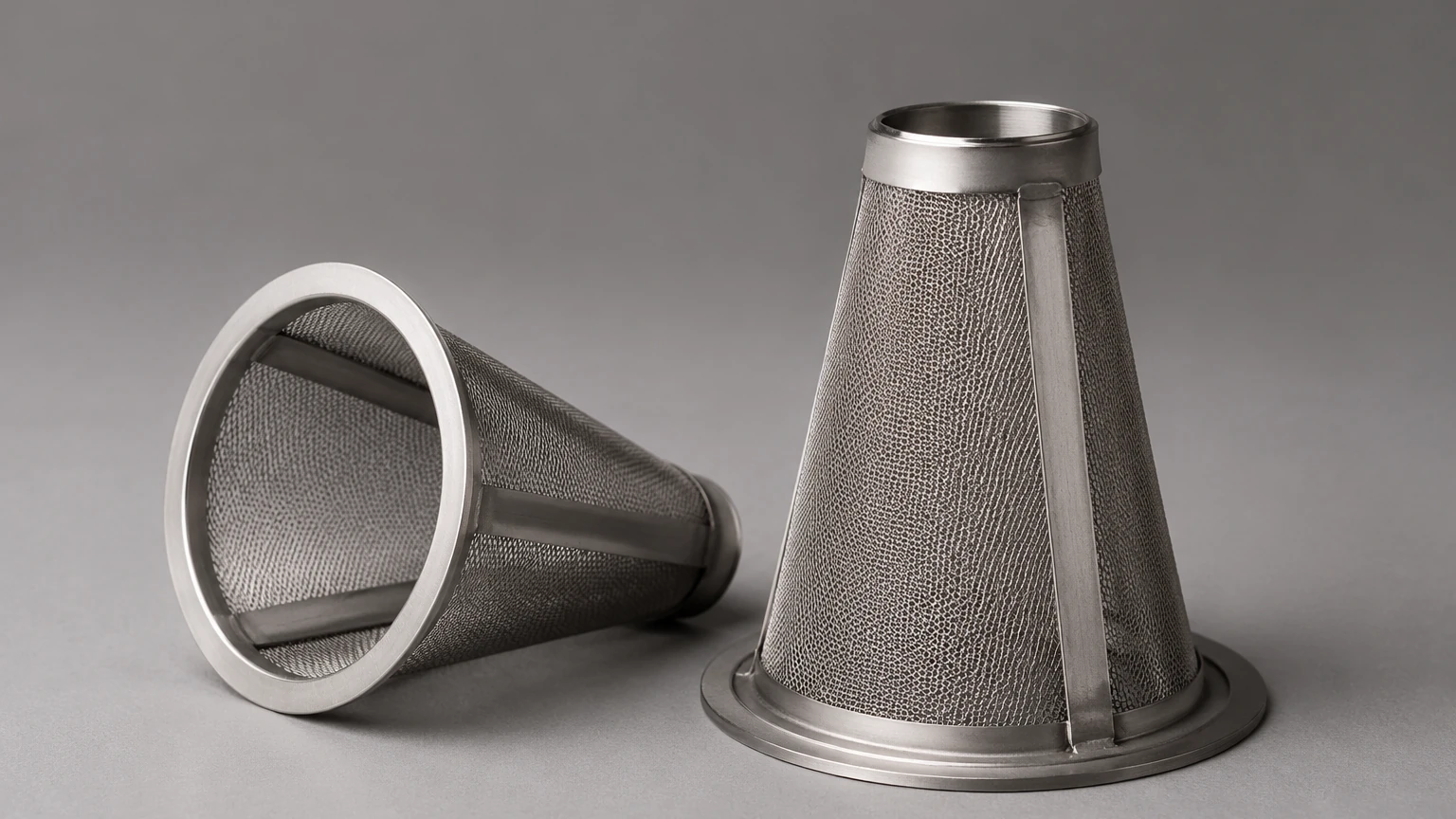
A witch hat strainer is a cone-shaped filtration element typically installed between two pipe flanges. Its name is derived from its distinct conical geometry, which provides a significantly larger surface area compared to a simple flat plate or disc strainer. This increased surface area is vital for maintaining low pressure drops while handling high volumes of debris during the "flush-out" phase of a piping system.
Geometric Configurations
There are two primary geometric variations used in industrial applications:
1. Long Cone Strainers: These offer the highest surface area and the lowest pressure drop. They are preferred when the piping layout allows for a longer axial footprint and when high levels of particulate are expected.
2. Short Cone Strainers: Also known as truncated cones or "pancake" strainers in some contexts, these are designed for installations where space between flanges or downstream clearance is limited. While they have a higher pressure drop than long cones, they still provide superior protection compared to flat strainers.
Temporary vs. Permanent Use
While witch hat strainers are primarily classified as "temporary strainers" for use during system startup, they are often constructed with the same high-grade materials as permanent filtration units. In some low-flow or non-critical applications, they may remain in place for extended periods, though standard practice dictates their removal once the system has reached a steady state of cleanliness. For more information on permanent filtration options, you can visit the Main Page to explore comprehensive industrial solutions.
Material Selection and Structural Integrity
The performance of a witch hat strainer is heavily dependent on the materials used in its construction. Because these strainers are often subjected to high-velocity flows and abrasive debris, material selection must account for both chemical compatibility and mechanical strength.
Stainless Steel Alloys
Stainless steel is the industry standard for conical strainers due to its corrosion resistance and structural stability.
* SS304: Suitable for general-purpose applications, including water treatment and mild chemical environments.
* SS316/316L: Preferred for pharmaceutical, food and beverage, and marine applications where resistance to pitting and chloride-induced corrosion is required.
* Specialty Alloys: For highly corrosive environments, such as those found in chemical processing plants handling concentrated acids, materials like Monel, Hastelloy, or Duplex stainless steel may be specified.
Reinforcement Techniques
In high-pressure systems, a single layer of wire mesh may lack the structural rigidity to withstand the differential pressure (Delta P) caused by debris accumulation. To prevent the cone from collapsing or "telescoping," manufacturers like Kaifil utilize a multi-layered construction. This typically involves a heavy-duty perforated metal backing that provides the structural skeleton, lined with a fine wire mesh that determines the filtration accuracy. The perforated plate ensures the strainer maintains its shape under hydraulic load, while the mesh captures fine particles.
Calculating Filtration Performance and Open Area
One of the most critical metrics in selecting a witch hat strainer is the "Open Area Ratio." This ratio compares the total open area of the holes in the strainer to the cross-sectional area of the inlet pipe.
Open Area Ratios
* 100% Open Area: The open area of the strainer equals the area of the pipe. This is rarely sufficient for industrial use as it leads to immediate pressure drops upon the slightest accumulation of debris.
* 150% to 200% Open Area: This is the standard for most temporary startup applications. It provides a safety margin, allowing the system to operate efficiently even as the strainer begins to fill.
* 300% Open Area and Above: Specified for high-viscosity fluids or systems where the interval between cleaning cycles must be maximized.
Pressure Drop (Delta P) Considerations
Engineers must calculate the clean pressure drop to ensure the pump head is sufficient to overcome the resistance of the strainer. As the witch hat strainer captures debris, the effective open area decreases, and the differential pressure increases. If the Delta P exceeds the design limit of the strainer, the mesh may rupture or the entire cone could be pushed downstream into the equipment it was meant to protect. Monitoring differential pressure across the flange connection is a best practice during the commissioning phase.
Application Scenarios and Industry Use Cases
The versatility of the witch hat strainer makes it a staple in various heavy industries. Each sector has unique requirements regarding filtration precision and material hygiene.
Oil and Gas Commissioning
In the oil and gas sector, pipelines are often miles long and can contain significant amounts of mill scale and sand. Witch hat strainers are installed upstream of compressors and turbines during the initial run-in. Here, the strainers must be robust enough to handle high-pressure gas or liquid flows without vibrating or failing.
Chemical and Petrochemical Processing
Chemical plants require precise material compatibility. A witch hat strainer used in a caustic line must be made of materials that will not leach or corrode. Furthermore, in these environments, the strainers are often used to protect expensive control valves that are sensitive to even small particulates.
Food, Beverage, and Pharmaceuticals
In sanitary applications, the design of the witch hat strainer must minimize "dead zones" where bacteria could proliferate. While typically temporary, these strainers are often manufactured from SS316L with polished surfaces to meet hygiene standards. They are used to ensure that any debris from new stainless steel piping installations does not enter the production batch.
Installation and Maintenance Best Practices
Proper installation is as important as the design of the strainer itself. Incorrectly installed strainers can lead to leaks, bypassed filtration, or mechanical failure.
Orientation and Flow Direction
The orientation of the cone is a frequent point of discussion among piping engineers.
* Flow into the Cone (Tip Pointing Downstream): This is the most common orientation. Debris is collected inside the cone, making it easier to remove the solids when the strainer is pulled from the line.
* Flow against the Cone (Tip Pointing Upstream): This orientation is sometimes used because it is structurally stronger; the pressure of the fluid pushes against the apex of the cone, which is the strongest point. However, debris accumulates around the outer base of the cone, which can make cleaning the pipe interior more difficult.
Flange Seating and Gaskets
Witch hat strainers feature a flat annular ring (the brim) that is sandwiched between two pipe flanges. It is essential to use appropriate gaskets on both sides of the strainer ring to ensure a leak-proof seal. The thickness of the strainer ring must be accounted for in the piping layout to ensure that bolt lengths and flange spacing are adequate.
Maintenance and Removal
Because these are often temporary components, they should be equipped with a "tail" or handle that extends beyond the flange outer diameter. This serves as a visual indicator to operators that a temporary strainer is currently in the line. Once the differential pressure stabilizes and the system is deemed clean, the strainer should be removed, cleaned, and stored, or replaced with a permanent filtration housing if required.
Customization and Selection Criteria for Procurement
When sourcing a witch hat strainer, providing the manufacturer with precise technical data is necessary to ensure the component performs as expected. Standard off-the-shelf strainers may not suffice for specialized industrial applications.
Key information to confirm before purchase includes:
* Pipe Size and Flange Rating: (e.g., 6-inch ANSI Class 300).
* Perforation and Mesh Requirements: The size of the smallest particle that must be captured (measured in microns or mesh count).
* Material Specification: Compatibility with the process fluid.
* Operating Conditions: Maximum temperature and pressure, as well as the expected flow rate.
* Length Constraints: Whether a long cone or short cone is required based on the available piping geometry.
Kaifil specializes in the custom fabrication of these components, allowing for tailored open area ratios and reinforced designs that meet specific engineering standards. By focusing on precision manufacturing, Kaifil ensures that every witch hat strainer provides the reliable protection necessary for modern industrial infrastructure.
In conclusion, the witch hat strainer is an indispensable tool for the protection of industrial piping systems. While simple in concept, its design and material execution require a deep understanding of fluid dynamics and mechanical engineering. By selecting the correct configuration and material, and following rigorous installation protocols, engineers can significantly reduce the risk of equipment failure and ensure a smooth transition from construction to full-scale operation.
