


24 Gauge Perforated Sheet Metal
In industrial filtration and precision engineering, the selection of material thickness and perforation specifications is a critical factor in determining the performance, durability, and efficiency of a component. Among the various gauges used in the manufacture of filtration media and protective screens, 24 gauge perforated sheet metal occupies a unique position. It offers a balance between lightweight flexibility and sufficient structural integrity for fine-to-medium filtration applications.
For engineers and procurement professionals, understanding the technical nuances of this specific gauge—approximately 0.0239 inches or 0.607 mm thick—is essential when designing filter cartridges, strainers, or acoustic panels. This article examines the technical properties, engineering considerations, and industrial applications of 24 gauge perforated sheet metal within the broader context of Perforated & Expanded Metal solutions.
Technical Specifications of 24 Gauge Material
The term "gauge" refers to a standard measurement of thickness for sheet metal. For stainless steel, 24 gauge is standardized at 0.0239 inches. While this may seem thin compared to heavy-duty structural plates, in the world of precision filtration, it is a robust choice.
Material Composition
While 24 gauge perforated sheet metal can be produced from various alloys, industrial applications typically demand stainless steel due to its superior corrosion resistance and mechanical strength.
* Grade 304 Stainless Steel: The most common choice for general industrial use. it provides excellent formability and resistance to oxidation. It is widely used in food processing and standard water treatment.
* Grade 316 Stainless Steel: Preferred for more aggressive environments, such as chemical processing or marine applications. The addition of molybdenum enhances resistance to pitting and crevice corrosion in chloride-rich environments.
* Specialty Alloys: For high-temperature or highly corrosive environments, materials like Monel, Inconel, or Hastelloy may be perforated at a 24-gauge thickness, though these are often custom-ordered for specific OEM requirements.
Tolerances and Precision
When specifying 24 gauge perforated sheet metal, engineers must account for manufacturing tolerances. Standard commercial tolerances for thickness usually fall within +/- 0.002 to 0.003 inches. In precision filtration, flatness and the absence of burrs are critical, as any surface irregularity can disrupt flow patterns or damage secondary filter media, such as fine wire mesh or membranes.
Perforation Patterns and Engineering Impact
The performance of perforated metal is defined not just by the thickness of the sheet, but by the geometry and arrangement of the holes. The pattern chosen directly influences the mechanical strength of the sheet and its hydraulic characteristics.
Round Hole Perforations
Round holes are the most common and cost-effective pattern. They offer the best balance of open area and structural strength.
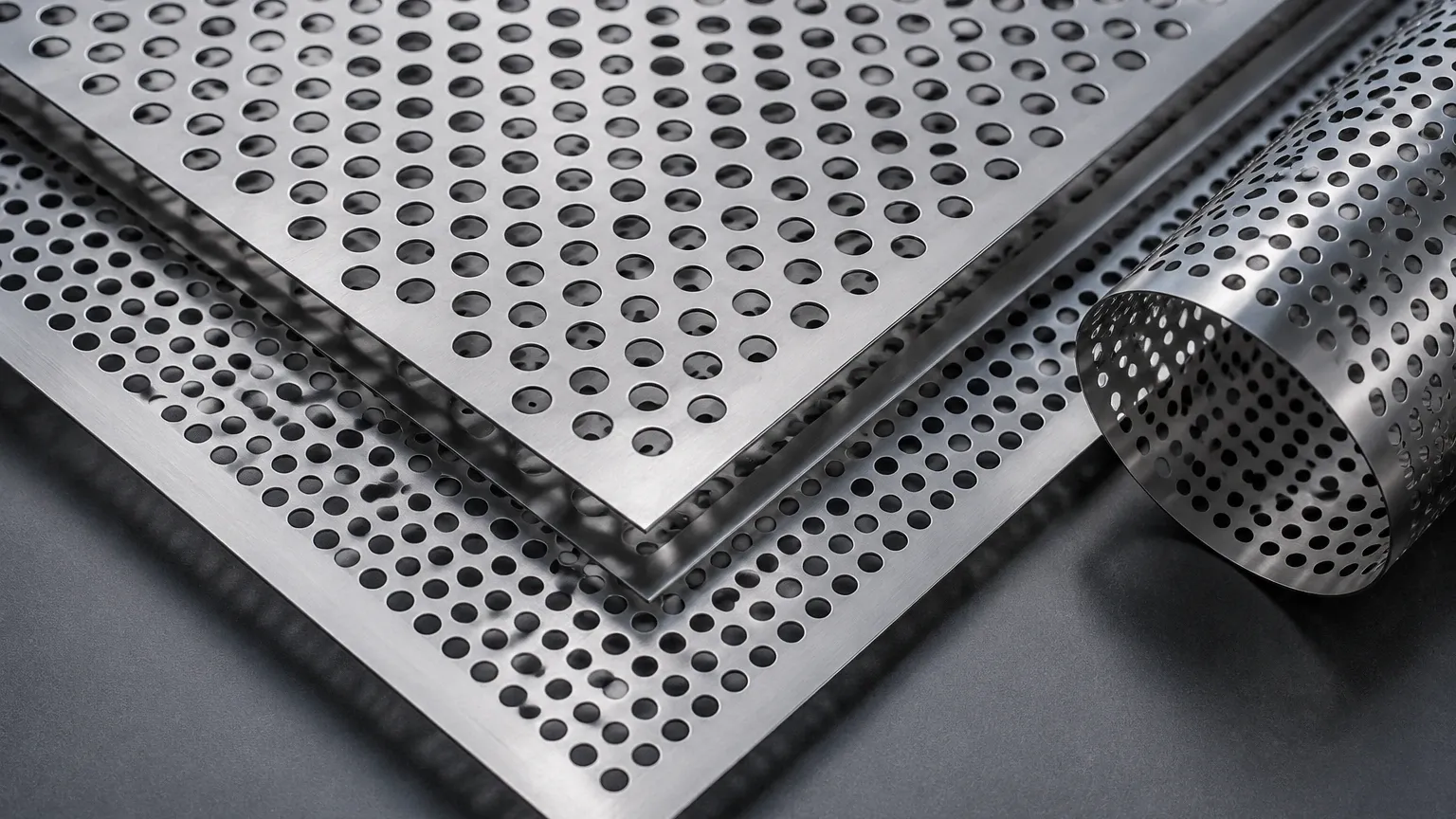
* 60-Degree Staggered: This is the industry standard. It provides the highest open area and uniform strength across the sheet. It ensures that the material can withstand pressure differentials without buckling.
* Straight Row: Holes are aligned in both vertical and horizontal rows. This is generally used for aesthetic applications or specific screening processes where a uniform path is required, though it offers less structural stability than staggered patterns.
Square and Slotted Holes
Square holes provide a higher open area than round holes of the same diameter, which can be beneficial for high-flow applications. However, they introduce stress concentration points at the corners, which may lead to fatigue over long-term vibration. Slotted holes are frequently used in sorting and sizing applications, particularly in the food and beverage industry where specific particle shapes must be retained or passed.
The Concept of "Open Area"
The open area is the percentage of the sheet that is comprised of holes. For 24 gauge perforated sheet metal, calculating the open area is vital for determining flow rate and pressure drop.
For a 60-degree staggered round hole pattern, the formula is:
Open Area % = (D² × 90.69) / P²
*(Where D = Hole Diameter and P = Center-to-Center Pitch)*
High open area (above 50%) increases flow but reduces the structural rigidity of the 24-gauge sheet. Conversely, a low open area provides a stronger support structure but increases the resistance to fluid or gas flow.
Role in Industrial Filtration Systems
In the filtration industry, 24 gauge perforated sheet metal is rarely used as a standalone primary filter for fine particles. Instead, it serves several critical roles in complex filtration assemblies.
Support Cores for Filter Cartridges
In high-pressure hydraulic or chemical filtration, fine wire mesh or pleated paper media lack the structural strength to resist collapse under pressure. 24 gauge perforated metal is often rolled into cylinders and welded to form an inner or outer support core. Its thickness is sufficient to provide the necessary hoop strength while remaining light enough to keep the overall cartridge weight manageable.
Pre-Filtration and Coarse Strainers
For applications involving the removal of large debris, such as in cooling water intakes or pump suction strainers, a 24-gauge perforated sheet with larger hole diameters (e.g., 1/8" or 1/4") acts as an effective first line of defense. It protects downstream equipment from damage caused by stones, wood chips, or large scale.
Diffusers and Flow Distributors
In chemical reactors and water treatment tanks, perforated sheets are used to break up concentrated flows and distribute fluids evenly across a larger surface area. The 24-gauge thickness allows for easy fabrication into conical or curved shapes to fit specific vessel geometries.
Fabrication and Customization Considerations
One of the primary advantages of 24 gauge perforated sheet metal is its workability. Because it is relatively thin, it can be fabricated using standard industrial techniques without the need for heavy-duty specialized machinery required for plate-grade materials.
Forming and Rolling
24-gauge material can be cold-formed into tight radii. This is essential for manufacturing small-diameter filter elements. When rolling perforated metal, engineers must consider the "margin"—the unperforated area along the edges of the sheet. Proper margins ensure that when the sheet is rolled into a cylinder, the longitudinal seam can be welded cleanly without interfering with the perforation pattern.
Welding Techniques
Welding thin-gauge perforated metal requires precision to avoid burn-through. TIG (Tungsten Inert Gas) welding is the preferred method for stainless steel 24-gauge sheets, as it provides a clean, strong bond with minimal heat-affected zones. Resistance spot welding is also commonly used for attaching perforated wraps to end caps in filter assembly.
Surface Finishing
Depending on the application, the perforated sheet may undergo additional processing:
* Degreasing: Essential for oxygen service or food-grade applications to remove lubricants used during the punching process.
* Electropolishing: Removes a thin layer of material to eliminate burrs and create a smooth, mirror-like finish that resists bacterial growth and improves corrosion resistance.
* Deburring: Mechanical or chemical processes to ensure the edges of the holes are smooth, preventing the trapping of fibers or particles.
Key Evaluation Criteria for Engineers
When selecting or ordering 24 gauge perforated sheet metal, technical professionals should confirm several parameters to ensure the product meets the application's demands:
1. Hole Size vs. Material Thickness: A general rule in perforating is that the hole diameter should not be smaller than the material thickness. For 24 gauge (0.0239"), hole diameters should ideally be 0.024" or larger to prevent excessive tool wear and ensure clean punches.
2. Pitch and Arrangement: Specify whether the stagger is "staggered in the flow" or "staggered across the flow," as this can impact the mechanical stress distribution.
3. Flatness Requirements: Punching holes into a sheet introduces internal stresses that can cause the material to curl or bow. If the application requires the sheet to be perfectly flat (e.g., for a vibrating screen), it must undergo a leveling process after perforation.
4. Edge Margins: Clearly define the width of the solid metal borders. "No margins" (perforations to the edge) may lead to incomplete holes at the boundary, which can be sharp and difficult to weld.
Common Risks and Mitigation
The most common risk associated with 24 gauge perforated sheet metal is structural failure due to improper open area calculation. If the holes are too large or too close together, the remaining "ligament" (the metal between the holes) may be too weak to support the pressure load. This leads to deformation or tearing.
Another risk is corrosion at the punch sites. The process of perforating exposes the internal grain structure of the metal. In highly corrosive environments, these edges can become focal points for rust if the material is not properly passivated or if the incorrect alloy grade was selected.
Conclusion
24 gauge perforated sheet metal is a versatile and essential component in the industrial filtration landscape. Its specific thickness allows for a high degree of customization and ease of fabrication while providing the necessary durability for support structures and coarse filtration tasks. By carefully considering hole patterns, open areas, and material grades, engineers can optimize their filtration systems for maximum throughput and longevity.
As a professional manufacturer, Kaifil specializes in providing high-performance Perforated & Expanded Metal solutions tailored to the rigorous demands of the chemical, pharmaceutical, and food processing industries. Whether you require standard sheets or custom-fabricated filter components, understanding these technical boundaries ensures a reliable and cost-effective solution for your filtration challenges.
