


9 Gauge Expanded Metal
In industrial engineering and heavy-duty filtration, the selection of structural support materials is critical to the longevity and efficiency of the system. 9 gauge expanded metal represents one of the more robust specifications used across chemical processing, water treatment, and industrial machinery. Characterized by its significant thickness and high strength-to-weight ratio, this material serves as a foundational component for engineers designing filtration housings, protective guards, and structural reinforcements.
Understanding the technical nuances of 9 gauge expanded metal is essential for technical professionals who must balance mechanical durability with specific flow requirements. This guide examines the engineering properties, manufacturing variations, and application-specific considerations for integrating this material into industrial environments.
Technical Specifications and Material Composition
The term "9 gauge" refers to the thickness of the base metal sheet before the expansion process. In the United States Standard Gauge for sheet steel, 9 gauge is approximately 0.1495 inches (3.8 mm) thick. When converted to expanded metal, this thickness provides a rigid, non-raveling structure that can withstand substantial mechanical stress without deforming.
Material Selection for Industrial Environments
For B2B applications, the choice of alloy is as important as the gauge itself. While carbon steel is common for general structural use, industrial filtration and chemical processing often require specialized alloys:
* Stainless Steel (304 and 316L): These are the primary choices for Kaifil’s filtration solutions. Stainless steel 9 gauge expanded metal offers superior corrosion resistance, which is vital in pharmaceutical and food and beverage sectors where hygiene and chemical stability are paramount. 316L is particularly favored for marine or high-chloride environments due to its resistance to pitting.
* Carbon Steel: Often used in hydraulic applications where the fluid is non-corrosive, providing a cost-effective solution for high-pressure support cores.
* Aluminum: Selected for applications requiring weight reduction without a total sacrifice of structural integrity, though it lacks the sheer tensile strength of steel variants.
Structural Variations: Standard vs. Flattened
When specifying Perforated & Expanded Metal for a project, engineers must choose between standard (raised) and flattened configurations. Each serves a distinct purpose in industrial design.
Standard (Raised) Expanded Metal
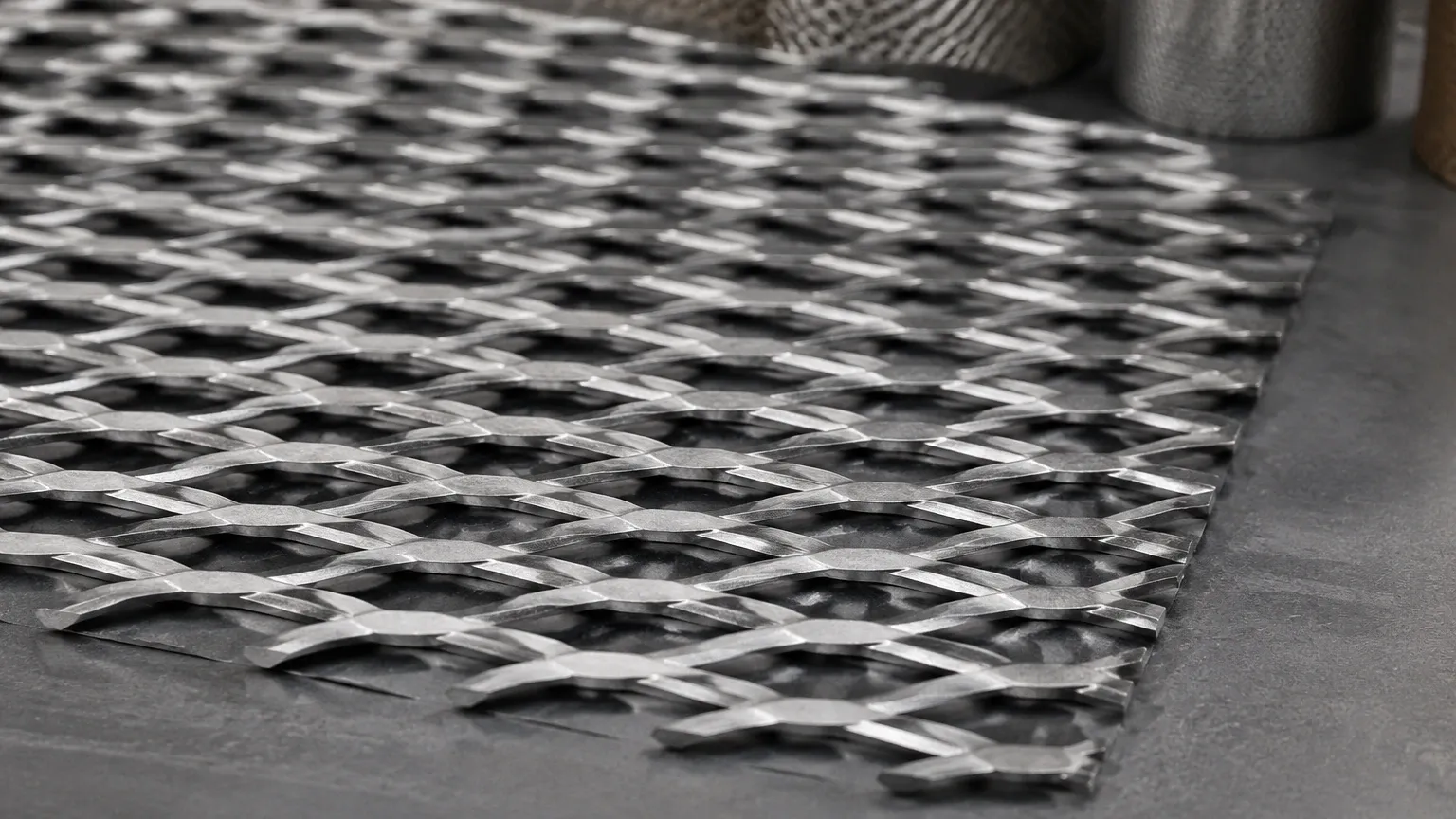
Standard 9 gauge expanded metal is the product as it comes off the expanding machine. The strands and bonds are set at a uniform angle to the plane of the sheet. This creates a three-dimensional surface that provides excellent grip and rigidity. In filtration, the raised profile can help create turbulence in fluid flow, which may be desirable in certain mixing or aeration processes. However, the raised edges can also increase the overall thickness of the component, which must be accounted for in housing clearances.
Flattened Expanded Metal
Flattened 9 gauge expanded metal is produced by passing the standard expanded sheet through a cold-roll reducing mill. This process flattens the strands and bonds into a single plane, reducing the overall thickness and creating a smooth surface. For engineers designing filter cartridges, flattened expanded metal is often preferred as a support layer for fine wire mesh. The smooth surface prevents the delicate mesh from being abraded or punctured by the sharp edges of raised strands under high differential pressure.
Engineering Metrics: SWD, LWD, and Open Area
To accurately specify 9 gauge expanded metal, engineers must use standardized dimensions that define the diamond-shaped openings. These metrics directly impact the flow rate and the size of particles the material can effectively support or deflect.
1. SWD (Short Way of Design): The distance from the center of one bond to the center of the next bond measured across the short diamond diagonal.
2. LWD (Long Way of Design): The distance from the center of one bond to the center of the next bond measured across the long diamond diagonal.
3. Strand Width: The amount of metal fed into the machine between the strokes of the upper and lower dies.
4. Percentage of Open Area: This is a critical calculation for filtration. It determines the pressure drop across the material. A 9 gauge expanded metal with a larger diamond pattern will have a higher open area, facilitating higher flow rates but providing less structural support for secondary filter media.
Role in Industrial Filtration Systems
Kaifil utilizes 9 gauge expanded metal primarily as a structural reinforcement component. In high-pressure hydraulic systems or large-scale water treatment facilities, fine wire mesh filters lack the inherent strength to resist collapsing under the force of the fluid stream.
Support Cores and Outer Protectors
In the construction of custom stainless steel filter cartridges, 9 gauge expanded metal is often rolled into cylinders to serve as the internal core. Its rigidity ensures that the filter maintains its shape even as the pressure drop increases due to particulate loading. Conversely, it can be used as an outer protective wrap to shield delicate pleated media from mechanical damage during installation or backwashing cycles.
Compatibility with Secondary Media
When used in conjunction with precision wire mesh, the 9 gauge structure must be free of burrs and sharp protrusions. High-quality manufacturing processes ensure that the expansion and flattening stages do not introduce structural weaknesses or surface defects that could compromise the integrity of the filtration system.
Evaluation Criteria for Procurement Teams
When sourcing 9 gauge expanded metal for industrial projects, purchasing teams and engineers should evaluate suppliers based on technical precision rather than just price. The following criteria are essential for ensuring the material meets industrial standards:
* Dimensional Tolerances: In precision engineering, even slight variations in SWD or LWD can interfere with the assembly of filter housings. Suppliers should provide clear tolerance specifications for both sheet size and diamond dimensions.
* Flatness and Camber: For large-scale panels, the flatness of the sheet is critical. Excessive camber (the curvature of the edge) can lead to misalignment during welding or framing.
* Material Certification: In industries like pharmaceuticals or food processing, material traceability is mandatory. Ensure the supplier provides Mill Test Reports (MTRs) confirming the chemical composition of the stainless steel or alloy used.
* Edge Configuration: Specify whether "random sheared" or "bond sheared" edges are required. Bond shearing provides a closed diamond edge, which is safer for handling and easier to weld into frames.
Common Risks and Engineering Pitfalls
Failure to account for the specific characteristics of 9 gauge expanded metal can lead to system failures or increased maintenance costs. One common risk is the "Blinding" or Clogging of the openings. While the expanded metal itself is rarely the primary filtration layer, if the diamond size is too small for the viscosity of the fluid, it can trap larger debris and cause a premature pressure spike.
Another consideration is Galvanic Corrosion. If a stainless steel 9 gauge expanded metal support is used in a system with carbon steel piping in the presence of an electrolyte, the resulting corrosion can lead to structural failure. Engineers must ensure that all components within the filtration assembly are metallurgically compatible or properly insulated.
Customization and OEM Capabilities
Every industrial application has unique requirements regarding flow velocity, pressure, and chemical exposure. Off-the-shelf expanded metal often fails to meet the exact needs of specialized filtration systems. This is where OEM customization becomes vital.
Customization options for 9 gauge expanded metal include:
* Specialized Diamond Shapes: Adjusting the SWD and LWD to optimize the balance between open area and mechanical strength.
* Custom Slitting and Shearing: Providing exact dimensions that eliminate the need for secondary cutting on the assembly line, reducing waste and labor costs.
* Surface Finishes: Options such as electro-polishing for stainless steel components to improve corrosion resistance and ease of cleaning in sanitary applications.
Conclusion: Making Informed Decisions
9 gauge expanded metal is a versatile and indispensable material in the world of industrial filtration and structural design. Its ability to provide immense strength while maintaining a high degree of open area makes it the preferred choice for support cores and protective layers in demanding environments.
Before proceeding with a purchase, engineers should confirm the exact material grade, the required open area for flow calculations, and whether a standard or flattened profile is best suited for the application. By focusing on these technical details and partnering with experienced manufacturers like Kaifil, organizations can ensure their filtration systems operate with maximum reliability and minimal total cost of ownership.
