


Aluminum Expanded Metal Mesh
Aluminum expanded metal mesh is a versatile industrial material produced through a precision slitting and stretching process. Unlike woven wire mesh or welded products, expanded metal is formed from a single solid sheet of aluminum, resulting in a continuous structure without joints, welds, or points of potential failure. This manufacturing method creates a diamond-shaped pattern that offers an exceptional strength-to-weight ratio, making it a preferred component in industrial filtration, structural support, and architectural applications.
For engineers and procurement professionals, understanding the technical nuances of aluminum expanded metal is critical for optimizing system performance and ensuring long-term durability. This guide examines the engineering characteristics, manufacturing variations, and selection criteria necessary for integrating this material into demanding industrial environments.
Engineering Characteristics of Aluminum Expanded Metal Mesh
The primary appeal of aluminum expanded metal mesh lies in its unique physical properties. Because the material is stretched rather than punched, there is virtually no waste during production, which contributes to its cost-effectiveness compared to other metal processing methods.
Strength and Structural Integrity
One of the most significant advantages of expanded metal is its structural continuity. The "bonds" (the intersections where the strands meet) are part of the original metal sheet. This allows the material to distribute loads evenly across the surface. In filtration applications, this rigidity prevents the mesh from sagging or deforming under high-pressure differentials, a common issue with lighter woven meshes.
Lightweight and Corrosion Resistance
Aluminum is approximately one-third the weight of steel or stainless steel. This weight reduction is vital in aerospace, automotive, and portable filtration systems where overall mass affects efficiency and operational costs. Furthermore, aluminum naturally forms a protective oxide layer that resists corrosion. In environments where moisture or mild chemicals are present, aluminum expanded metal mesh provides a durable solution without the need for expensive specialized coatings.
Conductivity and Shielding
Aluminum is an excellent conductor of both heat and electricity. Expanded mesh is frequently used in heat exchangers and as a substrate for EMI/RFI shielding. The open area of the mesh allows for airflow and heat dissipation while the continuous metal structure provides a reliable path for electrical grounding or interference blocking.
Manufacturing Variations: Raised vs. Flattened Mesh
When specifying aluminum expanded metal mesh, engineers must choose between two primary physical forms: raised (standard) and flattened.
Raised Expanded Metal
Raised expanded metal is the immediate product of the expanding machine. The strands and bonds are set at a uniform angle to the plane of the sheet. This creates a three-dimensional surface that provides excellent grip and directional airflow. In filtration, the angled strands can help deflect larger particles or create turbulence that improves the capture rate of certain contaminants. However, the raised profile increases the overall thickness of the material significantly beyond the original gauge of the sheet.
Flattened Expanded Metal
Flattened expanded metal is produced by passing the raised mesh through a cold-roll reducing mill. This process flattens the strands and bonds into a single plane, resulting in a smooth, flat surface. Flattening reduces the overall thickness and increases the width of the strands. This form is often preferred when the mesh serves as a support layer for fine wire cloth or when a low-profile component is required to fit within tight tolerances in a filter housing.
Technical Advantages in Industrial Filtration Systems
In the context of industrial filtration, aluminum expanded metal mesh serves several critical functions. It is rarely used as the primary fine-filtration media but is indispensable as a support or pre-filtration component.
1. Media Support and Pleat Spacing: In pleated filter cartridges, expanded metal provides the necessary rigidity to maintain pleat geometry. Without this support, the pleats could collapse under flow pressure, drastically reducing the effective filtration area and increasing pressure drop.
2. Pre-Filtration: For HVAC and large-scale air intake systems, multiple layers of aluminum expanded mesh act as a permanent, washable pre-filter. The staggered diamond patterns create a tortuous path for air, trapping large particulates, grease, or moisture droplets before they reach high-efficiency secondary filters.
3. Flow Distribution: The geometry of the mesh helps break up laminar flow into turbulent flow, which can be beneficial in certain chemical processing applications to ensure more uniform contact with catalyst beds or secondary filter media.
Material Selection: Choosing the Right Aluminum Alloy
Not all aluminum expanded metal is created equal. The choice of alloy dictates the mesh's performance in specific environments.
* Alloy 3003-H14: This is the most common grade for expanded metal. It is alloyed with manganese, providing excellent workability and moderate strength. It is highly resistant to atmospheric corrosion and is suitable for most general industrial and architectural uses.
* Alloy 5052-H32: For applications involving marine environments or exposure to salt spray, 5052 is the superior choice. It offers higher strength than 3003 and exceptional resistance to alkaline environments. It is frequently used in offshore filtration and cooling systems.
* Alloy 6061-T6: While less common in thin-gauge expanded mesh, 6061 is used when maximum structural strength is required. It is heat-treatable and offers the highest mechanical properties among the common aluminum alloys.
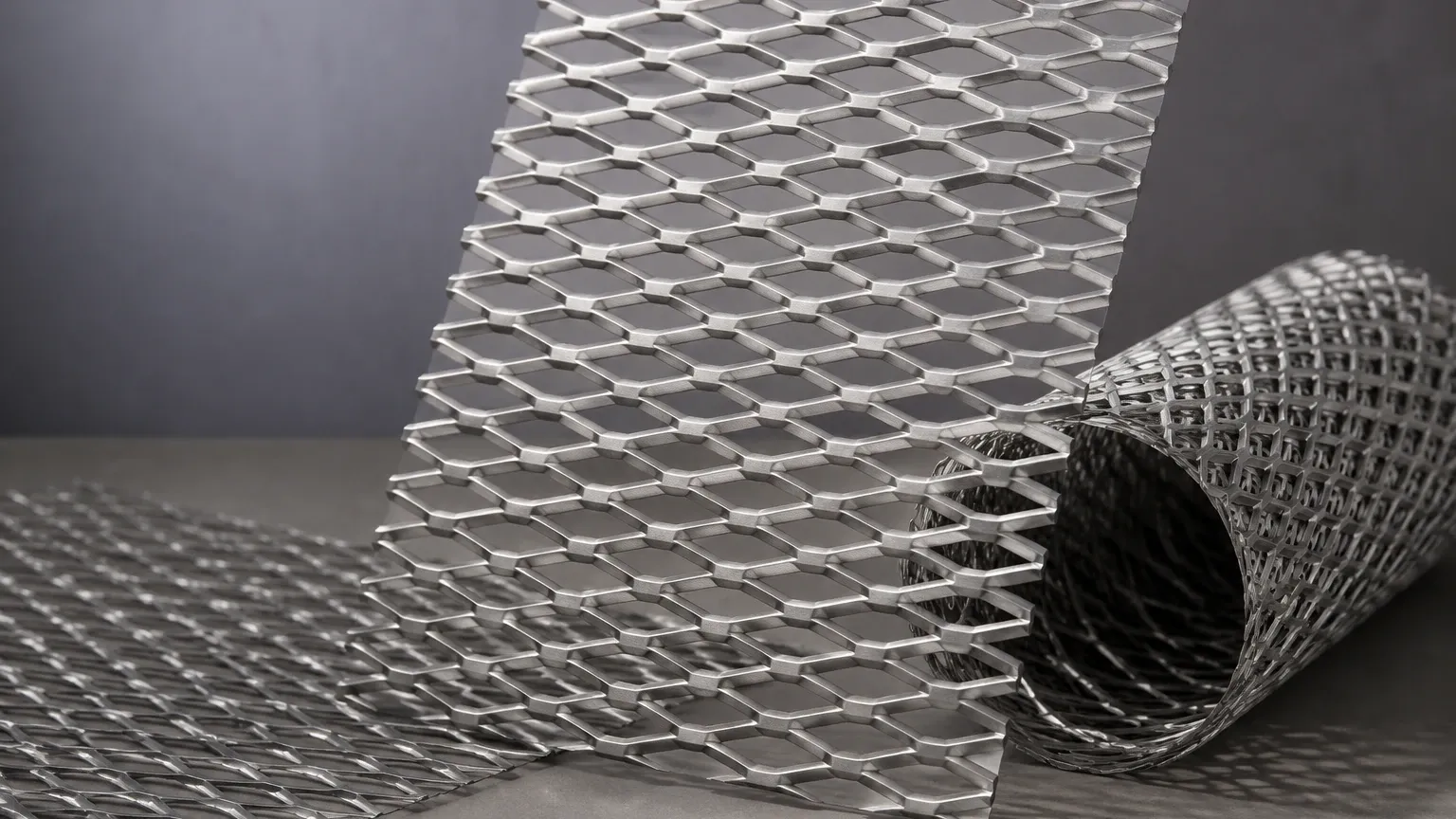
Comparing Perforated & Expanded Metal for Industrial Use
When designing a filtration system or structural component, engineers often weigh the pros and cons of Perforated & Expanded Metal solutions. While both provide open area and structural support, their manufacturing footprints and performance characteristics differ.
Perforated metal is created by punching holes into a sheet, which inherently produces scrap material (the "slugs"). This makes perforated metal generally more expensive than expanded metal, especially when using high-grade alloys. However, perforated metal offers more precise control over hole size and spacing, and it can leave solid margins (unperforated borders) on the edges of the sheet, which simplifies welding and assembly.
In contrast, expanded metal is a "no-waste" product. The stretching process increases the area of the original sheet, often yielding two to three times the original length. This makes it the more economical choice for large-scale applications. Additionally, for a given weight, expanded metal is typically stronger than perforated metal because the strands are oriented at an angle, providing truss-like structural support. For most industrial filtration support needs, expanded metal provides the necessary performance at a lower total cost of ownership.
Engineering Specifications and Procurement Guidelines
To ensure the correct product is manufactured, procurement teams must provide specific technical parameters. Standard terminology in the expanded metal industry includes:
* SWD (Short Way of Diamond): The distance from the center of one bond to the center of the next bond measured across the short diamond diagonal.
* LWD (Long Way of Diamond): The distance from the center of one bond to the center of the next bond measured across the long diamond diagonal.
* SWO (Short Way of Opening): The actual width of the opening.
* LWO (Long Way of Opening): The actual length of the opening.
* Strand Width: The amount of metal fed into the machine for each stroke.
* Strand Thickness: The thickness of the original base metal.
Open Area Calculation
The open area percentage is a critical metric for filtration and airflow. It determines the pressure drop across the mesh. For raised expanded metal, the calculation is complex due to the angle of the strands. For flattened mesh, the open area is generally calculated by the ratio of the strand width to the SWD. Engineers should confirm the required open area early in the design phase to avoid restricted flow or insufficient structural support.
Surface Treatments
While aluminum is naturally corrosion-resistant, certain applications require additional surface treatments:
* Anodizing: Increases the thickness of the natural oxide layer, providing even better corrosion resistance and the ability to add color for architectural or coding purposes.
* Powder Coating: Provides a thick, durable barrier against chemicals and abrasion.
* Chemical Conversion Coating (Chromate): Used primarily for parts requiring low electrical resistance and improved paint adhesion.
Installation and Maintenance Considerations
Proper handling of aluminum expanded metal mesh is essential to maintain its structural integrity. When cutting the mesh to size, it is important to account for the "diamond direction." The mesh is much more rigid along the LWD than the SWD. If the mesh is being used as a support screen, the LWD should ideally span the direction of the greatest stress.
Maintenance of aluminum mesh is relatively straightforward. In filtration applications, the mesh can often be cleaned using high-pressure air or water, provided the cleaning force does not exceed the yield strength of the strands. Because there are no crevices formed by overlapping wires (as in woven mesh), the risk of bacterial growth or localized crevice corrosion is significantly reduced, making it suitable for food and beverage or pharmaceutical pre-filtration.
Conclusion
Aluminum expanded metal mesh represents a highly efficient balance of strength, weight, and cost. Its monolithic structure eliminates the weaknesses associated with welds and joints, while the variety of available alloys and finishes allows it to be tailored to specific industrial environments. By carefully selecting between raised and flattened profiles and specifying the correct diamond dimensions, engineers can achieve optimal filtration performance and structural reliability. Whether used as a protective guard, a media support layer, or a specialized EMI shield, aluminum expanded metal remains a fundamental component in modern industrial engineering.
