


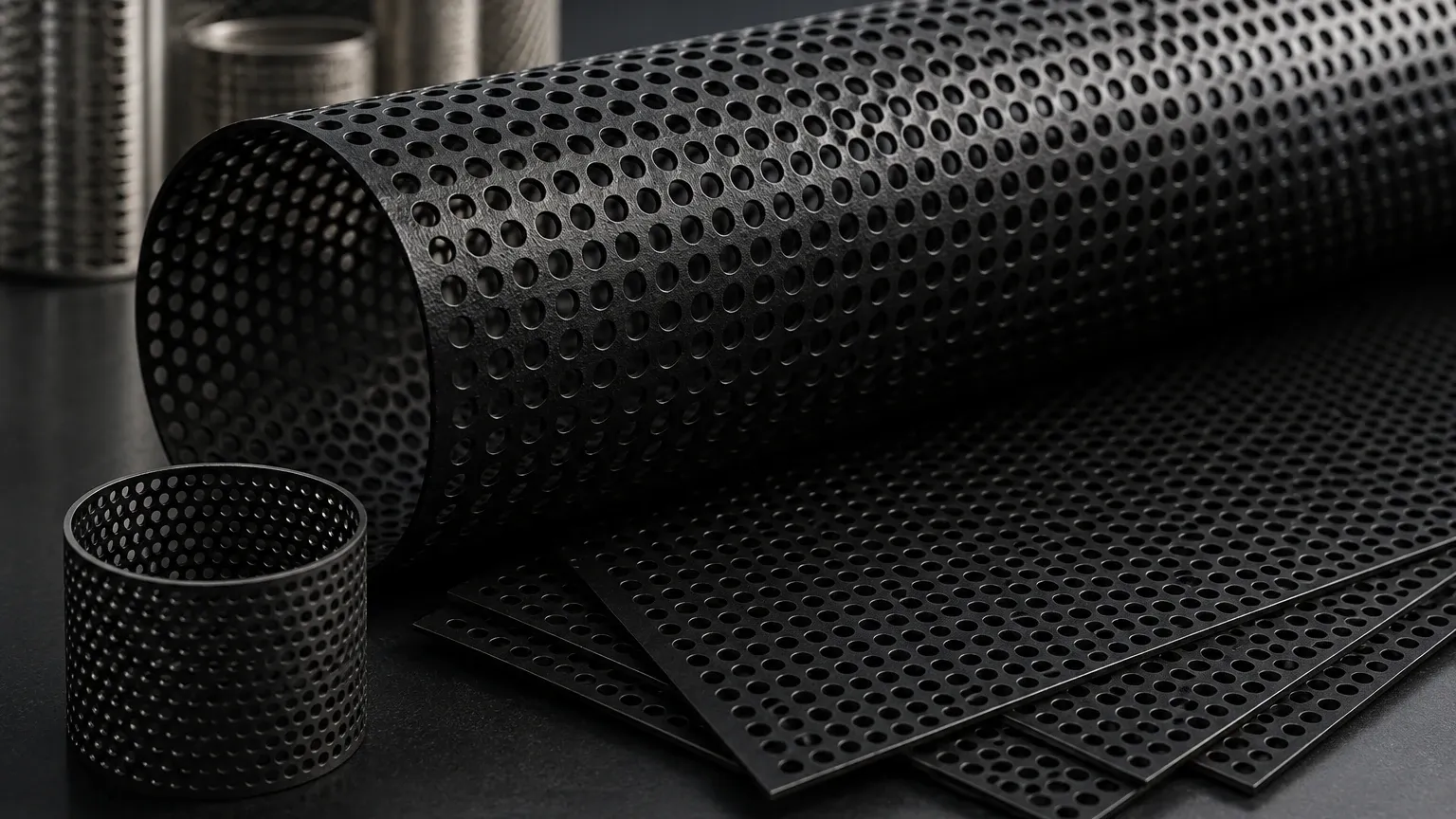
Black Perforated Metal
In industrial engineering and filtration design, black perforated metal represents a specialized category of components where structural utility meets specific environmental or functional requirements. While often associated with architectural aesthetics, the technical application of black-finished perforated sheets is critical in sectors ranging from heavy machinery enclosures to precision filtration supports. For engineers and procurement professionals, selecting the right black perforated metal involves understanding the intersection of base material properties, perforation geometry, and the chemical or physical nature of the black finish itself.
As a core component of Perforated & Expanded Metal solutions, these products provide the necessary mechanical strength and open area required for fluid dynamics, air ventilation, and particle separation, while the black coating offers additional benefits such as corrosion resistance, light absorption, or chemical shielding.
Understanding Black Perforated Metal in Industrial Applications
Black perforated metal is not a single material but rather a composite specification consisting of a metallic substrate—typically carbon steel, aluminum, or stainless steel—subjected to a secondary finishing process. The "black" designation usually refers to a surface treatment such as powder coating, e-coating (electrophoretic deposition), black oxide, or anodizing.
In industrial environments, the choice of a black finish is rarely purely cosmetic. For example, in electronic enclosures or optical filtration systems, a matte black perforated screen is used to minimize light reflection and glare, which could otherwise interfere with sensor accuracy or operator visibility. In outdoor or high-moisture environments, the black coating serves as a primary barrier against oxidation, significantly extending the service life of the underlying metal.
From a filtration perspective, perforated metal serves as the rigid skeleton for finer mesh media or as a primary coarse filter. When these systems are exposed to the elements or corrosive chemicals, the integrity of the finish is as vital as the precision of the holes. Engineers must evaluate how the coating thickness affects the effective open area and the overall flow coefficient of the panel.
Material Substrates and Coating Technologies
The performance of black perforated metal is fundamentally dictated by the combination of the base metal and the coating method. Each combination offers distinct advantages regarding durability, cost, and environmental resistance.
Carbon Steel with Powder Coating
Carbon steel is the most frequent substrate for black perforated metal due to its high tensile strength and cost-effectiveness. Powder coating involves applying a dry plastic powder (typically epoxy or polyester) electrostatically and then curing it under heat. This creates a thick, durable layer that is highly resistant to chipping, scratching, and UV degradation. It is the standard choice for industrial guards, ventilation panels, and structural filtration supports.
Stainless Steel with Black Oxide or PVD
When the application involves high temperatures or aggressive chemical exposure, stainless steel (304 or 316 grade) is the preferred substrate. A black oxide finish is a chemical conversion coating that provides a uniform black appearance without significantly altering the dimensions of the part. For even higher durability and a premium finish, Physical Vapor Deposition (PVD) can be used to apply a thin, extremely hard ceramic layer. These methods are preferred in pharmaceutical or food processing environments where coating flaking must be strictly avoided.
Aluminum with Anodizing
For weight-sensitive applications, such as aerospace or portable industrial equipment, black anodized perforated aluminum is utilized. Anodizing is an electrochemical process that converts the metal surface into a decorative, durable, corrosion-resistant, anodic oxide finish. Unlike powder coating, the black color is integrated into the metal structure, ensuring it will not peel or flake under mechanical stress.
Engineering Specifications: Hole Patterns and Open Area
The primary function of any perforated metal component is to allow the passage of air, light, or liquids while retaining specific solids. The engineering of these components requires precise calculation of hole patterns and the resulting open area.
Hole Geometry
* Round Holes: The most common and efficient pattern for most filtration and ventilation needs. They offer the best balance of structural strength and ease of manufacturing.
* Square Holes: Often used when a higher open area is required. Square holes provide a larger passage for air but can lead to stress concentrations at the corners, potentially reducing the fatigue life of the panel.
* Slotted Holes: Ideal for sorting or sifting applications where the shape of the particles is elongated. Slotted patterns are also used in drainage systems to prevent clogging.
Open Area Calculations
The "Open Area" is the percentage of the total area of the sheet that is occupied by the holes. This is a critical metric for engineers calculating pressure drops and flow rates. For a standard 60-degree staggered round hole pattern, the formula is:
Open Area % = (D² × 90.69) / R²
*(Where D is the hole diameter and R is the center-to-center pitch)*
When specifying black perforated metal, it is essential to account for the coating thickness. A heavy powder coating (typically 60 to 100 microns) can slightly reduce the effective diameter of the holes, which may be significant in high-precision filtration applications involving small apertures.
Performance Factors in Filtration and Protection
In the context of industrial filtration, black perforated metal often serves as a support structure for wire mesh or synthetic filter media. Its role is to withstand the differential pressure across the filter element without deforming.
Pressure Drop and Flow Resistance
The introduction of a perforated plate into a fluid stream inevitably causes a pressure drop. Engineers must ensure that the open area is sufficient to maintain required flow rates while the black coating remains intact under the shear forces of the fluid. In gas filtration, the smooth surface of a high-quality black coating can actually reduce turbulence compared to a raw, burred metal edge.
Corrosion and Chemical Compatibility
In chemical processing, the black finish must be compatible with the media being filtered. For instance, while powder-coated carbon steel is excellent for water treatment, it may fail in the presence of strong organic solvents. In such cases, a black-finished stainless steel or a specific fluoropolymer coating (like PTFE) may be required to prevent the substrate from leaching ions into the process stream.
Thermal Stability
Industrial filters often operate at elevated temperatures. It is crucial to verify that the black finish will not outgas or degrade at the operating temperature. Polyester powder coatings are generally stable up to 150°C, while black oxide on stainless steel can withstand much higher temperatures without losing its integrity.
Quality Evaluation and Selection Criteria
Procuring black perforated metal for technical applications requires a rigorous evaluation of quality standards. Unlike decorative panels, industrial components must adhere to strict dimensional and performance tolerances.
Coating Adhesion and Thickness
The longevity of the component depends on the adhesion of the black finish. A common test is the Cross-Hatch Tape Test (ASTM D3359), which evaluates the resistance of the coating to separation from the substrate. Furthermore, coating thickness should be measured using ultrasonic or magnetic gauges to ensure consistency across the entire panel, especially inside the holes where "faraday cage" effects can sometimes lead to thinner coverage.
Flatness and Burrs
The perforation process involves high-speed punching, which can introduce internal stresses into the metal, causing it to curl or buckle. High-quality perforated sheets undergo a leveling process to ensure they are perfectly flat for subsequent fabrication or installation. Additionally, all holes should be free of burrs. Burrs not only interfere with the coating process but can also cause localized turbulence or trap contaminants in a filtration system.
Edge Margins
Engineers must specify the "margins"—the unperforated areas along the edges of the sheet. Margins are necessary for welding the perforated panel into a frame or filter housing. Inconsistent margins can lead to alignment issues during assembly and may compromise the structural integrity of the final product.
Practical Considerations for Procurement and Customization
When moving from design to procurement, providing a detailed specification to the manufacturer is vital to ensure the final product meets the application's demands. At Kaifil, we emphasize the importance of technical clarity during the OEM process.
Before placing an order for Perforated & Expanded Metal with a black finish, purchasing teams should confirm the following data points:
1. Substrate Grade: Specify the exact alloy (e.g., Carbon Steel Cold Rolled, Stainless 316L, Aluminum 5052).
2. Hole Specification: Diameter, pitch (center-to-center distance), and pattern (staggered or straight).
3. Coating Type: Specify the coating chemistry (e.g., Epoxy-Polyester Powder) and the RAL color code (e.g., RAL 9005 Jet Black).
4. Dimensional Tolerances: Define acceptable variances in sheet size, hole diameter, and flatness.
5. Environmental Exposure: Disclose if the part will be exposed to high UV, salt spray, or specific industrial chemicals.
By addressing these technical boundaries, engineers can ensure that the black perforated metal they integrate into their systems provides the necessary durability and filtration performance. Whether used as a protective screen in heavy machinery or a structural support in a chemical reactor, the synergy between precise perforation and advanced coating technology remains a cornerstone of modern industrial design.
