


Circle Perforated Metal Sheet
In industrial filtration and structural engineering, the circle perforated metal sheet serves as a fundamental component for fluid dynamics control, mechanical support, and media protection. As a specialized category within Perforated & Expanded Metal solutions, these sheets are engineered to precise specifications to meet the rigorous demands of chemical processing, pharmaceutical manufacturing, and high-pressure hydraulic systems.
For engineers and procurement professionals, selecting the correct circle perforated metal sheet involves more than choosing a hole size. It requires a comprehensive understanding of open area percentages, material fatigue, chemical compatibility, and the structural relationship between the perforations and the surrounding metal matrix. This guide examines the technical parameters and application-specific considerations essential for integrating perforated components into industrial systems.
Technical Fundamentals of Circle Perforated Metal Sheet
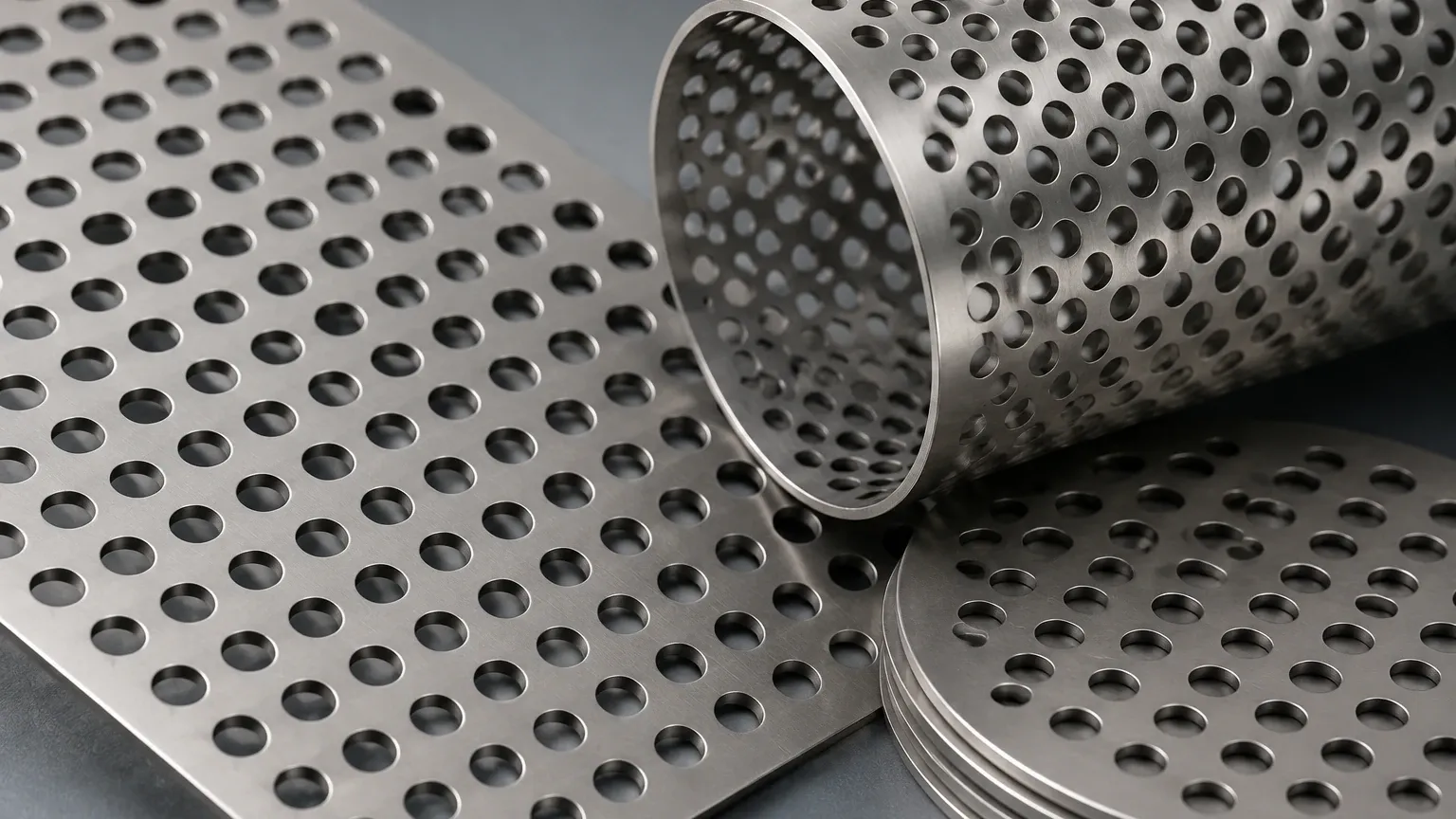
A circle perforated metal sheet is defined by a pattern of round holes punched into a solid metal substrate. Unlike expanded metal, which is slit and stretched to create openings without material loss, perforated metal is manufactured through a punching process that removes material to create precise, repeatable geometries. This process allows for high dimensional accuracy, which is critical when the sheet must interface with other filtration components like fine wire mesh or synthetic membranes.
Hole Patterns and Geometry
The arrangement of holes significantly impacts both the mechanical strength of the sheet and its hydraulic performance. The two most common configurations are:
1. Staggered Pattern (60-Degree): This is the industry standard for industrial filtration. The 60-degree staggered arrangement provides the highest open area and uniform stress distribution. It ensures that the fluid flow is evenly distributed across the surface, minimizing localized pressure drops.
2. Straight Line Pattern: In this configuration, holes are aligned in both horizontal and vertical rows. While easier to align for certain aesthetic or structural applications, straight patterns generally offer lower structural integrity under high-pressure loads compared to staggered patterns.
Calculating Open Area
The "Open Area" is the percentage of the sheet that consists of holes. This metric determines the flow capacity and the degree of resistance the sheet will offer to a fluid or gas stream. For a 60-degree staggered pattern, the formula is:
Open Area % = (D² × 90.69) / R²
Where *D* is the hole diameter and *R* is the center-to-center pitch. Engineers must balance the need for a high open area (for low pressure drop) with the need for structural rigidity (to prevent the sheet from deforming under load).
Material Selection for Industrial Environments
The performance of a circle perforated metal sheet is inextricably linked to its metallurgy. Kaifil specializes in stainless steel filtration solutions because the material provides the necessary durability for demanding industrial cycles.
Stainless Steel Grades
* Grade 304: The most common choice for general industrial use. It offers excellent corrosion resistance in a wide range of atmospheric environments and many corrosive media. It is frequently used in food and beverage processing due to its ease of cleaning and sanitization.
* Grade 316/316L: Containing molybdenum, Grade 316 provides superior resistance to chlorides and acids. This makes it the preferred choice for marine environments, chemical processing plants, and pharmaceutical applications where aggressive cleaning agents or corrosive process fluids are present. The "L" (low carbon) variant is essential for components that require welding, as it prevents carbide precipitation and subsequent intergranular corrosion.
* Exotic Alloys: For extreme temperatures or highly specialized chemical environments, materials such as Monel, Inconel, or Duplex stainless steel may be specified to ensure the longevity of the filtration system.
Surface Treatments and Finishing
Post-perforation treatments are often required to ensure the component meets hygiene or performance standards. These include:
* Degreasing: Removing lubricants used during the punching process.
* Pickling and Passivation: Restoring the protective oxide layer on stainless steel after mechanical processing.
* Electropolishing: Achieving a microscopically smooth surface to prevent bacterial growth and improve flow efficiency.
Engineering Considerations: The 1:1 Rule and Structural Limits
One of the most common challenges in specifying a circle perforated metal sheet is the relationship between the hole diameter and the sheet thickness. As a general engineering rule, the hole diameter should not be smaller than the thickness of the material.
The Diameter-to-Thickness Ratio
If a hole diameter is smaller than the material thickness, the punching force required increases exponentially, leading to excessive tool wear, potential punch breakage, and distortion of the metal sheet. For example, if an application requires a 2mm hole, the sheet thickness should ideally be 2mm or less. If a thicker plate is required for structural reasons but small holes are needed for filtration, alternative methods like laser drilling or waterjet cutting may be necessary, though these are typically less cost-effective than high-speed punching for large volumes.
The "Bridge" and Edge Margins
The "bridge" is the solid metal between the holes. If the bridge is too narrow, the sheet loses its structural integrity and may fail under the vibration or pressure fluctuations common in hydraulic and pneumatic systems. Similarly, specifying "margins"—the unperforated areas along the edges of the sheet—is vital for subsequent assembly. Margins provide a solid surface for welding the sheet into a cylinder or bolting it into a housing frame.
Applications in Industrial Filtration Systems
Within the scope of Perforated & Expanded Metal products, the circle perforated metal sheet serves several distinct roles in filtration architecture.
Support Cores for Filter Cartridges
In high-pressure filtration, fine wire mesh or pleated paper media lack the structural strength to withstand the differential pressure between the upstream and downstream sides. A perforated metal cylinder acts as the internal core, providing the necessary mechanical support to prevent the media from collapsing. The precision of the circle perforated metal sheet ensures that the support core has a consistent diameter and smooth surface, preventing damage to the delicate primary filter layers.
Pre-Filtration and Coarse Strainers
In water treatment and chemical processing, perforated sheets are often used as the first line of defense. They remove large debris, protecting downstream pumps, valves, and finer filtration stages. Because they are constructed from solid metal, these strainers can be cleaned and reused multiple times, offering a lower total cost of ownership compared to disposable filter elements.
Centrifuge Baskets and Vibratory Screens
The durability of stainless steel perforated sheets makes them ideal for centrifugal separation. The sheets must withstand high rotational speeds and the abrasive force of solids being pressed against the screen. The round hole geometry is preferred in these applications because it resists clogging and provides a more uniform discharge of the liquid phase compared to slotted or square openings.
Quality Control and Procurement Best Practices
When sourcing circle perforated metal sheets for industrial projects, engineers must confirm several quality parameters to ensure the component will perform as expected in the field.
Flatness and Leveling
The punching process naturally introduces internal stresses into the metal, which can cause the sheet to curl or bow. For applications where the sheet must be formed into a precise cylinder or fitted into a tight housing, "roller leveling" is a critical post-processing step. This process flattens the sheet to within strict tolerances, ensuring ease of assembly and consistent performance.
Burr Control
Punching inevitably creates a "burr" on the exit side of the hole. In filtration, burrs can trap particles, cause turbulence, or even break off and contaminate the process fluid. Specifying the maximum allowable burr height or requesting a deburring process (such as sanding or chemical milling) is essential for high-purity applications in the pharmaceutical and food industries.
Verification Checklist for Engineers
Before finalizing a purchase order for perforated components, technical teams should confirm the following:
* Material Certification: Ensure the stainless steel grade meets ASTM or ISO standards.
* Dimensional Tolerances: Define acceptable variations in hole diameter, pitch, and overall sheet dimensions.
* Flow Requirements: Verify that the calculated open area meets the system's flow rate and pressure drop requirements.
* Environmental Compatibility: Confirm that the material and finish can withstand the operating temperature and chemical exposure of the application.
Customization and OEM Capabilities
Kaifil provides extensive customization options for circle perforated metal sheets, recognizing that standard off-the-shelf products rarely meet the specific requirements of complex industrial systems. From custom hole patterns designed to align with specific flow dynamics to specialized margins that facilitate automated welding, tailored solutions are often the key to optimizing filtration performance.
By working closely with a manufacturer that understands both the mechanical properties of metal and the principles of fluid filtration, engineering teams can develop components that are not only durable but also contribute to the overall efficiency of the industrial process. Whether the requirement is for a heavy-gauge support plate or a high-precision thin-gauge screen, the selection of the right circle perforated metal sheet is a critical step in achieving reliable, long-term filtration success.
For more information on material options, technical specifications, and custom design support, engineers are encouraged to Review product options and application support to ensure their filtration components are engineered for maximum performance and durability.
