


Copper Expanded Metal
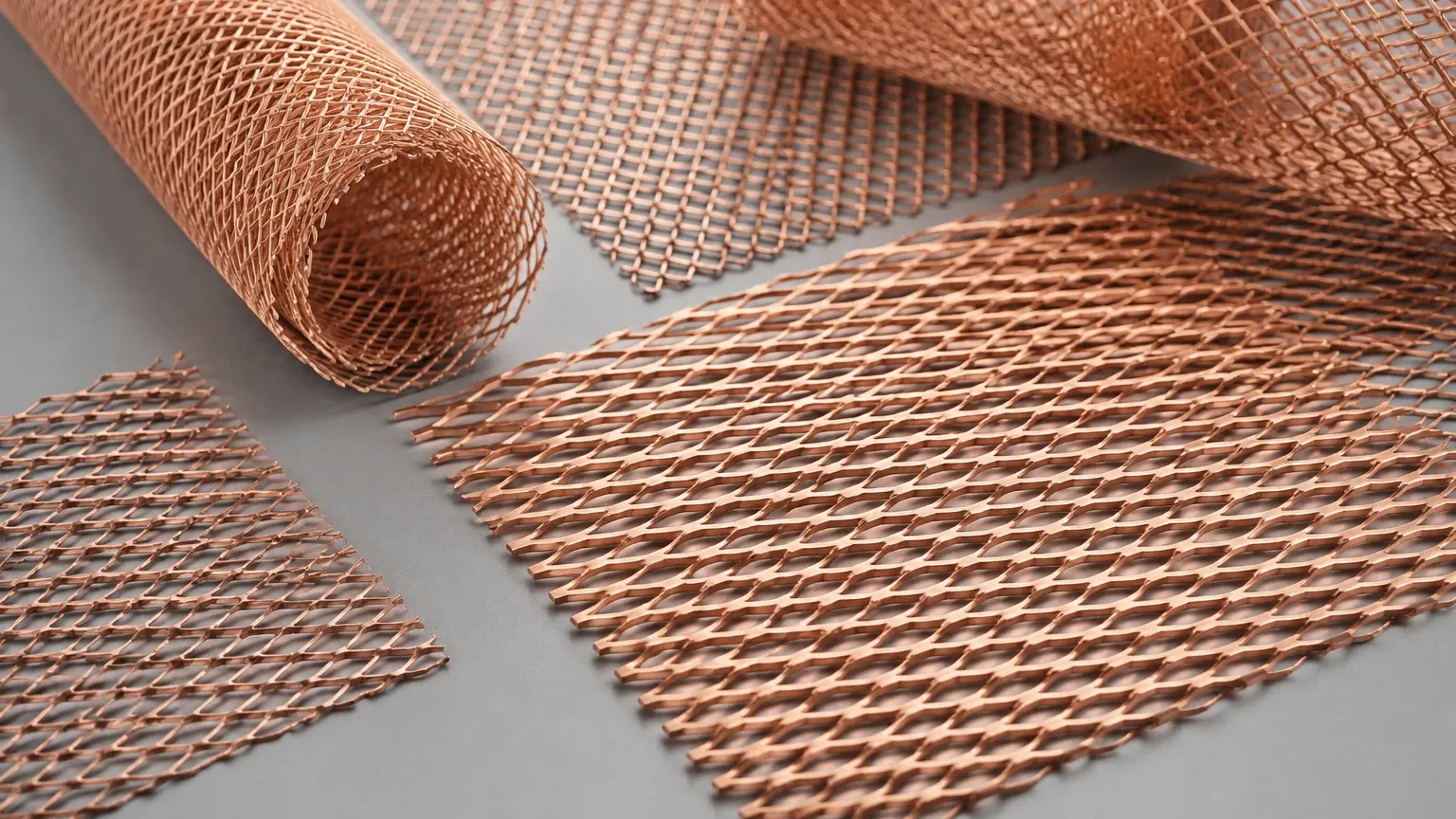
Copper expanded metal is a highly specialized industrial material produced through a process of simultaneous slitting and stretching. Unlike perforated metal, which involves punching holes and generating scrap material, the expansion process transforms a solid copper sheet into a continuous diamond-shaped mesh without any material loss. This unique manufacturing method results in a product that maintains structural integrity while offering high open-area percentages, making it an essential component in filtration, electrical shielding, and thermal management.
For engineers and procurement professionals, understanding the technical nuances of copper expanded metal is critical for ensuring performance in demanding environments. As a manufacturer specializing in Perforated & Expanded Metal, Kaifil provides precision-engineered solutions that leverage the inherent properties of copper—such as superior electrical conductivity and corrosion resistance—to meet specific industrial requirements.
The Manufacturing Process and Structural Integrity
The production of copper expanded metal begins with a solid copper coil or sheet. A machine equipped with a specialized knife slits the metal while simultaneously pulling it. This stretching action creates the characteristic diamond-shaped openings. Because the strands and bonds (the intersections where the strands meet) are part of a single piece of metal, the material is significantly stronger than a woven or welded mesh of equivalent weight.
From an engineering perspective, the structural continuity of expanded metal is a primary advantage. There are no joints to fail, no welds to break, and no loose wires to unravel. This makes copper expanded metal an ideal choice for high-vibration environments or applications where the mesh must be formed, bent, or welded into complex shapes without losing its dimensional stability.
Material Properties: Why Use Copper?
While stainless steel is the standard for many filtration applications, copper expanded metal is selected for its distinct physical and chemical properties.
Electrical and Thermal Conductivity
Copper is second only to silver in terms of electrical conductivity. This makes copper expanded metal the preferred material for EMI (Electromagnetic Interference) and RFI (Radio Frequency Interference) shielding. In these applications, the mesh acts as a Faraday cage, blocking external electromagnetic fields or preventing internal signals from escaping. Its high thermal conductivity also makes it useful in heat exchangers and as a substrate for battery electrodes.
Corrosion Resistance and Antimicrobial Properties
Copper naturally forms a protective patina when exposed to the atmosphere, providing excellent resistance to corrosion in marine and industrial environments. Furthermore, copper is recognized for its antimicrobial properties, which can be a significant factor in certain water treatment or air filtration systems where the inhibition of microbial growth is required.
Ductility and Formability
Copper is more ductile than stainless steel, allowing it to be expanded into very fine meshes with precise tolerances. This formability is beneficial when the expanded metal needs to be integrated into custom filter housings or wrapped around internal support structures.
Engineering Specifications: LWD, SWD, and Strand Geometry
When specifying copper expanded metal, engineers must use standardized terminology to ensure the final product meets the application's requirements. The geometry of the mesh is defined by several key measurements:
* LWD (Long Way of Design): The distance from the center of one bond to the center of the next bond across the long axis of the diamond.
* SWD (Short Way of Design): The distance from the center of one bond to the center of the next bond across the short axis of the diamond.
* LWO (Long Way of Opening): The internal dimension of the diamond across the long axis.
* SWO (Short Way of Opening): The internal dimension of the diamond across the short axis.
* Strand Width: The amount of metal fed into the knives during the expansion process.
* Strand Thickness: The thickness of the original base metal sheet.
By adjusting these parameters, manufacturers can control the open area percentage, which directly impacts flow rates, pressure drops, and filtration efficiency. In filtration applications, the SWO is often the most critical dimension, as it determines the size of the particles that the mesh will retain or allow to pass.
Standard vs. Flattened Copper Expanded Metal
There are two primary forms of expanded metal: standard (raised) and flattened.
Standard Expanded Metal
In its standard form, the strands and bonds are set at a uniform angle to the plane of the sheet. This creates a three-dimensional surface that provides extra strength and rigidity. The angled strands can also be used to deflect light, air, or fluid flow, which is useful in certain specialized industrial processes.
Flattened Expanded Metal
Flattened expanded metal is produced by passing the standard expanded sheet through a cold-roll reducing mill. This process flattens the strands and bonds into the same plane as the original sheet, resulting in a smooth, two-dimensional surface. Flattened copper expanded metal is often preferred for applications where a consistent thickness is required, such as in battery electrodes or when the mesh is used as a support layer for thin filter membranes to prevent puncturing.
Industrial Applications in Filtration and Beyond
Copper expanded metal serves diverse roles across several high-tech and industrial sectors:
1. Electrochemical Filtration: Used in fuel cells and electrolyzers where both fluid passage and electrical current collection are necessary.
2. EMI/RFI Shielding: Protecting sensitive electronic components in aerospace, defense, and medical imaging equipment (e.g., MRI rooms).
3. Support Media: In multi-stage filtration systems, a coarse copper expanded metal layer can provide structural support for finer stainless steel or synthetic filter media.
4. Lightning Protection: Integrated into composite aircraft structures or wind turbine blades to dissipate the energy from lightning strikes.
5. Acoustic Damping: Used in specialized mufflers and sound-attenuating panels where the copper's density and the mesh's geometry help dissipate sound energy.
Quality Evaluation and Procurement Risks
When sourcing copper expanded metal, engineers should be aware of common risks that can compromise the performance of the final component.
Strand Uniformity and Breakage
During the expansion process, excessive tension or dull tooling can lead to "necking" or micro-fractures in the strands. These defects reduce the structural integrity of the mesh and can lead to premature failure under mechanical stress. A visual inspection should confirm that all bonds are solid and that the strands maintain a consistent width.
Surface Contamination and Oxidation
Copper is sensitive to oils and environmental contaminants. For high-precision applications like electronics or pharmaceuticals, the material must be thoroughly degreased and, in some cases, passivated to ensure a clean surface. While a natural patina is often acceptable, heavy oxidation before the product reaches the assembly stage can interfere with welding or electrical conductivity.
Dimensional Tolerances
Expanded metal is prone to "camber" (a slight curve in the sheet) and variations in the LWD/SWD if the machinery is not properly calibrated. For components that must fit into precision-machined housings, specifying tight tolerances on the overall sheet dimensions and the opening sizes is essential.
Comparison: Copper Expanded Metal vs. Perforated Metal
While both materials are used for similar functions, the choice between expanded and perforated metal often comes down to cost and performance characteristics.
* Material Utilization: Expanded metal is more cost-effective in terms of raw material because it produces zero scrap. Perforated metal can result in up to 40% or more material waste, which is particularly expensive when working with high-value metals like copper.
* Weight-to-Strength Ratio: Expanded metal generally offers a higher strength-to-weight ratio than perforated metal because the strands are oriented at an angle, providing truss-like reinforcement.
* Flow Characteristics: Perforated metal provides more predictable flow patterns due to its uniform hole shapes. Expanded metal, with its angled strands, can create turbulence, which may be desirable in heat transfer applications but undesirable in certain laminar flow filtration scenarios.
Pre-Purchase Checklist for Engineers
Before finalizing a specification for copper expanded metal, technical professionals should confirm the following details with their manufacturer:
1. Alloy Grade: Confirm if C11000 (Electrolytic Tough Pitch) is required for maximum conductivity or if a different alloy is needed for specific corrosion environments.
2. Open Area Percentage: Calculate the required open area to balance flow rate with structural requirements.
3. Flattening Requirements: Determine if the application requires the smooth surface of flattened mesh or the rigidity of standard mesh.
4. Edge Configuration: Specify whether the edges should be "closed" (bonded) or "open" (cut strands), as this affects safety and installation.
5. Secondary Processing: Identify if the material requires degreasing, annealing, or custom cutting to size.
By focusing on these technical parameters, procurement teams can ensure they receive a product that aligns with the engineering demands of their specific application. For more information on available patterns and technical specifications, review the options for Perforated & Expanded Metal to find the optimal solution for your filtration or industrial project.
