


Decorative Perforated Metal Panels
In industrial and architectural engineering, the selection of materials often requires a balance between structural integrity and aesthetic requirements. Decorative perforated metal panels represent a specialized category of fabricated components that serve both functional and visual purposes. Unlike standard industrial screens used solely for coarse filtration or heavy-duty sorting, these panels are engineered with specific geometries and finishes to enhance the appearance of equipment, buildings, and interior spaces while maintaining the inherent strength of the base metal.
For engineers and procurement professionals, understanding the technical nuances of these panels is essential. Whether they are used for ventilation in high-end electronic enclosures or as cladding for industrial facilities, the performance of Perforated & Expanded Metal depends on precise material selection, hole pattern optimization, and advanced manufacturing techniques.
The Engineering Principles of Decorative Perforated Metal Panels
Decorative perforated metal panels are created through a process of punching or laser-cutting a series of holes into a metal sheet. While the primary goal may be aesthetic, the engineering behind the perforation pattern affects the panel's mechanical properties. When a metal sheet is perforated, its weight is reduced, and its transparency is increased, but its structural rigidity is also altered.
Engineers must consider the "ligament width"—the distance between two adjacent holes. If the ligament is too narrow, the panel may warp during the punching process or fail under mechanical stress. Conversely, if the ligament is too wide, the intended decorative effect or the required airflow may be compromised. Achieving the correct balance requires a deep understanding of the material's yield strength and the stresses applied during the fabrication of Perforated & Expanded Metal products.
Material Science: Selecting the Right Alloy for Performance
The choice of material is the most critical factor in determining the longevity and suitability of decorative perforated metal panels. While various metals can be perforated, stainless steel remains the industry standard for high-performance applications due to its corrosion resistance and mechanical durability.
1. Stainless Steel (Grades 304 and 316): Grade 304 is suitable for most indoor and general outdoor applications. However, for panels exposed to marine environments or chemical processing areas, Grade 316 is preferred due to its higher molybdenum content, which provides superior resistance to pitting and chloride corrosion.
2. Aluminum: Often selected for its high strength-to-weight ratio and natural resistance to oxidation. Aluminum panels are frequently used in architectural facades where weight reduction is a priority.
3. Carbon Steel: A cost-effective option for indoor applications where the panels will be powder-coated or painted to prevent rust.
4. Specialty Alloys: In specific industrial contexts, such as high-temperature environments, alloys like Monel or Inconel may be used, though these are less common for purely decorative purposes.
Selecting the appropriate material ensures that the decorative perforated metal panels do not just look appropriate upon installation but maintain their appearance and structural role throughout their intended lifecycle.
Technical Specifications: Open Area, Pitch, and Pattern Geometry
When specifying decorative perforated metal panels, technical teams must define several geometric parameters that dictate the panel's performance. These specifications are vital for applications involving airflow, sound attenuation, or light filtration.
Open Area Calculation
The "open area" refers to the percentage of the sheet that is occupied by holes. This is a critical metric for HVAC engineers and equipment designers. For a standard round hole pattern in a 60-degree staggered orientation, the open area is calculated using the formula:
* % Open Area = (D² × 90.69) / P²
Where D is the hole diameter and P is the pitch (the distance from the center of one hole to the center of the next). For decorative panels, the open area can range from 10% to over 60%, depending on whether the priority is privacy, shading, or maximum ventilation.
Pattern Geometry
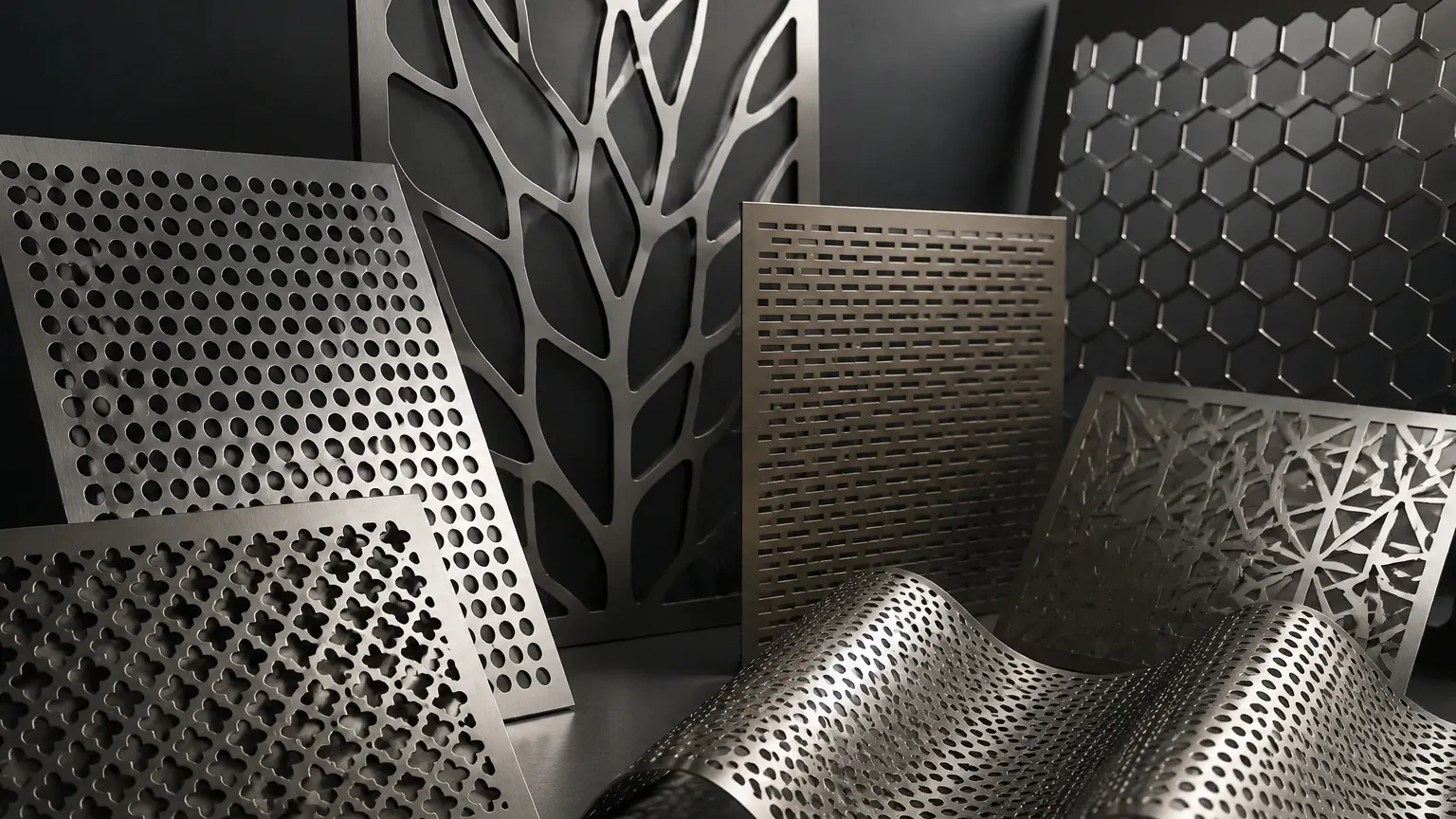
While round holes are the most common and cost-effective, decorative perforated metal panels often utilize more complex shapes, including:
* Square and Slotted Holes: Provide a modern, linear aesthetic and are often used for drainage or ventilation grilles.
* Hexagonal Patterns: Offer a high open-area percentage while maintaining excellent structural stability.
* Custom Geometric Shapes: Advanced CNC punching allows for the creation of unique patterns, including logos or organic shapes, which are frequently used in brand-specific industrial equipment housing.
Manufacturing Methods: Comparing Perforation and Expansion
There are two primary methods for creating the textured and patterned surfaces found in industrial design: perforation and expansion. Both fall under the broader category of Perforated & Expanded Metal, but they result in different physical characteristics.
Perforation
Perforation involves removing material from the sheet using a high-speed press equipped with a die and punch set. This method allows for high precision and a wide variety of hole shapes. It is the preferred method for decorative perforated metal panels that require specific margins (unperforated edges) for mounting or welding.
Expansion
Expanded metal is produced by simultaneously slitting and stretching the metal sheet. This process creates a diamond-shaped mesh without any material waste. While expanded metal is highly cost-effective and provides a unique 3D texture, it offers less flexibility in pattern design compared to perforation. In decorative contexts, expanded metal is often used for security screens or sunshades where a more industrial, rugged look is desired.
Functional Applications in Industrial and Commercial Environments
Decorative perforated metal panels are not merely cosmetic; they are integrated into complex systems where they perform essential tasks. In B2B sectors, these applications include:
* Acoustic Control: When backed with sound-absorbing materials, perforated panels serve as acoustic baffles in power plants, data centers, and manufacturing facilities. The hole size and spacing are engineered to allow sound waves to pass through the metal and be trapped by the insulation.
* Equipment Enclosures: High-performance machinery often generates significant heat. Perforated panels provide the necessary ventilation to prevent overheating while protecting internal components from debris and unauthorized access.
* Architectural Cladding and Sunshades: In large-scale industrial architecture, these panels reduce solar heat gain on building envelopes, leading to significant energy savings in climate control systems.
* Fluid and Air Diffusion: In chemical processing and cleanroom environments, perforated plates are used to diffuse the flow of air or liquids, ensuring uniform distribution without causing excessive turbulence.
Customization and OEM Precision in Metal Fabrication
For many engineering projects, off-the-shelf solutions are insufficient. Customization is a hallmark of professional manufacturing in the Perforated & Expanded Metal industry. Technical teams should look for manufacturers capable of providing comprehensive OEM services, which include:
* Precision Tooling: The ability to create custom dies for unique perforation patterns.
* Secondary Processing: This includes leveling (to ensure the panel is perfectly flat after the stress of punching), shearing to exact dimensions, and forming (bending or rolling the panels into specific shapes).
* Edge Margins: Customizing the solid borders around the perforated area is essential for seamless integration into frames or support structures. Engineers must specify these margins to ensure that the panels can be bolted or welded without compromising the pattern.
* Surface Finishing: To enhance durability and aesthetics, panels can undergo various treatments. For stainless steel, electropolishing provides a high-shine, ultra-clean surface. For other metals, powder coating or PVDF (Polyvinylidene Fluoride) coatings offer a wide range of colors and superior UV resistance.
Quality Control and Procurement Considerations
When sourcing decorative perforated metal panels, purchasing teams and engineers must verify that the manufacturer adheres to strict quality control standards. Because these panels often serve as the "face" of a product or building, even minor defects can lead to project delays or increased costs.
Key evaluation criteria include:
1. Dimensional Tolerances: Ensure the manufacturer can meet the required tolerances for hole diameter, pitch, and overall sheet dimensions. Standard industrial tolerances are usually acceptable, but high-precision applications may require tighter controls.
2. Flatness Requirements: The perforation process introduces internal stresses that can cause the metal to "oil-can" or bow. A professional manufacturer will use precision leveling equipment to ensure the final product meets flatness specifications.
3. Burr Removal: Punching metal inevitably creates burrs on the exit side of the hole. For decorative panels, especially those in accessible areas, deburring is a mandatory secondary process to ensure safety and a smooth finish.
4. Material Traceability: For projects in the pharmaceutical, food, or aerospace industries, material test reports (MTRs) are necessary to verify the chemical composition and mechanical properties of the alloy used.
Before finalizing an order, it is advisable to confirm the lead times for custom tooling and the manufacturer's capacity for large-volume production. Understanding the total cost of ownership—including maintenance, durability, and installation ease—is more important than the initial purchase price.
Conclusion
Decorative perforated metal panels are a versatile and essential component in modern industrial design. By combining the strength of metals like stainless steel with the flexibility of custom perforation patterns, these panels provide engineers with a tool to solve complex problems related to airflow, sound, and structural weight, all while achieving a professional aesthetic.
When selecting a partner for Perforated & Expanded Metal solutions, technical expertise and manufacturing precision are the most important factors. A deep understanding of material science, pattern geometry, and secondary processing ensures that the final panels meet the rigorous demands of industrial applications. For technical professionals, confirming these details during the design and procurement phases is the key to achieving long-term performance and reliability.
