


Expanded Metal Edge Protector
In industrial filtration and structural engineering, the integrity of a component is often defined by its weakest point. For filtration systems utilizing expanded metal as a support medium or a primary filter element, the perimeter represents a critical zone for both performance and safety. An expanded metal edge protector is not merely a finishing touch; it is a functional engineering requirement that ensures structural rigidity, prevents fluid bypass, and protects both the equipment and the personnel handling it.
At Kaifil, we specialize in the precision manufacturing of Perforated & Expanded Metal solutions tailored for demanding industrial environments. Understanding the technical nuances of edge protection allows engineers to specify components that withstand high-pressure differentials and corrosive chemical exposures while maintaining long-term operational efficiency.
The Fundamentals of Expanded Metal in Industrial Filtration
Expanded metal is produced through a process of simultaneous slitting and stretching of metal sheets—typically stainless steel, carbon steel, or aluminum. Unlike perforated metal, which involves punching holes and generating scrap, expanded metal is formed by cold-working the material into a diamond-shaped mesh pattern. This process results in a high strength-to-weight ratio and a continuous structure without joins or welds within the mesh itself.
However, the very process that gives expanded metal its strength also creates "sharp" or "raw" edges where the strands are cut at the perimeter. In a filtration context, these raw edges pose several challenges:
1. Structural Instability: Without a perimeter frame or edge protector, the mesh can unravel or deform under hydraulic pressure.
2. Fluid Bypass: In filter cartridges, an unprotected edge creates gaps between the filter media and the housing, allowing unfiltered fluid to bypass the system.
3. Media Damage: Sharp edges can puncture adjacent layers of fine wire mesh or synthetic filter media during the assembly of multi-layered filter elements.
4. Handling Hazards: Industrial safety protocols require the elimination of sharp burrs to prevent injury during installation and maintenance cycles.
Why an Expanded Metal Edge Protector is Essential
An expanded metal edge protector serves as a transition interface between the mesh and the rest of the filtration system. By capping the exposed strands, the protector provides a smooth, uniform surface that is essential for creating a hermetic seal.
Structural Reinforcement
In high-viscosity applications or systems with frequent pressure surges, the expanded metal serves as a support pleat or a core for the filter. The edge protector acts as a structural spine, distributing mechanical stress evenly across the mesh. This prevents the "telescoping" effect where the center of the mesh bows out while the edges remain fixed, a common failure mode in poorly designed industrial filters.
Sealing and Gasket Seating
For a filter to be effective, every drop of fluid must pass through the media. When expanded metal is used as a basket or a cylindrical support, the edges must interface with gaskets or O-rings. A raw edge would shred a rubber or silicone gasket instantly. An expanded metal edge protector, typically in the form of a U-profile or a welded flat bar, provides a flat, stable surface for gasket compression, ensuring zero-leakage performance.
Material Selection and Corrosion Resistance
Selecting the right material for both the mesh and the edge protector is critical to the longevity of the filtration component. At Kaifil, we emphasize material compatibility to prevent galvanic corrosion, which can occur when dissimilar metals are joined in a conductive fluid.
* 304 Stainless Steel: The standard choice for general industrial applications, providing excellent strength and basic corrosion resistance for water treatment and food and beverage sectors.
* 316L Stainless Steel: Specified for pharmaceutical and chemical processing. The addition of molybdenum and lower carbon content provides superior resistance to pitting and crevice corrosion, particularly in chloride-rich environments.
* Specialty Alloys: For extreme temperatures or highly acidic environments, alloys such as Monel or Inconel may be utilized for both the expanded metal and the edge protection components.
Engineers must ensure that the welding or bonding method used to attach the edge protector does not compromise the material's properties. For instance, improper welding of 316L can lead to chromium depletion at the grain boundaries, making the edge prone to "intergranular corrosion."
Design Specifications: U-Edging vs. Framed Construction
There are several methods to implement an expanded metal edge protector, each suited to different mechanical requirements.
U-Channel Edging
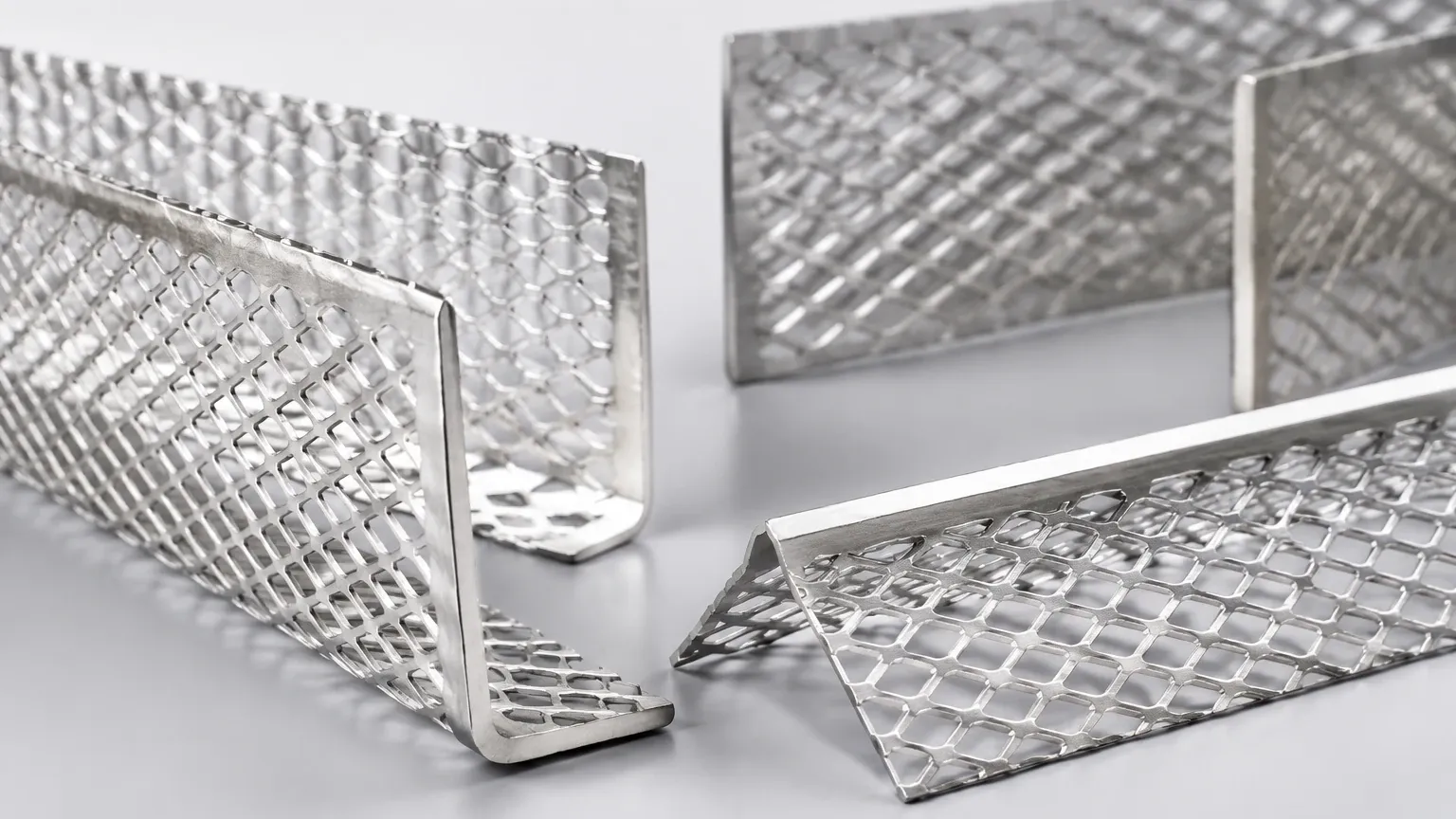
This is the most common form of edge protection. A metal strip is folded into a "U" shape and fitted over the raw edge of the expanded metal. It is then spot-welded or stitch-welded into place. U-channels are ideal for flat panels used in screeners or guards. They provide a clean aesthetic and a blunt edge for safety.
Hemmed Edges
In lighter-gauge applications, the edge of the expanded metal itself (or an attached thin-gauge sheet) can be folded back on itself. While this provides a smooth edge, it does not offer the same structural rigidity as a separate U-channel or frame.
Integrated Frames and End Caps
For cylindrical filter cartridges, the expanded metal is often rolled and seam-welded. The edge protector in this case takes the form of a machined end cap. The mesh is recessed into a groove in the end cap and bonded using epoxy or, more commonly in high-purity applications, through TIG (Tungsten Inert Gas) welding. This creates a robust, one-piece component capable of withstanding significant backwash pressures.
Engineering Considerations for High-Pressure Applications
When designing a system that incorporates Perforated & Expanded Metal, engineers must calculate the total open area and the resulting pressure drop (ΔP). However, the edge protector also plays a role in fluid dynamics.
A bulky edge protector can create turbulence at the periphery of the filter, leading to uneven cake distribution in solid-liquid separation processes. To mitigate this, the edge protector should be as low-profile as possible while still meeting structural requirements.
Furthermore, the "bond area"—the region where the mesh meets the protector—must be inspected for slag or weld spatter. In precision filtration, even a small piece of weld spatter breaking loose can contaminate the downstream flow, potentially damaging sensitive equipment like high-pressure pumps or spray nozzles.
Customization and OEM Integration
No two industrial filtration challenges are identical. Customization is often required to meet specific dimensional tolerances or flow characteristics. When sourcing an expanded metal edge protector, purchasing teams should confirm the following with the manufacturer:
* Dimensional Tolerances: Industrial housings often have tight tolerances. The thickness of the edge protector must be factored into the overall outer diameter (OD) or width of the component.
* Mesh Orientation: The orientation of the diamonds (Long Way of Diamond vs. Short Way of Diamond) affects how the edge protector sits on the mesh.
* Surface Finish: Depending on the industry, the edge protector may require electropolishing to remove microscopic burrs and improve corrosion resistance, or passivating to restore the protective oxide layer after welding.
Kaifil provides comprehensive OEM support, working from technical drawings to produce filter components that integrate seamlessly into existing hardware. Our manufacturing process ensures that the transition from the expanded metal mesh to the edge protector is smooth, secure, and free of defects.
Maintenance and Longevity of Edge-Protected Components
The lifespan of an industrial filter is often determined by its cleaning cycle. Filters that undergo frequent backpulsing or ultrasonic cleaning are subject to cyclic fatigue. The joint between the expanded metal and the edge protector is a primary stress concentration point.
During routine inspections, engineers should look for:
1. Weld Cracking: Signs of stress fractures at the attachment points of the edge protector.
2. Erosion: In high-velocity flows, the leading edge of the protector can erode over time, especially if the fluid contains abrasive particles.
3. Deformation: Any bowing or warping of the edge protector, which indicates that the system is operating beyond its designed pressure limits.
Replacing a component before the edge protector fails is essential to prevent catastrophic bypass, which could lead to expensive downstream contamination and unscheduled downtime.
Conclusion
An expanded metal edge protector is a vital component in the architecture of industrial filtration systems. It bridges the gap between the high-performance open area of expanded metal and the mechanical requirements of the filter housing. By selecting the appropriate materials, finishing methods, and structural designs, engineers can significantly enhance the safety, durability, and efficiency of their filtration processes.
For technical professionals seeking reliable, custom-engineered solutions, Kaifil offers the expertise required to navigate the complexities of metal filtration. Whether you are designing a new system or optimizing an existing one, our focus on quality manufacturing ensures that every Perforated & Expanded Metal product meets the rigorous standards of modern industry. Contact our engineering team to discuss your specific requirements for edge protection and integrated filtration components.
