


Expanded Metal Edge Trim
In industrial manufacturing and filtration design, expanded metal is a versatile material prized for its structural integrity and open-area efficiency. However, the unique manufacturing process of expanding metal—where a solid sheet is simultaneously slit and stretched—results in sharp, unfinished edges consisting of cut "strands" and "bonds." For engineers and procurement teams, specifying the correct expanded metal edge trim is not merely an aesthetic choice; it is a critical technical requirement for safety, structural reinforcement, and seamless integration into larger assemblies.
Whether used in high-pressure hydraulic filters, chemical processing strainers, or architectural guards, the edge treatment determines how the component interacts with its environment. This guide examines the technical nuances of expanded metal edge trim, the materials utilized in demanding B2B applications, and the engineering considerations necessary for optimal performance.
The Engineering Necessity of Edge Finishing
Expanded metal is defined by its diamond-shaped openings, created without any waste of material. Unlike perforated metal, which is punched, expanded metal retains the strength of the original sheet while increasing its surface area. This process, however, leaves "random" or "open" edges where the diamonds are bisected.
There are three primary reasons why an engineered edge trim is essential in industrial contexts:
1. Safety and Handling: Raw expanded metal edges are inherently sharp. In environments where technicians must frequently inspect or replace filter elements, exposed edges pose a significant laceration risk. Trimming or framing the mesh ensures compliance with workplace safety standards.
2. Structural Rigidity: While expanded metal is strong, its edges are the most vulnerable points for deformation. A perimeter trim acts as a structural frame, preventing the mesh from warping under mechanical stress or high flow rates in filtration systems.
3. Mounting and Sealing: In filtration applications, a bypass-free seal is mandatory. An expanded metal edge trim provides a flat, uniform surface that can be gasketted or welded into a housing, ensuring that the fluid or gas passes through the media rather than around it.
Types of Expanded Metal Edge Trim Profiles
The selection of a trim profile depends on the gauge of the metal, the diamond size (SWD and LWD), and the final application. Standard industrial profiles include:
U-Edging (U-Channel)
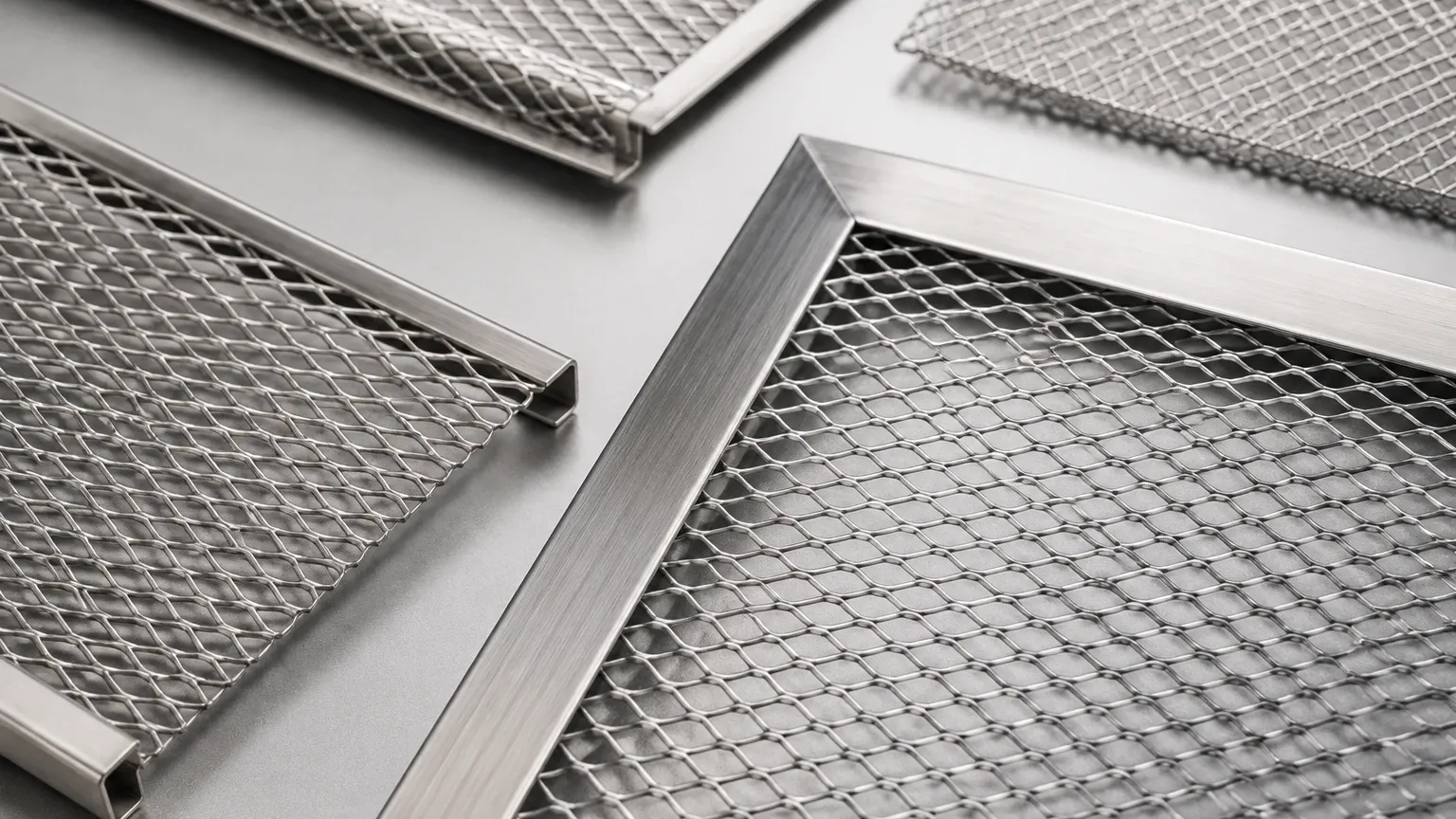
U-edging is the most common solution for framing expanded metal. It consists of a cold-rolled metal strip formed into a "U" shape. The expanded metal sheet is slid into the channel and then secured.
* Technical Advantage: It completely encapsulates the sharp edges and provides a smooth, rounded perimeter.
* Specifications: Available in various throat widths to accommodate different mesh thicknesses (measured from the top of the raised strand).
J-Channel
Similar to U-edging, the J-channel has one leg longer than the other. This is often used when the mesh needs to be flush-mounted against a flat surface or when one side of the trim requires more welding surface area.
Flat Bar and Angle Iron
For heavy-duty industrial applications, such as large-scale strainers or floor gratings, flat bars or angle irons are welded directly to the perimeter. This is common when the expanded metal must support significant weight or withstand high-velocity impacts.
Custom Extrusions and Folded Edges
In precision filtration, such as stainless steel filter cartridges, the mesh may be hemmed or folded back on itself to create a finished edge without adding a separate component. This reduces the total part count and potential points of corrosion.
Material Selection for Demanding Industrial Environments
Material compatibility is paramount when specifying Perforated & Expanded Metal components. The edge trim should generally match the base material of the mesh to prevent galvanic corrosion and ensure uniform thermal expansion.
* Stainless Steel (304 and 316L): The gold standard for chemical processing, food and beverage, and pharmaceutical industries. 316L is preferred for its superior resistance to pitting and crevice corrosion in chloride-rich environments. When welding trim to mesh, using low-carbon (L-grade) stainless steel minimizes carbide precipitation, preserving the corrosion resistance of the heat-affected zone (HAZ).
* Carbon Steel: Suitable for hydraulic oil filtration and general industrial guards where corrosion is managed through coatings or non-corrosive fluids. It is often hot-dip galvanized after the trim is attached to ensure the edges are fully protected.
* Aluminum: Utilized in aerospace and lightweight architectural applications. Aluminum edging requires specialized TIG welding techniques to ensure a clean, structural bond with the expanded mesh.
Fabrication Techniques: Securing the Trim to the Mesh
How the trim is attached to the expanded metal significantly impacts the longevity of the component. Engineers must specify the joining method based on the mechanical loads the part will encounter.
Resistance Spot Welding
This is the most efficient method for attaching U-edging. Multiple spot welds are placed along the length of the trim, fusing the channel to the bonds of the expanded metal. It is ideal for high-volume OEM production.
MIG and TIG Welding
For heavy-duty applications or when a hermetic seal is required, continuous or stitch welding via MIG (Metal Inert Gas) or TIG (Tungsten Inert Gas) is used. TIG welding is particularly valued in the pharmaceutical and food industries because it produces clean, slag-free welds that are easy to sanitize.
Mechanical Fastening
In some architectural or removable guard applications, the trim may be bolted or riveted to the mesh. This is less common in filtration due to the risk of bypass, but it allows for easier replacement of the mesh insert while retaining the frame.
Design Considerations for Filtration and Support Systems
When integrating expanded metal edge trim into a filtration system, several engineering factors must be balanced:
1. Effective Filtration Area (EFA)
The width of the edge trim will inevitably cover a portion of the mesh. Designers must calculate the EFA by subtracting the area occupied by the trim from the total surface area to ensure the filter meets flow rate and pressure drop requirements.
2. Raised vs. Flattened Expanded Metal
Expanded metal is produced in two forms: "raised" (as it comes off the machine) and "flattened" (processed through a cold-rolling mill). Raised metal has a greater overall thickness, which requires a wider U-channel throat. Flattened metal is easier to trim and provides a smoother surface for gasket sealing.
3. Tolerance Management
Industrial expanded metal has inherent tolerances regarding camber and out-of-squareness. A well-designed edge trim can help "square up" a component, but the fabrication process must account for these variations to ensure the final part fits into its housing without interference.
4. Cleaning and Maintenance
In hygienic applications, any gap between the mesh and the trim can become a "bug trap" for bacteria or debris. For these sectors, engineers should specify fully seal-welded edges or specialized hygienic trim profiles that eliminate crevices.
Procurement and Quality Verification Standards
When sourcing expanded metal components with integrated edging, technical professionals should confirm several key data points with their manufacturer to ensure the product meets the intended lifecycle expectations:
* Mesh Specification: Confirm the SWD (Short Way of Design), LWD (Long Way of Design), strand width, and strand thickness.
* Trim Gauge: Ensure the trim material thickness is sufficient to provide the required structural support without adding unnecessary weight or cost.
* Weld Integrity: For structural or high-pressure applications, specify the frequency and type of welds. Non-destructive testing (NDT) such as dye penetrant inspection may be required for critical chemical processing components.
* Finishing Requirements: Determine if the assembly requires deburring, pickling and passivation (for stainless steel), or electro-polishing to achieve the necessary surface finish.
Conclusion
Expanded metal edge trim is a fundamental component in the transition from raw industrial material to a finished, functional engineering solution. By selecting the appropriate profile, material, and attachment method, engineers can significantly enhance the safety, durability, and performance of their filtration and structural systems.
As a professional manufacturer, Kaifil specializes in providing customized stainless steel filtration solutions that incorporate precision-engineered edge treatments. Understanding the interplay between the mesh geometry and the framing requirements allows for the development of high-performance components that withstand the rigors of demanding industrial environments. For those seeking reliable, high-accuracy components, evaluating the specific needs of the application—from chemical compatibility to mechanical stress—is the first step toward an optimized filtration or protective solution.
