


Expanded Metal Jobs
In the landscape of industrial manufacturing and filtration, expanded metal serves as a fundamental component for a vast array of structural and functional applications. Unlike perforated metal, which is created by punching holes and removing material, expanded metal is produced by simultaneously slitting and stretching a solid sheet of metal. This process creates a diamond-shaped pattern that is both structurally sound and resource-efficient. For engineers and procurement specialists managing industrial expanded metal jobs, understanding the nuances of material selection, geometric specifications, and performance characteristics is essential for ensuring the longevity and efficiency of the final assembly.
Industrial filtration and structural reinforcement projects require a high degree of precision. Whether the material is intended for use as a support medium in a high-pressure hydraulic filter or as a protective screen in a chemical processing plant, the technical specifications must align with the environmental demands of the application. This guide examines the critical factors involved in specifying and sourcing components for expanded metal jobs, focusing on the technical requirements of the B2B sector.
Technical Specifications and Geometric Parameters
When specifying expanded metal for industrial projects, engineers must move beyond simple thickness measurements. The geometry of the mesh determines its flow rate, structural integrity, and suitability for specific filtration tasks.
SWD and LWD Dimensions
The two primary measurements in any expanded metal specification are the Short Way of Diamond (SWD) and the Long Way of Diamond (LWD).
- SWD: The distance from the center of the bond on one side to the center of the bond on the opposite side across the short axis.
- LWD: The distance across the long axis of the diamond.
These dimensions, combined with the strand width and thickness, define the "opening" size. For filtration jobs, the opening size determines the largest particle that can pass through the mesh. It is important to note that the actual opening (Short Way of Opening or SWO) is slightly smaller than the SWD because it accounts for the width of the metal strands.
Standard vs. Flattened Expanded Metal
Expanded metal is typically produced in two forms: standard (raised) and flattened.
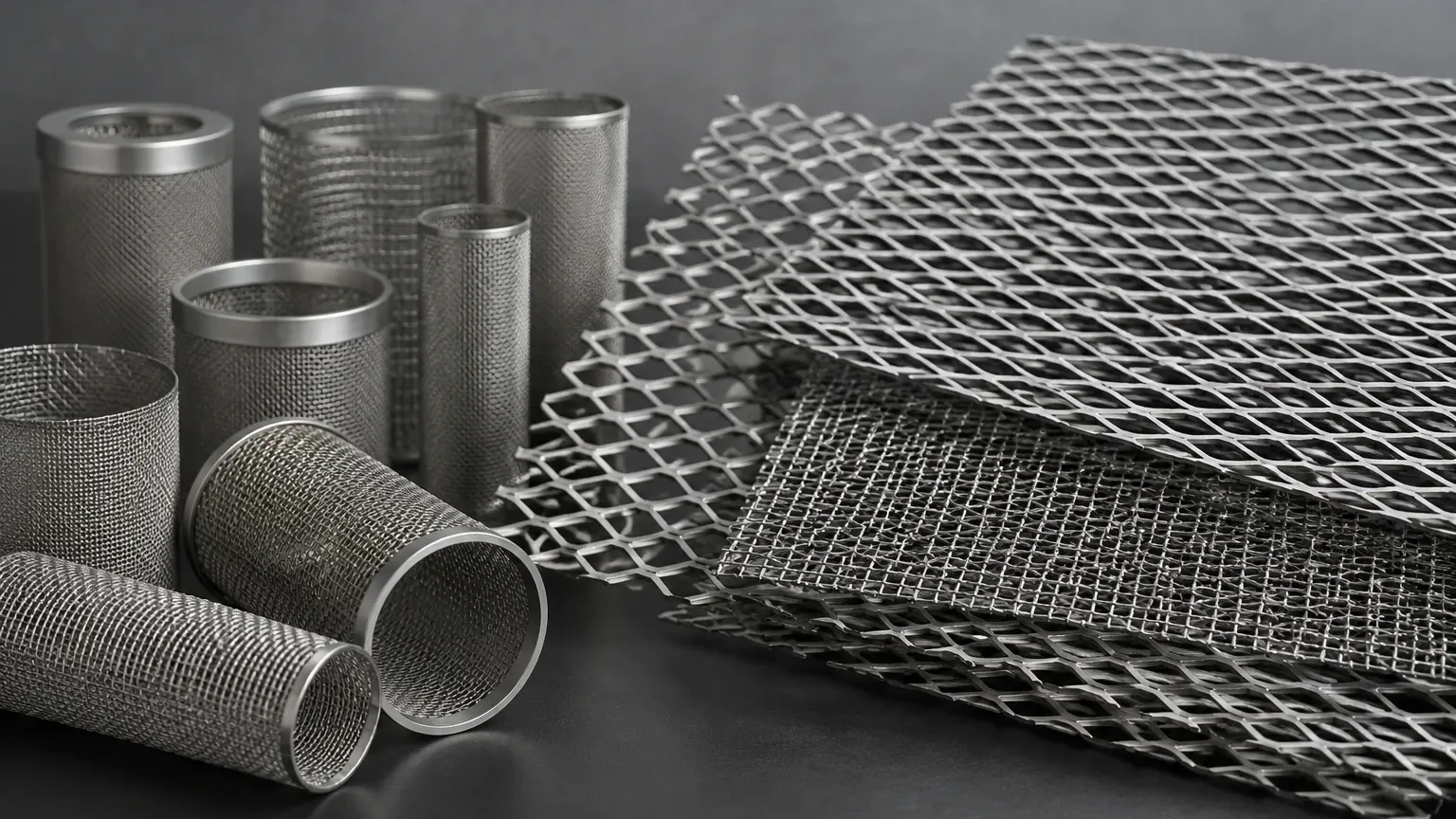
- Standard Expanded Metal: This is the material as it comes off the expanding machine. The strands and bonds are set at a uniform angle to the plane of the sheet, providing extra strength and rigidity. This form is often used in applications where a high strength-to-weight ratio is required or where the three-dimensional surface can assist in breaking up fluid flow.
- Flattened Expanded Metal: This material is passed through a cold-rolling reducing mill after the expansion process. This results in a smooth, flat surface. Flattened metal is often preferred for filtration support layers where a uniform thickness is required to prevent damage to delicate filter media, such as glass fiber or thin membranes.
Material Selection for Corrosive Environments
The success of expanded metal jobs often hinges on the chemical compatibility of the material with the process fluid. While expanded metal can be made from various alloys, stainless steel remains the industry standard for high-performance filtration and industrial components due to its resistance to oxidation and corrosion.
Stainless Steel Grade 304
Grade 304 is the most common stainless steel used in industrial mesh. It offers excellent corrosion resistance in a wide range of atmospheric environments and many corrosive media. It is frequently specified for food and beverage processing, where hygiene and durability are paramount. However, in environments with high chloride concentrations, Grade 304 may be susceptible to pitting.
Stainless Steel Grade 316 and 316L
For more demanding expanded metal jobs, such as those in marine environments or chemical processing plants involving acids and halides, Grade 316 is the preferred choice. The addition of molybdenum enhances its resistance to pitting and crevice corrosion. Grade 316L (low carbon) is often specified for components that require extensive welding, as it minimizes the risk of intergranular corrosion in the heat-affected zone.
Specialty Alloys
In extreme cases involving high temperatures or highly aggressive chemicals, engineers may specify specialty alloys like Monel, Inconel, or Hastelloy. These materials ensure that the expanded metal maintains its structural integrity even under conditions that would cause standard stainless steel to fail.
Engineering Performance: Open Area and Flow Dynamics
One of the primary reasons expanded metal is selected for filtration and separation jobs is its predictable open area. The percentage of open area is a critical calculation for engineers designing systems where pressure drop and flow rate are key performance indicators.
Calculating Open Area
The open area is determined by the relationship between the strand width and the diamond dimensions. A higher percentage of open area results in a lower pressure drop across the filter but may reduce the structural rigidity of the mesh. In B2B applications, finding the optimal balance between permeability and mechanical strength is a core engineering challenge.
Flow Turbulence and Distribution
The three-dimensional nature of standard expanded metal can be used strategically to influence fluid dynamics. In certain Perforated & Expanded Metal applications, the angled strands act as micro-vanes, promoting turbulence that can help prevent the buildup of filter cake or ensure more even distribution of a fluid across a catalyst bed. Conversely, if laminar flow is required, flattened expanded metal is typically the better choice.
Integration into Filtration Systems
Expanded metal is rarely a standalone product in an industrial setting; it is usually a component within a larger assembly. Understanding how it integrates with other parts is vital for successful expanded metal jobs.
Support for Pleated Media
In high-pressure hydraulic or air filtration, expanded metal is often used as a support pleat. It provides the necessary stiffness to prevent the filter media from collapsing under the force of the fluid flow. Because expanded metal can be produced in very thin gauges while maintaining high strength, it is an ideal choice for lightweight, high-performance filter cartridges.
Protective Shrouds and Cages
For large-scale industrial filters, expanded metal is frequently used as an outer shroud or an inner core. It protects the more fragile filtration layers from mechanical damage during installation and operation. The diamond pattern allows for maximum flow while providing a robust physical barrier against large debris.
Customization and OEM Capabilities
Many industrial projects require custom dimensions that do not fit standard stock sizes. Professional manufacturers provide OEM services that include precision shearing, circular cutting, and forming. When planning expanded metal jobs, it is important to confirm that the manufacturer can meet specific tolerances, especially for components that must fit precisely into machined housings or frames.
Quality Control and Evaluation Criteria
For procurement teams, evaluating the quality of expanded metal involves more than a visual inspection. Technical documentation and adherence to standards are necessary to ensure the material will perform as expected in the field.
1. Dimensional Accuracy: Ensure the SWD, LWD, and strand width are within the specified tolerances. Even minor deviations can significantly impact the open area percentage and flow characteristics.
2. Bond Integrity: The "bond" is where the strands intersect. In high-vibration environments, weak bonds can lead to structural failure. High-quality expanded metal should have clean, strong bonds with no signs of cracking or thinning.
3. Surface Finish: For many B2B applications, the surface must be free of burrs, oil, and scale. This is particularly important in the pharmaceutical and food industries, where contaminants can compromise the entire production batch.
4. Material Certification: Always request Mill Test Reports (MTRs) to verify the chemical composition and mechanical properties of the stainless steel or alloy used.
Maintenance and Lifecycle Considerations
The total cost of ownership for expanded metal components is influenced by their durability and ease of maintenance. In filtration applications, the ability to clean and reuse the mesh can significantly reduce long-term operational costs.
Cleaning Protocols
Stainless steel expanded metal is highly compatible with various cleaning methods, including backwashing, steam cleaning, and ultrasonic baths. Because the material is a single piece of metal with no woven wires, there are no "pockets" where bacteria or debris can easily hide, making it more hygienic than some woven wire mesh alternatives.
Replacement Cycles
While expanded metal is exceptionally durable, it is not indestructible. Engineers should establish inspection intervals to check for signs of erosion, especially in high-velocity gas or liquid streams. If the strands begin to thin or if the diamond pattern becomes distorted, the component should be replaced to prevent downstream contamination or system failure.
Conclusion
Expanded metal jobs demand a technical approach that considers the intersection of material science, fluid dynamics, and mechanical engineering. By carefully selecting the appropriate stainless steel grade, diamond geometry, and finish, industrial professionals can ensure their filtration and structural systems operate at peak efficiency. Whether the goal is to provide a robust support structure for a filter medium or to create a durable barrier in a corrosive chemical environment, the versatility and efficiency of expanded metal make it an indispensable tool in modern industrial design. For those seeking specialized solutions, reviewing professional manufacturing capabilities ensures that every specification is met with the precision required for demanding B2B applications.
