


Expanded Metal Process
In the field of industrial filtration and structural engineering, the expanded metal process represents one of the most resource-efficient methods for producing rigid, permeable metal sheets. Unlike traditional perforation methods that involve punching out material to create openings, the expanded metal process transforms a solid metal sheet into a diamond-shaped mesh through a simultaneous slitting and stretching action. For engineers and procurement specialists at firms like Kaifil, understanding the nuances of this process is critical for selecting the right components for high-performance filtration systems, support structures, and protective guards.
This article examines the technical mechanics of the expanded metal process, the engineering parameters that dictate performance, and how this material integrates into complex industrial filtration solutions.
The Fundamental Mechanics of the Expanded Metal Process
The expanded metal process is a cold-working operation that utilizes a reciprocating upper blade and a stationary lower die. The process can be broken down into three distinct stages that occur in rapid succession:
1. Slitting: The upper blade descends onto the metal sheet (typically stainless steel, carbon steel, or aluminum), creating a series of precise slits. The blade is shaped with a specific profile—usually a series of half-diamonds—that determines the eventual shape of the mesh.
2. Stretching: As the blade slits the metal, it also exerts downward pressure, stretching the metal strands. Because the metal is stretched beyond its yield point but within its ultimate tensile strength, it retains the new shape without breaking. This stretching creates the characteristic open area of the mesh.
3. Advancing: Once one row of slits is completed, the metal sheet advances forward. The blade then shifts laterally by half a diamond width before the next stroke. This offset creates the interlocking "bonds" that give expanded metal its inherent structural integrity.
One of the primary advantages of the expanded metal process is that it produces zero scrap. Every square inch of the original raw material is retained in the final product, making it a highly sustainable and cost-effective alternative to Perforated & Expanded Metal produced via traditional punching.
Engineering Parameters: Defining Mesh Geometry
When specifying expanded metal for industrial applications, engineers must define several geometric parameters. These dimensions dictate the flow rate, pressure drop, and mechanical strength of the filter component.
Long Way of Design (LWD) and Short Way of Design (SWD)
These terms refer to the distances between the centers of the bonds (the points where the strands intersect). LWD is the measurement across the long axis of the diamond, while SWD is the measurement across the short axis. These dimensions are determined by the tooling used in the expanded metal process.
Strand Width and Thickness
The strand width is the amount of metal fed into the machine between strokes. The strand thickness refers to the thickness of the original base material. It is important to note that in the expanded metal process, the resulting mesh is thicker than the original sheet because the strands are turned at an angle during the stretching phase.
Open Area Percentage
For filtration applications, the open area is a critical performance metric. It determines the volume of fluid or gas that can pass through the mesh per unit of time. By adjusting the SWD and the strand width during the expanded metal process, manufacturers can precisely control the open area to meet specific flow requirements.
Material Selection for Industrial Filtration
While the expanded metal process can be applied to various ductile metals, industrial filtration environments often demand specific chemical and thermal resistance. Kaifil specializes in stainless steel solutions, where material selection is paramount.
* 304/304L Stainless Steel: The standard choice for general industrial applications. It offers good corrosion resistance and is highly compatible with the expanded metal process.
* 316/316L Stainless Steel: Preferred for marine environments, chemical processing, and pharmaceutical applications due to the addition of molybdenum, which enhances resistance to pitting and chloride-induced corrosion.
* High-Nickel Alloys: For extreme temperatures or highly aggressive chemical environments, alloys like Monel or Inconel may be processed, though they require specialized tooling and slower machine speeds due to their high work-hardening rates.
Standard vs. Flattened Expanded Metal
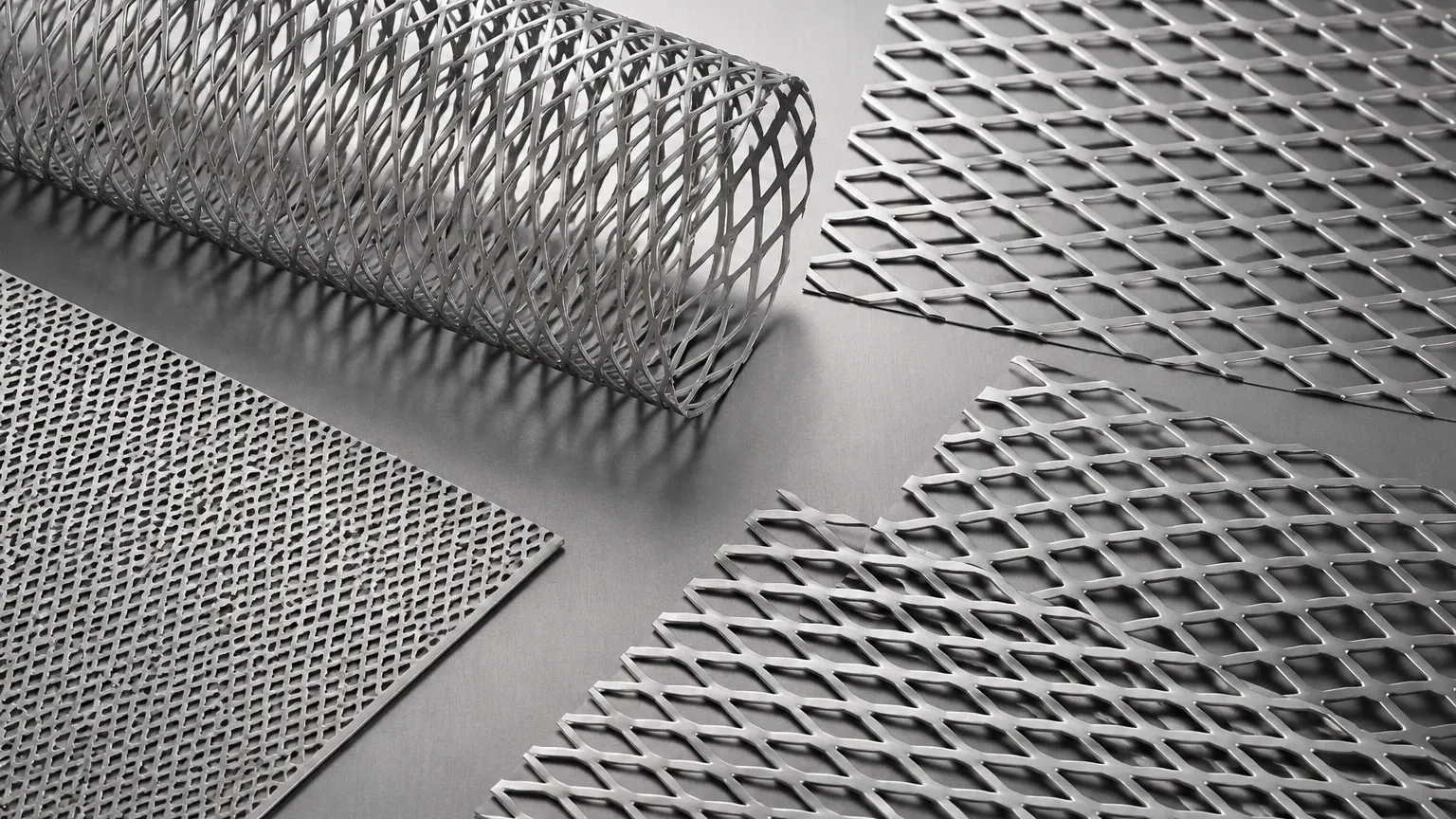
The output of the initial expanded metal process is known as "standard" or "raised" expanded metal. In this state, the strands and bonds are set at a sharp angle to the plane of the sheet. This creates a three-dimensional surface that provides excellent grip and structural rigidity but may not be suitable for all filtration designs.
To create a smooth, two-dimensional surface, the material undergoes a secondary process called flattening. The raised expanded metal is passed through a heavy-duty cold-rolling mill. This reduces the thickness of the strands and levels them into the same plane as the bonds.
Flattened expanded metal is often preferred in filter cartridges where the mesh serves as a support layer for fine wire mesh or non-woven filter media. The smooth surface prevents the delicate filtration layers from being abraded or punctured by the sharp edges of raised strands.
Comparative Analysis: Expanded Metal vs. Perforated Metal
Engineers often choose between expanded metal and perforated metal for filtration support. While both serve similar functions, the expanded metal process offers distinct technical benefits:
| Feature | Expanded Metal | Perforated Metal |
| :— | :— | :— |
| Material Waste | Zero (no scrap) | Significant (up to 40-60% waste) |
| Strength-to-Weight | High (strands are interconnected) | Moderate (holes weaken the sheet) |
| Structural Integrity | Excellent (unbroken piece of metal) | Good (but requires thicker gauges) |
| Cost | Generally lower due to material efficiency | Higher due to material loss and tooling wear |
| Flow Direction | Can be directional due to strand angle | Uniform through-hole flow |
In high-pressure hydraulic or water treatment applications, the interconnected nature of expanded metal makes it exceptionally resistant to pressure surges. Because the material is not cut or welded at the intersections, the "bonds" act as structural nodes that distribute mechanical stress evenly across the sheet.
Applications in Industrial Filtration Systems
Kaifil integrates components produced via the expanded metal process into a variety of filtration solutions. The versatility of the process allows for customization across several industrial roles:
1. Support Cores for Filter Cartridges
In pleated filter elements, the expanded metal acts as a rigid inner or outer core. It provides the necessary collapse strength to withstand high differential pressures while maintaining maximum open area for fluid flow.
2. Pre-Filtration and Trash Racks
In water treatment and HVAC systems, coarse expanded metal serves as a primary barrier to remove large debris before the fluid reaches finer filtration stages. Its durability ensures it can withstand high flow velocities and physical impact.
3. Media Pleat Support
When fine wire mesh or synthetic media is pleated to increase surface area, expanded metal can be used as a "spacer" or support layer. This prevents the pleats from collapsing against each other under pressure, ensuring the entire surface area of the filter remains active.
4. Flame Arrestors and Spark Traps
The large surface area of the strands in expanded metal makes it an effective heat sink. In gas filtration or exhaust systems, layers of expanded metal can be used to dissipate heat and extinguish flames or trap sparks.
Quality Control and Engineering Considerations
When sourcing components from the expanded metal process, engineers should confirm several quality factors to ensure long-term reliability:
* Camber and Out-of-Squareness: The stretching process can sometimes introduce internal stresses that cause the sheet to bow. Precision manufacturing involves leveling and shearing to ensure the final component meets tight dimensional tolerances.
* Edge Treatment: Expanded metal naturally has "random" edges where diamonds are cut. For safety and ease of assembly in filter housings, engineers should specify whether they require "bond edges" (closed diamonds) or if the edges will be encased in a frame or U-channel.
* Surface Cleanliness: In pharmaceutical and food-grade applications, the lubricants used during the expanded metal process must be completely removed. Ultrasonic cleaning or chemical degreasing is often required to meet industry hygiene standards.
Conclusion
The expanded metal process is a sophisticated manufacturing technique that balances material efficiency with mechanical performance. By transforming solid metal into a continuous, interconnected mesh, it provides industrial engineers with a versatile tool for fluid management, structural support, and component protection.
Whether used as a robust support core in a stainless steel filter cartridge or as a protective guard in a chemical reactor, expanded metal offers a unique combination of strength and permeability. For organizations seeking to optimize their filtration systems, selecting a partner like Kaifil—who understands the technical intricacies of the expanded metal process and material science—is essential for achieving durable and cost-effective results.
