


Expanded Metal Types
In industrial filtration and structural engineering, selecting the correct material geometry is fundamental to system longevity and performance. Expanded metal, a versatile material created by simultaneously slitting and stretching a solid sheet of metal, offers a unique combination of structural integrity and open-area efficiency. Unlike woven wire mesh, expanded metal is composed of a single piece of material, ensuring it cannot unravel and maintaining its shape under significant mechanical stress.
For engineers and procurement professionals, understanding the various expanded metal types is essential when designing filtration cores, protective cages, or support structures. Each type offers distinct characteristics regarding flow dynamics, surface smoothness, and weight-to-strength ratios. This guide examines the technical specifications and application-specific considerations for different expanded metal configurations within industrial environments.
Understanding the Expansion Process and Geometry
The manufacturing of expanded metal involves a "press" that slits and stretches the base metal in a single motion. This process creates diamond-shaped openings, though hexagonal and square patterns are also possible depending on the tooling. Because no material is lost during the process, it is often more cost-effective than perforated metal for certain applications.
To specify expanded metal accurately, engineers must use standardized terminology:
* SWD (Short Way of Design): The distance from the center of one bond to the center of the next bond across the short diamond diagonal.
* LWD (Long Way of Design): The distance across the long diamond diagonal.
* Strand Thickness: The thickness of the original base metal.
* Strand Width: The amount of metal fed into the machine for each slit.
* Bonds: The intersections where the strands meet, which provide the material's inherent rigidity.
By adjusting these parameters, manufacturers like Kaifil can produce Perforated & Expanded Metal solutions tailored to specific filtration accuracies and flow requirements.
Primary Expanded Metal Types
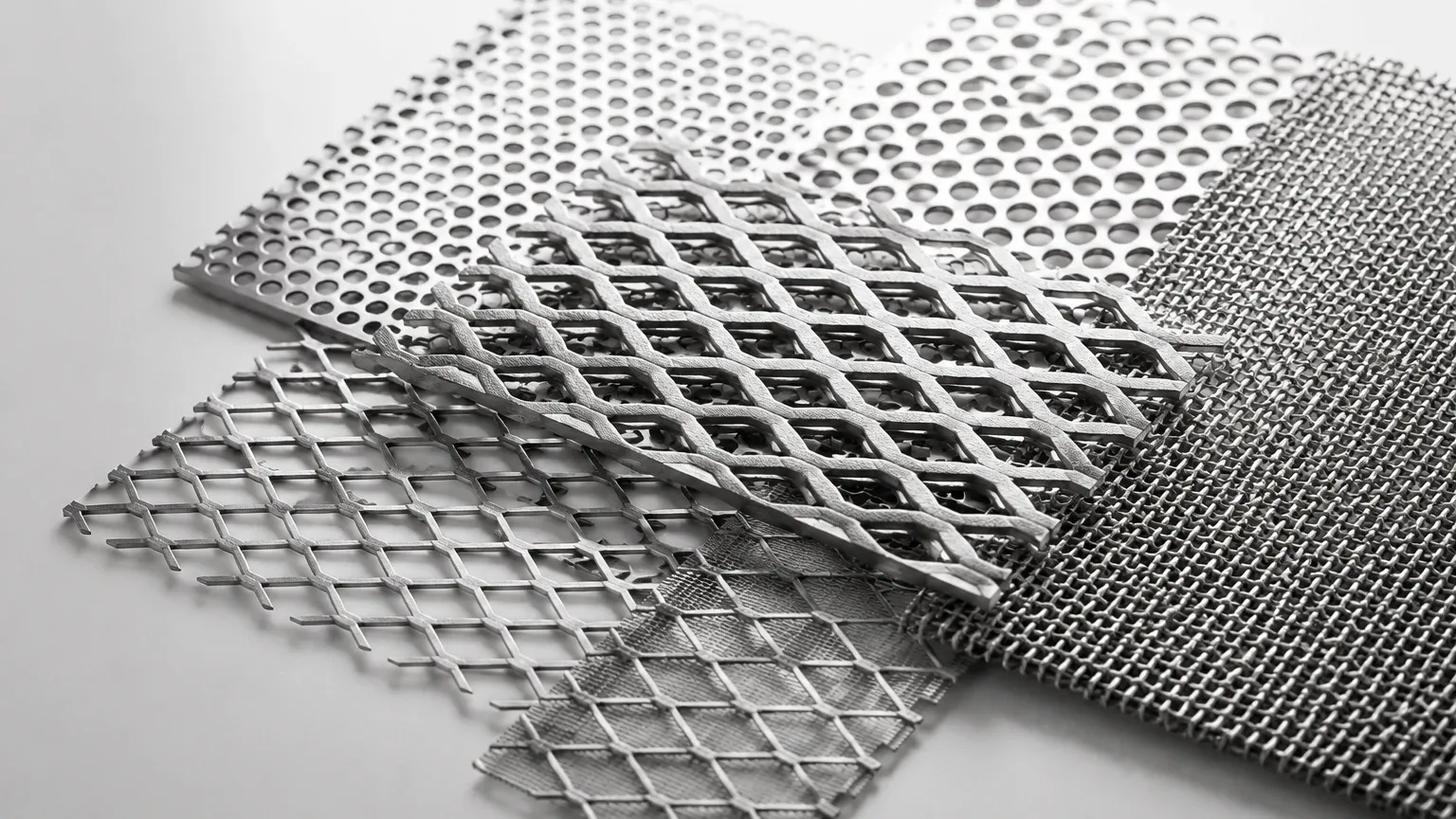
There are four primary categories of expanded metal used in industrial sectors. Choosing between these expanded metal types depends largely on whether the material will serve as a primary filter medium, a support structure, or a protective barrier.
1. Standard (Raised) Expanded Metal
Standard expanded metal is the product as it comes off the expansion press. The strands and bonds are set at a uniform angle to the plane of the sheet. This creates a three-dimensional surface that provides excellent grip and structural rigidity.
In filtration, standard expanded metal is often used as a pre-filter for large debris or as a protective outer wrap for filter cartridges. The raised strands can help break up laminar flow, which may be desirable in certain mixing or heat-exchange applications, though it does increase turbulence and pressure drop compared to flattened varieties.
2. Flattened Expanded Metal
Flattened expanded metal is produced by passing standard expanded metal through a cold-roll reducing mill. This process flattens the strands and bonds into the same plane as the original sheet. The result is a smooth, flat surface that is slightly thinner and longer than the standard version.
For industrial filtration, flattened expanded metal is often the preferred choice for support layers. When used as a backing for fine wire mesh or synthetic filter media, the smooth surface prevents the delicate media from being punctured or abraded by raised edges. It also facilitates easier cleaning and maintenance in backwash systems.
3. Micro Expanded Metal
Micro expanded metal features very small openings, often measured in microns or millimeters. These are typically manufactured from thinner foils or light-gauge sheets. Micro types are essential in precision applications such as battery electrodes, acoustic damping, and fine particle filtration. Because of the precision required in the expansion process, micro expanded metal requires specialized tooling to ensure uniformity across the entire surface area.
4. Expanded Metal Grating
While less common in the internal components of a filter, expanded metal grating is a heavy-duty type used for industrial walkways, platforms, and drainage covers. It is manufactured from heavier gauge plates and is designed to bear significant loads. In a water treatment facility or a large-scale chemical processing plant, this type of expanded metal ensures safety and durability in high-traffic areas around filtration equipment.
Material Selection for Industrial Filtration
The performance of different expanded metal types is heavily influenced by the base material. In the demanding environments of chemical processing, pharmaceuticals, and food production, material compatibility is non-negotiable.
* Stainless Steel (304, 316, 316L): The industry standard for filtration. Stainless steel expanded metal offers superior corrosion resistance and can withstand high-temperature sterilization processes. 316L is particularly valued in marine and pharmaceutical applications due to its resistance to pitting and chloride-induced stress corrosion cracking.
* Carbon Steel: Frequently used for structural support in hydraulic systems or oil filtration where the fluid provides some level of corrosion protection. It is often galvanized or coated to extend its service life.
* Aluminum: Selected for applications requiring weight reduction, such as aerospace filtration or portable equipment. Aluminum expanded metal also offers good corrosion resistance in specific atmospheric conditions.
* Specialty Alloys: For highly aggressive chemical environments, materials like Monel, Inconel, or Titanium may be expanded to provide the necessary chemical stability.
Engineering Considerations: Open Area and Pressure Drop
One of the most critical factors for an engineer selecting between expanded metal types is the percentage of open area. This figure directly impacts the flow rate and the initial pressure drop across the filter assembly.
Calculating the open area involves the relationship between the strand width and the SWD. A larger open area reduces the resistance to fluid or gas flow but may decrease the mechanical strength of the component. In high-pressure hydraulic applications, a balance must be struck: the expanded metal must be strong enough to support the filter media against collapse (differential pressure) while remaining open enough to prevent excessive energy loss in the system.
When evaluating Perforated & Expanded Metal, it is important to request technical data sheets that specify the open area percentage and the load-bearing capacity for the specific orientation (LWD vs. SWD) of the material.
Common Risks and Quality Evaluation
Integrating expanded metal into a high-performance filtration system requires rigorous quality control. Several common risks can compromise the integrity of the final product:
1. Burrs and Sharp Edges: The expansion process naturally creates sharp edges. In standard expanded metal, these burrs can damage filter media or injure maintenance personnel. For high-purity applications, deburring or electropolishing may be required.
2. Inconsistent Expansion: If the tension or the feed rate is inconsistent during manufacturing, the diamond shapes may vary in size. This leads to uneven flow distribution and localized high-velocity zones that can prematurely wear out the filter media.
3. Material Fatigue: At the bonds where the metal is most severely deformed during expansion, micro-cracks can occur. These areas are susceptible to stress corrosion cracking if the material is not properly annealed or if the expansion ratio is too aggressive for the specific alloy.
4. Flatness Tolerances: For flattened expanded metal used in multi-layer laminates, any "bow" or "camber" in the sheet can prevent proper bonding or sealing within the filter housing.
Customization and OEM Solutions
Standard off-the-shelf expanded metal rarely meets the exacting needs of specialized industrial filtration. Customization is often necessary to optimize performance. Manufacturers like Kaifil provide OEM services that allow for precise control over the expansion parameters.
Customization options include:
* Specific Dimensions: Cutting to size or providing slit-to-width coils to fit automated assembly lines.
* Forming and Welding: Rolling expanded metal into cylinders or cones for use as filter cores or strainers.
* Surface Treatments: Including annealing to remove internal stresses, or plating and coating for enhanced chemical resistance.
* Integrated Designs: Combining expanded metal with other components, such as solid metal end caps or internal support rings, to create a complete filtration sub-assembly.
Conclusion: Selecting the Right Type for Your Application
Choosing the correct expanded metal types involves more than just selecting a pattern that looks appropriate. It requires a technical evaluation of the fluid dynamics, the mechanical loads, and the chemical environment of the application.
For support layers where surface smoothness is paramount, flattened expanded metal is the logical choice. For protective cages or pre-filtration where rigidity and debris deflection are more important, standard raised expanded metal may be more effective. In all cases, verifying the material grade, open area, and manufacturing tolerances is essential to ensuring the reliability of the filtration system.
When sourcing components, engineers should confirm that the supplier can provide material certifications and maintain tight tolerances across production batches. By understanding the nuances of expanded metal geometry and material properties, purchasing teams can secure components that offer the best total cost of ownership through durability and optimized performance. For more detailed technical specifications and support in selecting the right material for your project, explore our range of Perforated & Expanded Metal solutions.
