


Expanded Metal Xs42
In the landscape of industrial filtration and structural engineering, the selection of support media is as critical as the selection of the primary filtration layer. Expanded metal xs42 represents a specific heavy-duty grade of expanded mesh frequently utilized in demanding industrial environments. Unlike perforated metals that are created by punching holes and generating scrap, expanded metal is produced by simultaneously slitting and stretching the material. This process results in a diamond-shaped pattern that offers an exceptional strength-to-weight ratio, making it a preferred choice for engineers designing high-pressure filtration systems and robust mechanical guards.
For technical professionals and procurement teams, understanding the nuances of expanded metal xs42 is essential for ensuring the longevity and efficiency of industrial equipment. This guide examines the technical specifications, material considerations, and application-specific benefits of this particular mesh grade within the context of professional filtration solutions.
Technical Specifications and Geometry of XS42
The designation "XS42" typically refers to a specific set of geometric properties within the expanded metal hierarchy. To evaluate its suitability for a project, engineers must focus on four primary dimensions: the Long Way of the Diamond (LWD), the Short Way of the Diamond (SWD), the strand width, and the material thickness.
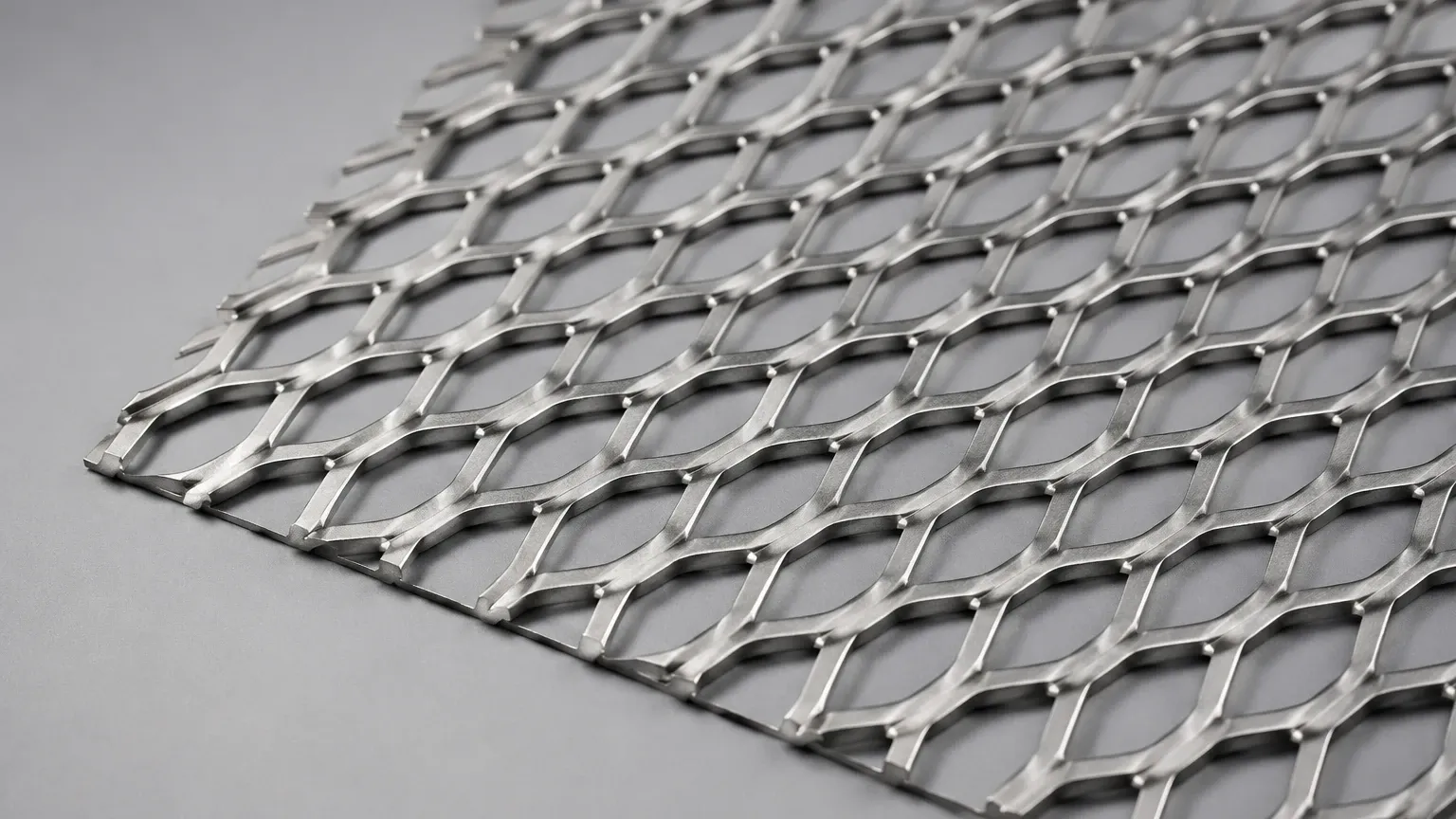
In the case of expanded metal xs42, the geometry is engineered for structural rigidity. The LWD usually measures approximately 30mm to 45mm, while the SWD is tighter, providing a dense enough pattern to support fine wire mesh layers without allowing for significant media migration or sagging. The "raised" or "standard" version of this mesh features strands that are set at an angle to the plane of the sheet. This angularity increases the overall thickness of the panel, providing enhanced mechanical grip and turbulence in fluid flow applications, which can be advantageous in certain chemical processing stages.
When specifying Perforated & Expanded Metal, the open area percentage is perhaps the most critical metric for filtration. Expanded metal xs42 offers a high percentage of open area—often exceeding 60%—which ensures minimal resistance to fluid or gas flow. This low pressure drop is vital for maintaining the energy efficiency of pumps and compressors within a larger industrial circuit.
Material Selection and Environmental Compatibility
While expanded metal xs42 can be manufactured from various alloys, stainless steel remains the industry standard for high-performance applications. The choice of material directly impacts the total cost of ownership and the replacement cycle of the filtration component.
Stainless Steel 304 vs. 316L
For most general industrial applications, Grade 304 stainless steel provides adequate corrosion resistance and structural integrity. However, in environments involving marine exposure, high chloride concentrations, or acidic chemical processing, Grade 316L is required. The addition of molybdenum in 316L significantly improves resistance to pitting and crevice corrosion, which is a common failure point in expanded metal due to the numerous intersections (bonds) created during the expansion process.
Specialty Alloys
In extreme cases, such as high-temperature exhaust filtration or aggressive pharmaceutical synthesis, materials like Monel, Inconel, or Hastelloy may be utilized. These alloys maintain their mechanical properties at temperatures where standard stainless steels would undergo oxidation or creep. When selecting expanded metal xs42, engineers must confirm the chemical compatibility of the alloy with the process fluid to prevent premature structural failure.
The Role of XS42 in Industrial Filtration Systems
In industrial filtration, expanded metal xs42 rarely acts as the primary particulate barrier. Instead, it serves two vital secondary roles: as a support structure (pleat support) and as a coarse pre-filter.
Structural Support for Fine Media
Fine wire mesh filters, capable of capturing micron-sized particles, lack the inherent stiffness to withstand high differential pressures. Expanded metal xs42 is often used as an outer cage or an inner core in stainless steel filter cartridges. By providing a rigid skeleton, the XS42 layer prevents the fine mesh from collapsing or deforming under the force of the fluid flow. This is particularly important in hydraulic systems where pressure spikes are frequent.
Pre-Filtration and Debris Management
In water treatment or raw chemical intake, expanded metal xs42 acts as a robust barrier against large debris, such as scale, stones, or biological matter. Its diamond pattern is effective at catching irregular shapes that might pass through a simple round-hole perforated plate. By removing these large contaminants, the XS42 layer protects the more delicate and expensive downstream filtration stages from mechanical damage.
Manufacturing and Customization Options
One of the primary advantages of working with a specialized manufacturer like Kaifil is the ability to customize the physical state of the expanded metal xs42 to meet specific engineering tolerances.
Flattened vs. Raised Mesh
Standard expanded metal (raised) has a textured surface where the strands are tilted. For applications where a smooth profile is required—such as when the mesh is in direct contact with a delicate filter membrane—the mesh can be "flattened." Flattening involves passing the raised expanded metal through a cold-rolling reducing mill. This process reduces the thickness of the sheet and creates a smooth, level surface, though it slightly increases the LWD and reduces the overall rigidity compared to the raised version.
OEM and Precision Fabrication
For integration into complex machinery, expanded metal xs42 can be supplied in custom-cut sheets, discs, or formed cylinders. Precision welding is required to join the ends of an expanded metal cylinder to ensure there is no "particulate bypass" at the seam. High-quality OEM services ensure that the mesh is degreased and deburred, removing any residual oils or sharp edges that could contaminate a sterile process or injure maintenance personnel.
Engineering Considerations: Strength and Flow Dynamics
When integrating expanded metal xs42 into a system design, engineers must look beyond simple dimensions and consider the dynamic behavior of the material under load.
Pressure Drop and Turbulence
The geometry of expanded metal creates a non-linear flow path. While this can increase the pressure drop slightly compared to a straight-hole perforated sheet of the same open area, the resulting turbulence can be beneficial. In heat exchange or certain catalytic reactions, this turbulence ensures better mixing and more uniform temperature distribution. Engineers must use computational fluid dynamics (CFD) or empirical testing to determine the exact impact of the XS42 layer on the system's total head loss.
Load-Bearing Capacity
Expanded metal is unique because it is a single piece of material; there are no joints or welds within the mesh itself (unlike woven wire mesh). This makes expanded metal xs42 exceptionally resistant to vibration fatigue. In heavy industrial machinery where constant oscillation is present, the monolithic structure of the expanded metal ensures that the mesh will not unravel or fray over time.
Procurement and Quality Verification
To ensure the reliability of a filtration system, the purchasing process for expanded metal xs42 must involve rigorous technical verification. Procurement teams should focus on the following criteria before finalizing an order:
1. Material Certification: Always request Mill Test Reports (MTRs) to verify the chemical composition of the stainless steel. This ensures the material meets the specific grade (e.g., 316L) required for corrosion resistance.
2. Dimensional Tolerances: Specify the allowable variance in LWD, SWD, and overall sheet thickness. In precision filtration, even a 1mm deviation can affect the fitment of the filter cartridge within its housing.
3. Surface Finish: For food and beverage or pharmaceutical applications, the mesh may require electropolishing to remove microscopic surface irregularities where bacteria could proliferate.
4. Edge Configuration: Determine if the mesh should have "random shears" (sharp edges) or "bond shears" (closed diamonds at the edges). Bond shearing is generally preferred for safety and ease of handling during installation.
Total Cost of Ownership and Maintenance
While the initial cost of stainless steel expanded metal xs42 is higher than carbon steel or plastic alternatives, the total cost of ownership is often lower due to its durability. In many industrial settings, these components are designed to be permanent or semi-permanent.
Maintenance typically involves periodic cleaning. Because of the open diamond structure, expanded metal is relatively easy to clean via backwashing or ultrasonic baths. Unlike woven meshes, which can trap particles within the wire intersections, the smooth strands of expanded metal allow for more effective release of captured solids. However, if the mesh shows signs of "blinding" (permanent clogging) or stress fractures at the bonds, it must be replaced immediately to prevent a catastrophic failure of the downstream filtration elements.
Conclusion
Expanded metal xs42 is a versatile and robust solution for industrial professionals seeking a balance between high flow rates and structural strength. Whether used as a protective guard, a support core for a filter cartridge, or a primary screen for coarse materials, its unique geometric properties provide reliable performance in the most demanding environments. By selecting the appropriate material grade and manufacturing finish, engineers can optimize their systems for both efficiency and longevity. For those evaluating custom filtration components, exploring the full range of Perforated & Expanded Metal options is the first step toward achieving a high-performance, cost-effective industrial solution.
