


Expanded Metal X 22
In the landscape of industrial filtration and structural support, material selection is dictated by the balance between mechanical strength, open area, and weight. Expanded metal x 22 represents a specific classification of metal mesh that is frequently utilized in precision engineering applications, particularly where lightweight yet rigid support structures are required. Unlike woven wire mesh or perforated sheets, expanded metal is produced through a unique process of simultaneous slitting and stretching, which results in a continuous, jointless piece of material with diamond-shaped openings.
For engineers and procurement specialists, understanding the nuances of expanded metal x 22 involves looking beyond the surface dimensions. It requires an analysis of the gauge, the geometry of the diamond openings, and the metallurgical properties of the base material. As a critical component in many filtration systems, expanded metal serves as the backbone for delicate filter media, providing the necessary reinforcement to withstand high-pressure differentials without compromising the flow characteristics of the system.
Understanding the Technical Specifications of Expanded Metal X 22
The designation "x 22" typically refers to the gauge of the base metal used in the expansion process. In the context of stainless steel and carbon steel industrial standards, 22-gauge material has a nominal thickness of approximately 0.030 inches (0.76 mm). When this sheet undergoes the expansion process, it is transformed into a mesh that maintains the structural integrity of the original metal while significantly increasing its surface area and decreasing its weight per square foot.
Geometric Parameters: SWD and LWD
To specify expanded metal x 22 accurately, engineers must define the diamond dimensions, which are categorized by two primary measurements:
1. SWD (Short Way of Diamond): The distance from the center of one bond to the center of the next bond measured across the short axis of the diamond.
2. LWD (Long Way of Diamond): The distance from the center of one bond to the center of the next bond measured across the long axis of the diamond.
For a 22-gauge expanded metal, the SWD often ranges from 0.125 inches to 0.5 inches, depending on the intended application. A smaller SWD provides a denser mesh with higher mechanical strength, whereas a larger SWD increases the open area and reduces the pressure drop across the filter element.
Strand Width and Thickness
The strand width is the amount of metal fed into the machine between each stroke of the upper die. In expanded metal x 22, the strand width is a critical variable that determines the final open area percentage. The strand thickness, conversely, remains equal to the original gauge of the base metal (unless the material is subsequently flattened).
Manufacturing Precision: Perforated & Expanded Metal Comparison
When evaluating Perforated & Expanded Metal for industrial use, it is essential to distinguish between the two manufacturing methods and how they impact performance. Perforated metal is created by punching holes into a solid sheet, which results in significant material waste (the "slugs"). In contrast, expanded metal is produced by slitting and stretching, which involves zero material waste and creates a higher strength-to-weight ratio.
Raised vs. Flattened Expanded Metal
Expanded metal x 22 is available in two primary forms:
* Standard (Raised): The strands and bonds are set at a uniform angle to the plane of the sheet. This creates a three-dimensional surface that offers excellent grip and can facilitate turbulent flow in certain filtration applications, which may be desirable for breaking up boundary layers.
* Flattened: The raised expanded metal is passed through a cold-rolling reducing mill. This process flattens the strands and bonds into the same plane as the sheet, resulting in a smooth, level surface. Flattened expanded metal x 22 is often preferred when the mesh serves as a support layer for fine wire cloth or synthetic membranes, as the smooth surface prevents abrasion or puncturing of the delicate media.
Material Selection for Industrial Filtration Environments
The performance of expanded metal x 22 is heavily dependent on the alloy selected. In industrial filtration, where exposure to corrosive chemicals, high temperatures, and high-pressure cleaning cycles is common, stainless steel is the industry standard.
Stainless Steel 304 and 316
* Type 304: This is the most common grade for general industrial use. It provides excellent mechanical properties and good resistance to atmospheric corrosion and many organic and inorganic chemicals. It is frequently used in food and beverage applications where hygiene and durability are paramount.
* Type 316: For more demanding environments, such as chemical processing or marine applications, Type 316 stainless steel is preferred. The addition of molybdenum enhances its resistance to pitting and crevice corrosion in chloride-rich environments. In pharmaceutical filtration, 316L (low carbon) is often specified to ensure maximum corrosion resistance after welding.
Beyond stainless steel, expanded metal can be produced from aluminum for lightweight applications, or specialty alloys like Monel or Inconel for extreme temperature and chemical resistance. However, for the majority of B2B filtration solutions, stainless steel 22-gauge expanded metal provides the optimal balance of cost and performance.
Structural Role in Filter Cartridge Design
In the construction of industrial filter cartridges, expanded metal x 22 serves several critical functions. It is rarely the primary filtration medium for fine particles; instead, it acts as a structural component that enables the overall assembly to function under stress.
Support Cores and Outer Guards
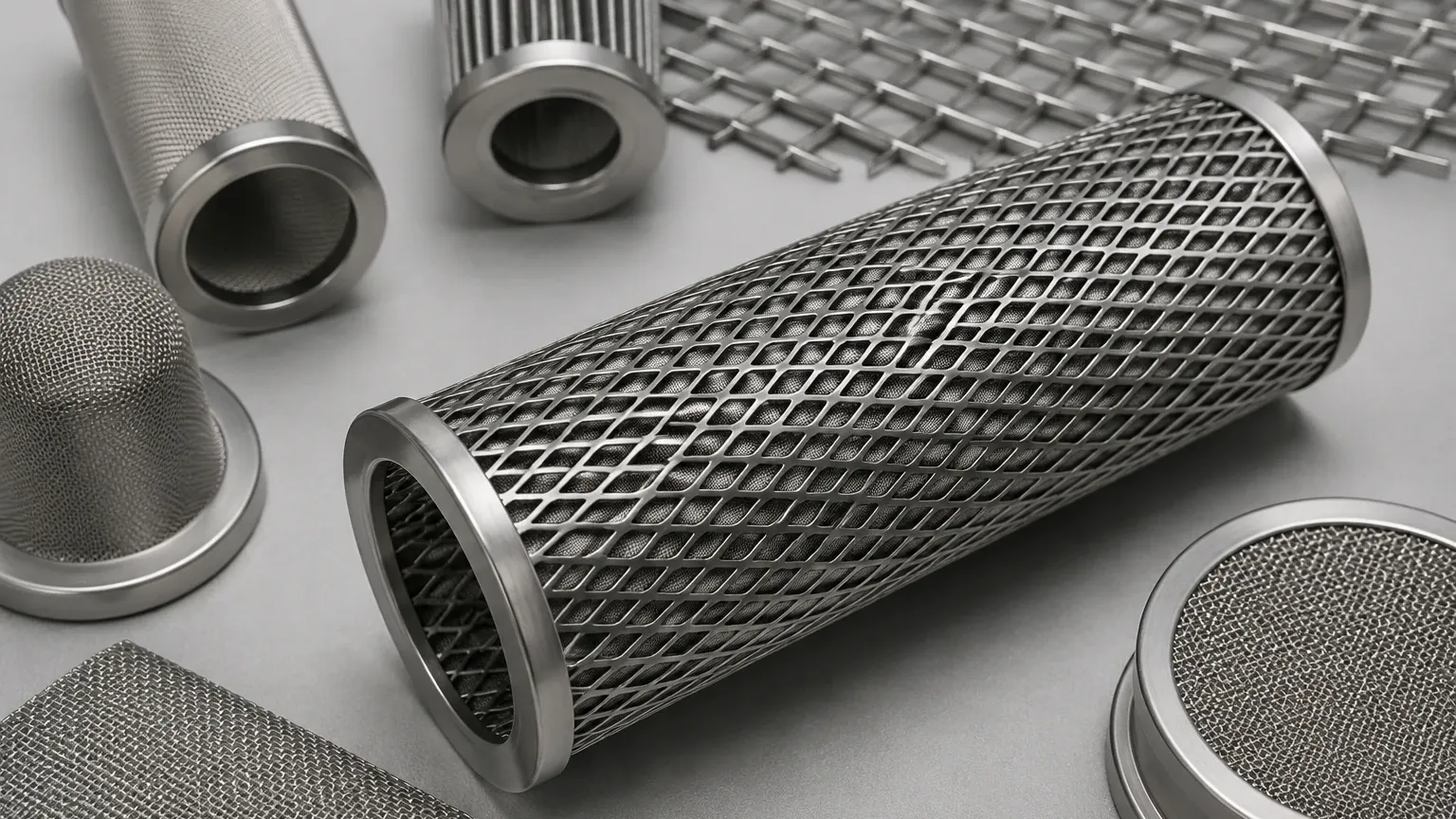
Most high-performance filter cartridges consist of a pleat pack or a multi-layered mesh cylinder. Expanded metal is used as the inner core to prevent the filter media from collapsing inward under the pressure of the fluid flow. It is also used as an outer guard to protect the media from mechanical damage during installation or backwashing.
Because expanded metal x 22 is thin yet rigid, it allows for a high pleat count in pleated filters. The diamond pattern provides multiple contact points for the filter media, ensuring that the pleats remain open and the full surface area of the filter is utilized. This prevents "pleat bunching," a common failure mode that leads to premature pressure spikes and reduced service life.
Flow Distribution
The angular nature of standard (raised) expanded metal can assist in flow distribution. As fluid enters a filter housing, the expanded metal guard can help diffuse the velocity, preventing direct impingement on the primary filter media. This uniform distribution is essential for maintaining consistent filtration efficiency across the entire length of the cartridge.
Key Evaluation Criteria for Engineers and Purchasing Teams
Selecting the right expanded metal x 22 requires a rigorous evaluation of technical data. When requesting quotes or reviewing specifications, engineers should focus on the following criteria:
Open Area Percentage
The open area determines the flow capacity and the pressure drop (delta P). For expanded metal x 22, the open area can vary significantly based on the SWD and strand width. A typical 1/2" #22 expanded metal might offer an open area of approximately 65% to 75%. Engineers must calculate the required flow rate and ensure the mesh does not become a bottleneck in the system.
Mechanical Integrity and Tolerances
In high-vibration environments or high-pressure systems, the structural integrity of the bonds (the points where the strands meet) is vital. Any weakness in the expansion process can lead to strand breakage, which could potentially bypass the filter or damage downstream equipment. Dimensional tolerances for LWD, SWD, and overall sheet flatness should be confirmed to ensure compatibility with automated assembly or welding processes.
Surface Finish and Cleanliness
For industries such as pharmaceuticals or food processing, the surface finish of the expanded metal is non-negotiable. The manufacturing process of slitting and stretching can leave microscopic burrs or oil residues. Specifying passivated or electropolished stainless steel expanded metal x 22 ensures that the component meets stringent cleanliness standards and is free from contaminants that could leach into the process stream.
Common Risks and Quality Assurance in Metal Mesh Procurement
Procuring industrial-grade expanded metal involves navigating several potential risks. One common issue is "gauge thinning," where the stretching process is pushed beyond the material's limits, resulting in strands that are thinner than specified. This compromises the burst strength of the filter core.
Another risk is the presence of sharp edges. While expanded metal inherently has sharp edges due to the slitting process, high-quality manufacturers employ deburring and edge-rolling techniques to ensure the material is safe to handle and does not damage other components in the filter assembly.
To mitigate these risks, purchasing teams should confirm that the supplier provides:
* Material Test Reports (MTRs): To verify the chemical composition and mechanical properties of the alloy.
* Dimensional Inspection Reports: To ensure the SWD, LWD, and strand dimensions meet the engineering drawings.
* Compliance Certifications: Such as FDA compliance for food-contact materials or ISO quality management certifications.
Customization and OEM Solutions for Specialized Applications
Standard off-the-shelf expanded metal sizes are often insufficient for specialized industrial applications. Customization is frequently required in terms of sheet size, coil width, and specific diamond dimensions to optimize the performance of a filtration system.
Tailored Diamond Geometries
By adjusting the tooling and the feed rate during production, manufacturers can create custom expanded metal x 22 with specific diamond shapes. For example, a "micro-expanded" pattern might be used for fine-particle pre-filtration, while a wider diamond might be used for heavy-duty support in viscous fluid applications.
Secondary Processing
Beyond the expansion process, secondary operations such as shearing, bending, rolling, and welding are often necessary to integrate the expanded metal into a final product. Choosing a partner with comprehensive manufacturing capabilities allows for the delivery of ready-to-install components, reducing assembly time and ensuring that the tolerances of the expanded metal are maintained through the final stage of production.
In conclusion, expanded metal x 22 is a versatile and essential material in the world of industrial filtration. Its unique combination of lightweight design, structural rigidity, and high open area makes it an ideal choice for support cores, guards, and primary filtration layers. By focusing on technical specifications, material quality, and the specific needs of the application, engineers can leverage this material to achieve efficient, durable, and cost-effective filtration performance.
