


Flat Perforated Metal Sheets
In industrial engineering and filtration design, flat perforated metal sheets serve as a foundational component for a wide array of mechanical systems. These sheets are produced by punching a series of holes into a solid metal substrate, creating a material that balances structural integrity with permeable functionality. For engineers and procurement specialists, the selection of these sheets involves more than simply choosing a hole size; it requires a deep understanding of material properties, manufacturing tolerances, and the mechanical stresses the component will face during its service life.
As a core element of Perforated & Expanded Metal solutions, flat perforated sheets are utilized across industries ranging from chemical processing to food production. Their primary role often involves acting as a support structure for finer filtration media or serving as a primary screen for coarse particle separation. Achieving the necessary precision in these components is critical to ensuring the longevity and efficiency of the larger industrial system.
Technical Specifications and Material Selection
The performance of flat perforated metal sheets is fundamentally dictated by the material from which they are fabricated. In demanding industrial environments, stainless steel is the preferred choice due to its mechanical strength and resistance to environmental degradation.
Stainless Steel Grades (304 vs. 316L)
* Grade 304: This is the most common stainless steel used for perforated sheets. It offers excellent corrosion resistance in most atmospheric conditions and is highly weldable. It is suitable for general industrial applications where extreme chemical exposure is not a primary concern.
* Grade 316L: Containing molybdenum, 316L provides superior resistance to chlorides and acids. In industries such as marine engineering, pharmaceutical manufacturing, and chemical processing, 316L is the standard for preventing pitting and crevice corrosion. The "L" designation indicates low carbon content, which minimizes carbide precipitation during welding, ensuring the structural integrity of the perforated pattern remains intact at the joints.
Specialized Alloys
For environments involving extreme temperatures or highly aggressive caustic agents, specialized alloys like Monel, Inconel, or Hastelloy may be required. These materials maintain their mechanical properties under thermal stress and offer specialized resistance to oxidation and reduction cycles.
Engineering Parameters: Hole Patterns and Open Area
The geometry of the perforations determines both the flow characteristics and the structural strength of the sheet. Engineers must calculate the "open area percentage" to predict pressure drop and filtration efficiency.
Common Hole Geometries
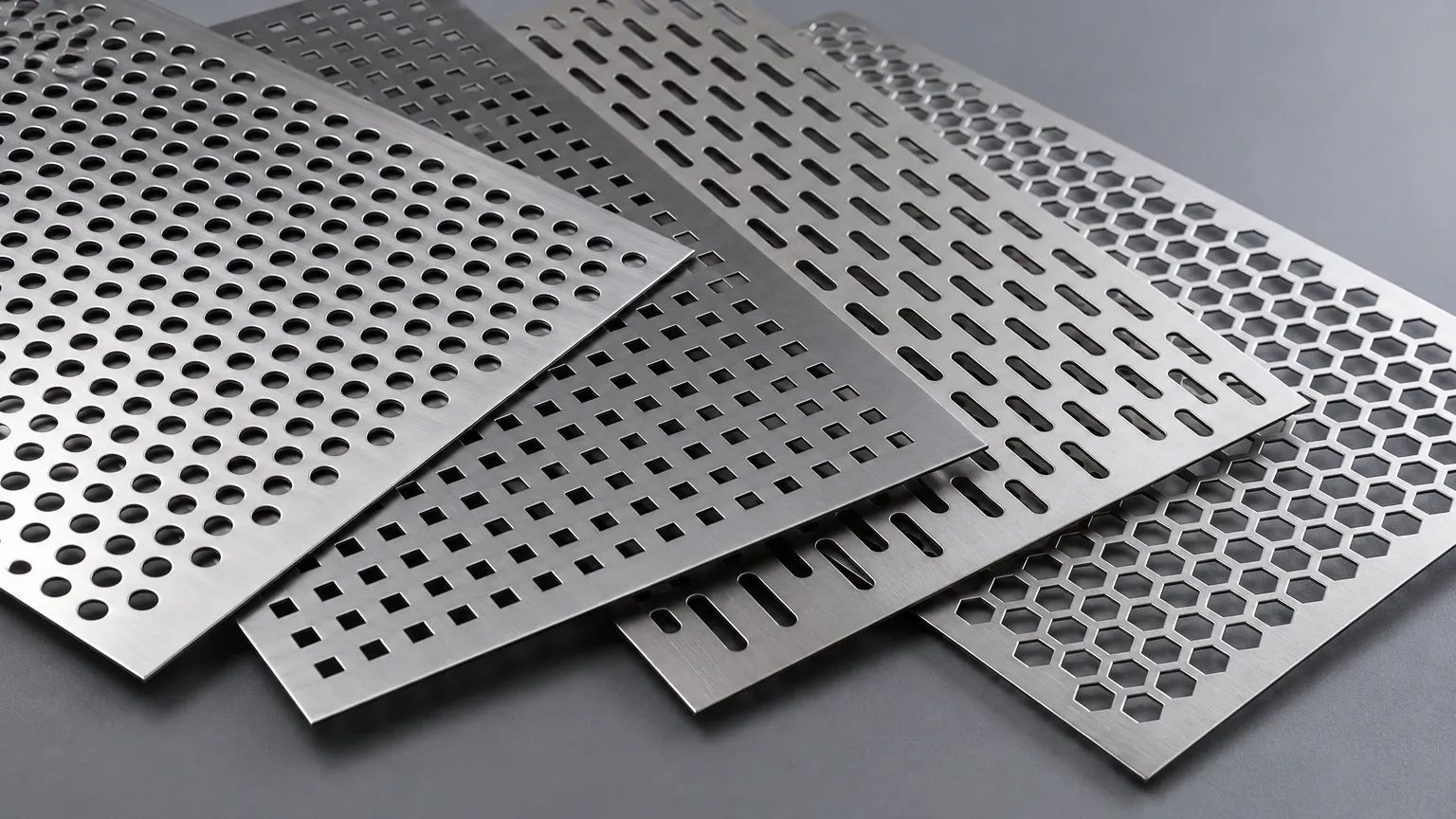
1. Round Holes: The most versatile and common pattern. Round holes offer the highest structural strength and are the easiest to manufacture with high precision. They are typically arranged in a 60-degree staggered pattern, which maximizes the open area while maintaining sheet rigidity.
2. Square Holes: Often used when a higher open area is required for high-flow applications. However, square holes create stress concentration points at the corners, which can lead to fatigue over time if the sheet is subjected to high-pressure pulses.
3. Slotted Holes: These are ideal for the filtration of elongated particles or for use in vibrating screens where material flow direction is critical.
Calculating Open Area
For a standard 60-degree staggered round hole pattern, the open area percentage is calculated using the formula:
Open Area % = (D² × 90.69) / P²
Where:
* D = Hole Diameter
* P = Pitch (the distance from the center of one hole to the center of the adjacent hole)
Selecting a high open area improves flow rates but reduces the load-bearing capacity of the sheet. In hydraulic or high-pressure gas applications, a balance must be struck between the "ligament" (the metal remaining between the holes) and the required throughput.
The Importance of Flatness and Precision Leveling
A common challenge in the production of flat perforated metal sheets is the internal stress introduced during the punching process. As the punch enters the metal, it displaces material, which can cause the sheet to bow, curl, or develop "oil canning" (a localized buckling).
The Leveling Process
To ensure the sheets are truly flat, they must undergo a precision leveling process. This involves passing the perforated sheet through a series of rollers that apply calculated pressure to neutralize internal stresses. For B2B applications where the sheet must be welded into a cylindrical filter cartridge or fitted into a tight housing, flatness tolerances are non-negotiable. A sheet that is not properly leveled will create gaps during assembly, leading to bypass issues or mechanical failure under vibration.
Edge Margins and Tolerances
Customization of margins—the unperforated areas along the edges of the sheet—is essential for subsequent fabrication. "Safe margins" (areas without holes) allow for easier welding and provide a solid surface for gaskets or mounting brackets. Engineers should specify the required margin width on all four sides to ensure the sheet integrates seamlessly into the final assembly.
Manufacturing Processes and Quality Control
Reliable filtration components depend on a controlled manufacturing environment. The process begins with the selection of high-quality coils or plates, followed by CNC-controlled punching to ensure hole consistency across the entire surface.
Deburring and Surface Finishing
The punching process naturally creates burrs on the exit side of the hole. In filtration applications, these burrs can trap contaminants, cause turbulence, or even break off and damage downstream equipment. Mechanical deburring is necessary to create a smooth surface. Furthermore, post-processing treatments like passivation or electropolishing are often employed to enhance the corrosion resistance of stainless steel by restoring the protective chrome-oxide layer.
Quality Assurance Metrics
When evaluating flat perforated metal sheets, technical teams should confirm the following:
* Dimensional Accuracy: Tolerance on length, width, and thickness.
* Hole Consistency: Verification that hole diameters do not deviate across the sheet.
* Material Certification: Mill test reports (MTRs) to verify the chemical composition of the alloy.
* Flatness Specification: Maximum allowable deviation per linear foot.
Industrial Applications for Flat Perforated Sheets
Flat perforated metal sheets are utilized as both standalone filtration elements and as components within complex systems.
Chemical and Petrochemical Processing
In these sectors, perforated sheets are used in catalyst support grids and reactor internals. The ability of stainless steel to withstand aggressive solvents and high temperatures makes it the primary choice. The sheets must be engineered to handle the weight of the catalyst bed while allowing for uniform fluid distribution.
Food and Beverage Industry
Sanitary requirements dictate the use of smooth, easily cleanable surfaces. Flat perforated sheets are used in grain drying, fruit juice extraction, and brewery lauter tuns. Here, the absence of burrs and the use of food-grade 304 or 316L stainless steel are mandatory to prevent bacterial growth and ensure compliance with safety standards.
Water Treatment and Desalination
Perforated sheets serve as the first line of defense in intake screens, removing large debris before the water reaches more sensitive membranes or fine filters. In desalination plants, the high salt concentration requires the use of 316L or Duplex stainless steel to prevent rapid corrosion.
Hydraulic and Lubrication Systems
In high-pressure hydraulic systems, perforated metal acts as a "diffuser" or a support core for pleated wire mesh filters. The sheet provides the mechanical strength needed to prevent the mesh from collapsing under the force of high-viscosity fluids or sudden pressure spikes.
Customization and OEM Considerations
For many industrial projects, standard off-the-shelf perforated sheets are insufficient. Customization allows engineers to tailor the component to the exact needs of the application.
Tailored Hole Patterns
Beyond standard round holes, OEM manufacturers can produce custom patterns designed for specific flow dynamics or acoustic dampening properties. This includes varying the hole size across a single sheet to manage flow distribution in a vessel.
Specialized Shapes and Fabrication
While the starting point is a flat sheet, these components are often further processed into discs, cones, or cylinders. Choosing a manufacturer with integrated fabrication capabilities—such as precision shearing, rolling, and TIG/plasma welding—ensures that the final component maintains the required tolerances from the initial perforation through to the final assembly.
Maintenance and Replacement Cycles
The service life of flat perforated metal sheets depends on the erosive and corrosive nature of the environment. In abrasive applications, such as mining or heavy slurry filtration, the edges of the holes will eventually wear down, increasing the hole diameter and reducing filtration accuracy.
Inspection Protocols
Regular inspection should focus on:
* Erosion Patterns: Checking for thinning of the ligaments between holes.
* Stress Cracking: Inspecting the areas around the holes for microscopic cracks, especially in high-vibration environments.
* Blinding/Clogging: Monitoring the buildup of scale or particulates that cannot be removed by backwashing.
By establishing a predictable replacement cycle based on these observations, plant managers can avoid catastrophic failures and maintain optimal system performance.
Conclusion: Selecting a Reliable Partner
Flat perforated metal sheets are critical engineering components that require precision manufacturing and rigorous material selection. Whether used in a chemical reactor, a food processing line, or a hydraulic system, the quality of the perforation and the flatness of the sheet directly impact the efficiency and safety of the operation.
When sourcing these materials, it is essential to work with a manufacturer that understands the technical nuances of industrial filtration. From material selection and hole pattern optimization to precision leveling and deburring, every step of the process must be executed with an eye toward the final application. By focusing on technical accuracy and engineering support, procurement teams can ensure they receive filtration solutions that meet the demanding requirements of modern industry.
