


Perforated Metal Gutter Guards
In industrial and commercial facility management, gutter systems represent a critical yet often overlooked component of structural integrity. Effective drainage prevents water ingress, foundation erosion, and premature roof degradation. However, standard open gutters are prone to clogging from debris, leading to significant maintenance costs and potential property damage. This has led many engineers and facility managers to specify perforated metal gutter guards as a robust, long-term solution.
Unlike residential-grade plastic or thin aluminum mesh, industrial-grade perforated metal gutter guards leverage precision engineering to balance high-volume water intake with effective debris exclusion. As a manufacturer specializing in stainless steel filtration and metal components, Kaifil provides the technical expertise required to select the right Perforated & Expanded Metal configurations for demanding environmental conditions.
The Engineering Principles of Perforated Gutter Protection
The primary function of a gutter guard is to act as a primary filter. In the context of industrial filtration, the performance of perforated metal gutter guards is determined by three main factors: hole geometry, open area percentage, and material thickness.
Hole Geometry and Pitch
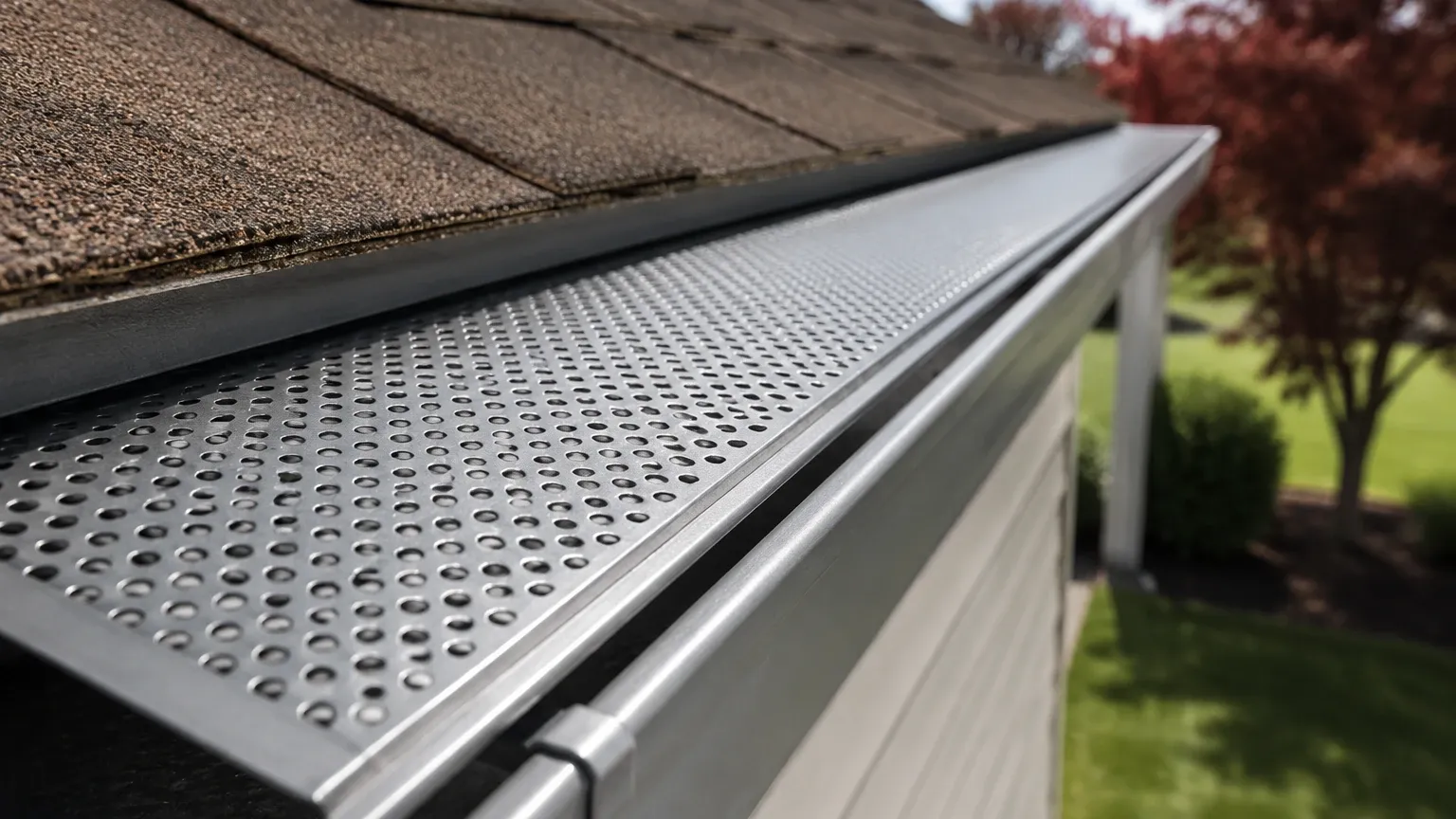
Perforated guards typically utilize round or square holes. Round holes are the most common due to their structural stability and ease of manufacturing. The "pitch"—the distance between the centers of adjacent holes—determines the density of the openings. For gutter applications, a staggered pattern is often preferred over a straight-row pattern because it maximizes the surface area available for water capture while maintaining the structural rigidity of the metal sheet.
Open Area Percentage
The open area is the ratio of the total area of the holes to the total area of the sheet. For effective gutter protection, the open area must be sufficient to handle peak rainfall intensity without causing water to "overshoot" the gutter. However, if the open area is too high, the structural integrity of the guard may be compromised, leading to sagging under snow loads or heavy debris accumulation.
Material Selection: Why Stainless Steel is the Industrial Standard
When specifying perforated metal gutter guards for commercial or industrial use, material selection is the most significant factor in determining the total cost of ownership. While aluminum and galvanized steel are common in lighter applications, stainless steel remains the superior choice for high-performance environments.
Corrosion Resistance
Industrial facilities often face corrosive atmospheres, whether from chemical processing exhaust, coastal salt air, or acidic rain. Stainless steel (specifically grades 304 and 316) provides exceptional resistance to oxidation. Grade 316, containing molybdenum, is particularly recommended for facilities located near the ocean or in heavy industrial zones where chloride exposure is a concern.
Mechanical Strength
Perforated metal gutter guards must withstand physical stresses that residential products cannot. This includes the weight of heavy snow, ice dams, and the impact of falling branches or industrial debris. Stainless steel offers a higher strength-to-weight ratio than aluminum, allowing for thinner, more efficient designs that do not sacrifice durability. This prevents the guards from collapsing into the gutter trough, which would otherwise create a hidden dam and exacerbate drainage issues.
Comparing Perforated & Expanded Metal for Gutter Guards
Engineers often choose between perforated and expanded metal for filtration and protection tasks. Both are available through Kaifil’s Perforated & Expanded Metal solutions, but they offer different performance characteristics.
Perforated Metal Characteristics
Perforated metal is created by punching holes into a solid sheet. This process allows for extreme precision in hole size and placement. For gutter guards, this means the "filtration grade" can be tightly controlled to exclude specific types of debris (such as pine needles or small seeds) while maintaining a smooth surface that encourages wind to blow debris off the top.
Expanded Metal Characteristics
Expanded metal is produced by slitting and stretching the material simultaneously. This creates a diamond-shaped mesh. Because the process involves no waste material, it can be more cost-effective. However, the raised edges of standard expanded metal can sometimes trap small debris. For gutter applications, "flattened" expanded metal is usually preferred to provide a lower profile, though it may still lack the precise filtration accuracy of a CNC-perforated sheet.
Hydraulic Performance and Flow Rate Considerations
A common concern for engineers is whether perforated metal gutter guards will cause water to bypass the gutter during heavy storms. This phenomenon, known as overshooting, occurs when the surface tension of the water and the velocity of the flow exceed the guard's ability to pull water through the perforations.
To mitigate this, technical specifications should account for:
1. Aperture Size: Smaller holes (e.g., 2mm to 4mm) are excellent for debris exclusion but require a higher density to maintain flow rates.
2. Surface Texture: A smooth, clean-finished stainless steel surface helps break the surface tension of the water, allowing it to drop into the gutter more efficiently.
3. Installation Angle: The guards should ideally be installed at a slight pitch that mirrors the roofline, but not so steep that water velocity prevents capture.
In high-flow industrial applications, Kaifil recommends calculating the maximum expected rainfall (in inches per hour) and matching it against the calculated flow capacity of the perforated sheet's open area, adjusted for a safety factor to account for partial debris coverage.
Customization and OEM Capabilities
Off-the-shelf gutter guards rarely meet the requirements of specialized industrial architecture. Customization is often necessary to accommodate unique gutter widths, non-standard mounting brackets, or specific environmental challenges.
As a professional manufacturer, Kaifil provides OEM services for perforated metal components. This includes:
* Custom Dimensions: Manufacturing guards to exact widths and lengths to reduce on-site cutting and waste.
* Variable Hole Patterns: Designing specific perforation zones to handle high-flow areas (like valley transitions) differently than straight runs.
* Edge Treatments: Providing hemmed edges or specialized mounting flanges to ensure a secure fit and prevent injury during maintenance.
* Material Thickness: Offering a range of gauges from lightweight 22-gauge to heavy-duty 16-gauge stainless steel depending on the structural requirements of the project.
Maintenance Cycles and Long-Term Durability
While perforated metal gutter guards are often marketed as "maintenance-free," a more accurate technical description is "low-maintenance." In an industrial B2B context, the goal is to extend the maintenance cycle from months to years.
Self-Cleaning Properties
The smooth surface of a high-quality stainless steel perforated guard allows for natural self-cleaning. As debris dries, wind uplift can easily remove it from the flat surface. In contrast, mesh or foam inserts often trap organic matter, which then decomposes and creates a substrate for moss or weed growth.
Inspection Protocols
Facility managers should include the gutter guards in annual roof inspections. Because stainless steel is resistant to UV degradation and thermal expansion/contraction, the primary focus of these inspections is typically checking for any unusual debris buildup in corners or ensuring that the mounting hardware remains tight.
Procurement: What to Confirm Before Purchasing
When sourcing perforated metal gutter guards for a large-scale project, purchasing teams and engineers should verify several technical details with the manufacturer to ensure the product meets the application's demands.
1. Alloy Verification: Ensure the material is true SS304 or SS316, especially if the price seems significantly lower than market averages for stainless steel.
2. Burr-Free Finish: Perforation processes can leave sharp burrs. For gutter guards, a deburred or polished finish is essential to prevent debris from snagging and to ensure safety for installation crews.
3. Tolerances: Confirm the dimensional tolerances. In large industrial buildings, even a small deviation in width can lead to significant installation delays over thousands of linear feet.
4. Load Ratings: If the guards will be used in regions with heavy snowfall, request data on the maximum static load the perforated pattern can support without permanent deformation.
Conclusion
Perforated metal gutter guards represent a sophisticated intersection of filtration technology and structural protection. By selecting high-grade stainless steel and optimizing the perforation pattern for both hydraulic capacity and debris exclusion, facility managers can significantly reduce long-term maintenance costs and protect their capital assets.
Kaifil continues to support the industrial sector with precision-engineered Perforated & Expanded Metal solutions tailored to the specific needs of each project. Whether you require standard configurations or custom OEM designs, focusing on material quality and engineering accuracy is the key to successful gutter system management.
