


Galvanized Expanded Metal Mesh
In industrial filtration and structural support, material selection is dictated by the balance between mechanical strength, chemical compatibility, and cost-efficiency. Galvanized expanded metal mesh represents a versatile solution for engineers requiring a rigid, porous medium that can withstand corrosive environments without the higher capital expenditure associated with high-grade stainless steel alloys.
Produced by simultaneously slitting and stretching a single sheet of metal, expanded metal creates a continuous diamond-patterned mesh. Unlike woven wire or perforated sheets, expanded metal involves no material waste and maintains structural integrity because the "bonds" where the strands intersect are part of the original metal sheet. When this base material is treated with a protective zinc coating, it becomes a robust component suitable for pre-filtration, support layers in multi-stage filter cartridges, and protective guarding in heavy-duty industrial machinery.
The Manufacturing Process and Structural Integrity
The production of galvanized expanded metal mesh begins with a solid sheet of carbon steel. This sheet is fed through a machine that performs a precision slitting and stretching operation. The result is a network of diamond-shaped openings. Because the process does not involve punching holes—as is the case with perforated metal—there is zero scrap loss, making it a highly sustainable manufacturing method.
From an engineering perspective, the structural advantage of expanded metal lies in its one-piece construction. There are no welds to fail under vibration and no individual wires to unravel under high-pressure flow. The strands are set at an angle to the plane of the sheet, which provides inherent stiffness and allows the material to deflect loads more effectively than flat sheets of the same weight.
For applications requiring a smooth surface, the mesh can undergo a secondary process known as "flattening." In this stage, the standard raised mesh is passed through a cold-roll reducing mill, which levels the strands and bonds into the same plane. Flattened galvanized expanded metal mesh is often preferred when the mesh serves as a support layer for delicate filter media, such as fine wire cloth or synthetic membranes, to prevent abrasion or puncturing of the primary filtration layer.
Understanding Galvanization: Protection Against Corrosion
Galvanization is the process of applying a protective zinc coating to steel to prevent rusting. For expanded metal mesh used in industrial filtration, two primary methods are utilized: pre-galvanization and post-production hot-dip galvanization.
Pre-Galvanized Expanded Metal
In this method, the steel sheet is galvanized at the mill before it reaches the expanding machine. While cost-effective, the slitting and stretching process exposes the raw steel edges at the cut points. Although zinc has sacrificial properties—meaning it will corrode to protect the adjacent exposed steel—pre-galvanized mesh is generally reserved for indoor applications or environments with low moisture levels.
Hot-Dip Galvanized (HDG) After Expansion
For demanding industrial environments, such as chemical processing or outdoor water treatment, the mesh is expanded first and then immersed in a bath of molten zinc. This ensures that every surface, including the cut edges and the interior of the diamond openings, is fully encapsulated in a thick layer of zinc-iron alloy. This provides superior protection against oxidation and significantly extends the service life of the component.
Technical Specifications and Engineering Parameters
When specifying galvanized expanded metal mesh for a project, engineers must define several key dimensions that dictate the mesh's performance in filtration and fluid dynamics:
* SWD (Short Way of Diamond): The distance from the center of one bond to the center of the next bond measured across the short diamond diagonal.
* LWD (Long Way of Diamond): The distance from the center of one bond to the center of the next bond measured across the long diamond diagonal.
* Strand Width: The amount of metal fed into the expanding machine for each stroke.
* Strand Thickness: The gauge or thickness of the original base metal.
* Open Area Percentage: This is perhaps the most critical value for filtration engineers. It determines the flow rate and pressure drop across the mesh. A higher open area allows for greater throughput but may reduce the structural rigidity of the mesh.
By adjusting these parameters, manufacturers like Kaifil can tailor the mesh to provide the exact level of support or debris retention required for a specific industrial application.
Applications in Industrial Filtration Systems
Galvanized expanded metal mesh serves multiple roles within complex filtration assemblies. Its primary function is often as a "support cage" or "pleat support" for high-efficiency filter cartridges.
Support for Fine Media
In hydraulic systems or air intake filters, the primary filtration media (such as fiberglass or fine stainless steel wire mesh) lacks the rigidity to withstand high differential pressures. Galvanized expanded metal is wrapped around the exterior or interior of the filter element to act as a skeleton, preventing the media from collapsing or deforming under the force of the fluid flow.
Pre-Filtration and Debris Removal
In water treatment and HVAC systems, larger diamond patterns are used as pre-filters. These components capture large particulates, such as leaves, scale, or metal shavings, before they can reach and clog more expensive fine-filtration stages. The zinc coating is particularly valuable here, as it resists the corrosive effects of constant moisture and aeration.
Flame and Spark Arrestors
Due to its thermal conductivity and structural stability, expanded metal is frequently used in industrial exhaust systems to dissipate heat and prevent the passage of sparks. The galvanized finish ensures that the arrestor remains functional even when exposed to fluctuating temperatures and atmospheric humidity.
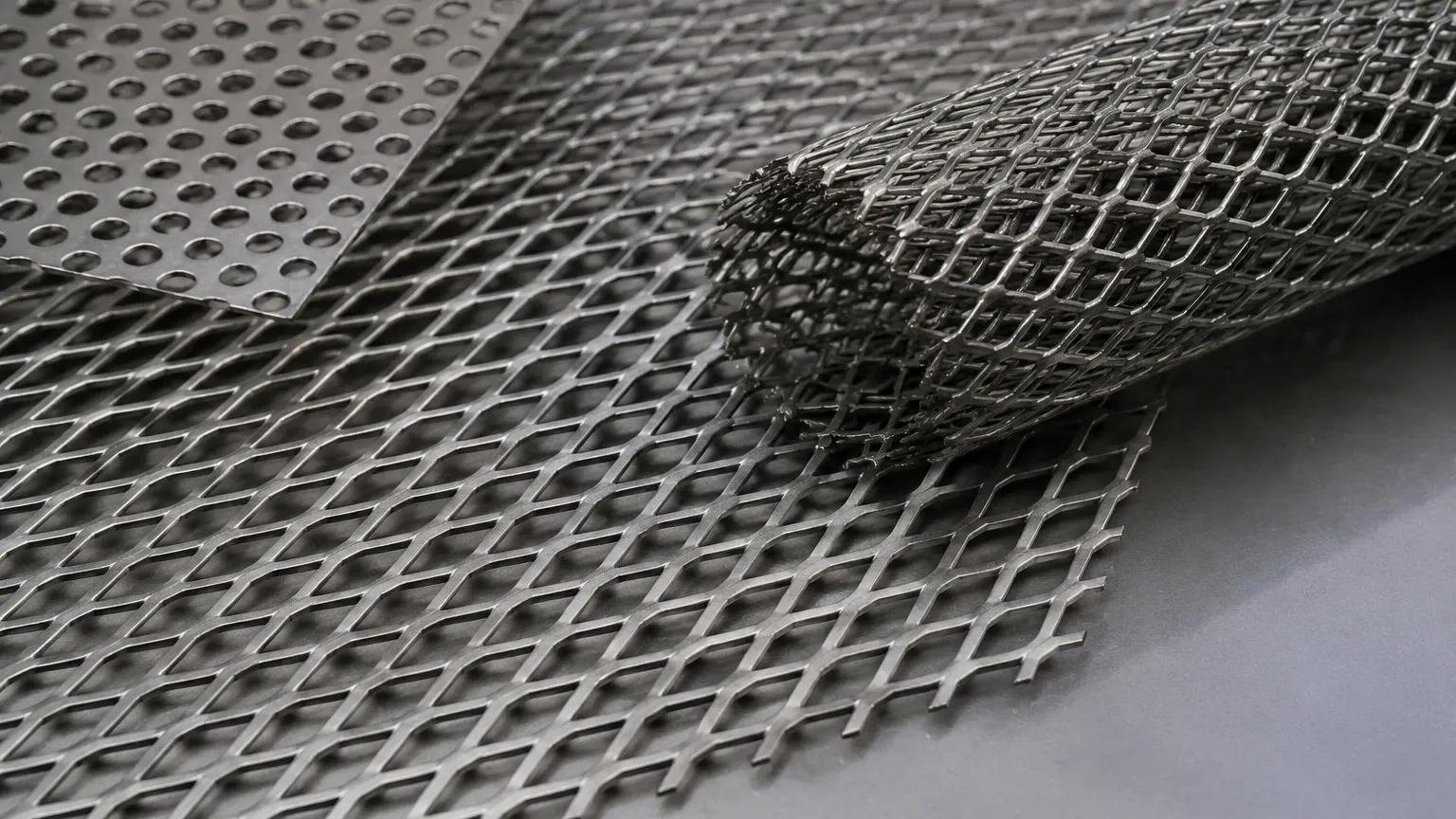
Comparing Perforated & Expanded Metal for Industrial Use
When selecting a metal medium, engineers often choose between Perforated & Expanded Metal based on the specific requirements of the application. While both provide open areas for flow, their mechanical properties differ significantly.
Perforated metal is created by punching holes into a sheet, which allows for extremely precise hole diameters and shapes (round, square, hexagonal). However, the punching process creates significant material waste and can weaken the base sheet if the holes are spaced too closely.
In contrast, expanded metal is typically more cost-effective because of the zero-waste manufacturing process. It also offers a higher strength-to-weight ratio. While perforated metal provides a flat, uniform surface by default, expanded metal provides a three-dimensional structure that can enhance turbulence in certain mixing or heat-exchange applications. For most heavy-duty filtration support roles, galvanized expanded metal mesh is the preferred choice due to its durability and lower production cost.
Selection Criteria for B2B Procurement
For procurement teams and engineers, selecting the right galvanized expanded metal requires a thorough understanding of the operating environment. Before placing an order, the following factors should be confirmed:
1. Atmospheric Conditions: Will the mesh be exposed to salt spray, acidic vapors, or constant submersion? This determines whether pre-galvanized or hot-dip galvanized coating is necessary.
2. Mechanical Load: What is the maximum pressure or weight the mesh must support? This will dictate the required strand thickness and SWD/LWD dimensions.
3. Compatibility: If the mesh is being used in a multi-layer filter, ensure the galvanized coating will not react with the fluid being filtered. For example, zinc is generally avoided in highly acidic or highly alkaline environments where stainless steel would be more appropriate.
4. Dimensional Tolerances: Industrial filtration housings often have tight tolerances. Confirming the allowable variance in sheet size and flatness is essential for seamless integration into the final product.
Maintenance and Replacement Cycles
While galvanized expanded metal mesh is designed for longevity, it is not permanent. Over time, the sacrificial zinc layer will deplete. In filtration systems, the mesh should be inspected during routine maintenance for signs of "white rust" (zinc oxide) or red rust (iron oxide).
If the mesh is used as a support for a disposable filter element, it is often replaced along with the media. However, in permanent installations, such as intake screens, the mesh can often be cleaned using low-pressure water or air. It is important to avoid abrasive cleaning methods that could strip the protective zinc coating, as this would lead to rapid oxidation and structural failure.
Customization and OEM Solutions
As a specialist in industrial filtration, Kaifil provides customized expanded metal solutions that meet the rigorous standards of the chemical, pharmaceutical, and food and beverage industries. Whether the application requires specific diamond dimensions for optimized flow or specialized flattening for media protection, custom manufacturing ensures that the filtration component performs reliably under pressure.
By selecting the appropriate grade of galvanized expanded metal mesh, industrial operations can achieve effective filtration and structural support while managing material costs. The combination of the strength of steel and the protection of zinc makes this material a staple in modern industrial engineering.
