


Heavy Expanded Metal
In industrial engineering and manufacturing, the selection of structural and filtration components often dictates the longevity and efficiency of a system. Heavy expanded metal represents a specialized category of metal mesh characterized by its high strength-to-weight ratio, mechanical rigidity, and versatile open-area configurations. Unlike standard or light-duty expanded metals used primarily for aesthetics or light screening, heavy expanded metal is engineered for demanding environments where structural integrity and durability are non-negotiable.
For engineers and procurement teams, understanding the technical nuances of Perforated & Expanded Metal is essential for optimizing performance in chemical processing, hydraulic systems, and heavy industrial filtration. This guide examines the manufacturing principles, technical specifications, and application-specific considerations for heavy expanded metal.
Understanding the Manufacturing and Structure of Heavy Expanded Metal
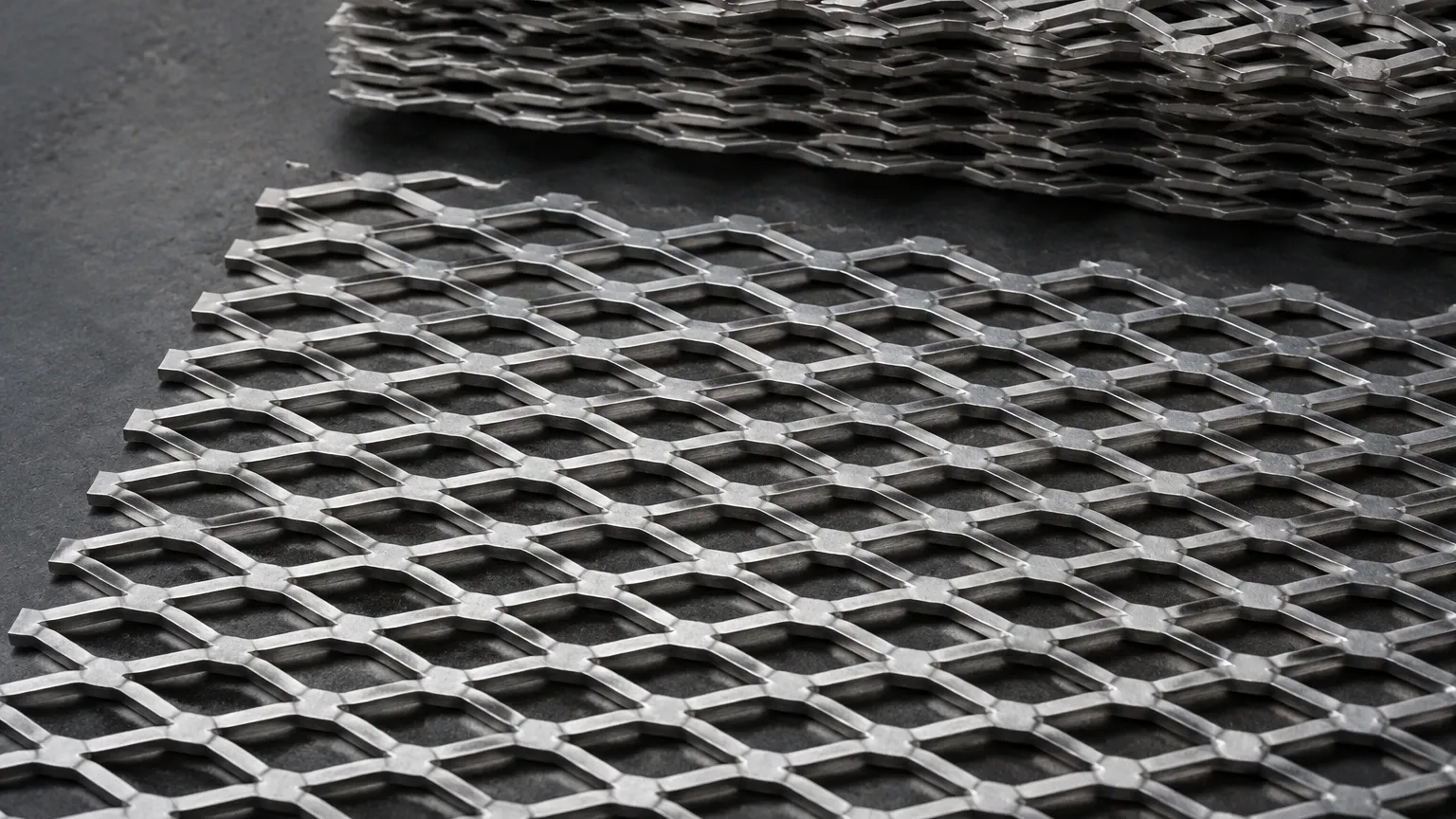
Heavy expanded metal is produced through a unique "slit and stretch" process. A single sheet of solid metal—typically stainless steel, carbon steel, or aluminum—is fed through a machine equipped with a reciprocating knife. This knife slits the metal at precise intervals while simultaneously stretching it into a diamond-shaped pattern.
One of the primary engineering advantages of this process is that it involves no material waste. Unlike perforated metal, where the "slugs" or holes are punched out and discarded (or recycled), expanded metal is formed by expanding the original sheet. This results in a finished product that can be up to ten times the length of the original raw material, depending on the strand width and opening size.
From a structural perspective, the intersections of the strands are called "bonds." In heavy expanded metal, these bonds remain part of the original solid metal sheet, providing inherent strength that is superior to woven wire mesh, where individual wires can shift or fray. The resulting truss-like structure allows the material to distribute loads evenly across its surface, making it an ideal candidate for high-pressure industrial applications.
Technical Specifications and Geometric Parameters
When specifying heavy expanded metal for industrial projects, engineers must define several critical geometric parameters. These dimensions determine the mesh's flow characteristics, load capacity, and compatibility with other filtration media.
* SWD (Short Way of Design): The distance from the center of one bond to the center of the next bond measured across the short diamond diagonal.
* LWD (Long Way of Design): The distance from the center of one bond to the center of the next bond measured across the long diamond diagonal.
* Strand Thickness: The thickness of the original base metal sheet. In heavy expanded metal, this typically ranges from 3mm to 8mm or more, depending on the application.
* Strand Width: The amount of metal fed into the knives for each stroke. This determines the width of the individual strands within the diamond pattern.
* Open Area Percentage: This is a calculation of the void space relative to the total surface area. It is a critical factor for determining flow rates and pressure drops in filtration and ventilation systems.
Furthermore, heavy expanded metal is available in two primary forms:
1. Raised (Standard) Expanded Metal: The strands and bonds are set at a uniform angle to the plane of the sheet. This provides maximum rigidity and a high-friction surface.
2. Flattened Expanded Metal: The raised mesh is passed through a cold-rolling mill, which flattens the strands and bonds into the same plane as the sheet. This reduces the overall thickness and creates a smooth surface, which is often required when the mesh serves as a support layer for delicate filter membranes.
Material Selection for Demanding Environments
The performance of heavy expanded metal is heavily dependent on the alloy selected. Because these components are frequently used in corrosive or high-temperature environments, material science plays a pivotal role in the selection process.
Stainless Steel (304, 316, 316L)
Stainless steel is the preferred material for heavy expanded metal in the chemical, pharmaceutical, and food and beverage industries. Grade 304 offers excellent corrosion resistance for general applications, while Grade 316/316L includes molybdenum, providing superior resistance to chlorides and acidic environments. For filtration components, using 316L (low carbon) is often necessary to prevent sensitization during welding processes.
Carbon Steel
For structural applications like industrial walkways, platforms, or heavy-duty machine guards where corrosion is not the primary concern, carbon steel provides a cost-effective solution with high tensile strength. These are often galvanized or powder-coated to extend their service life.
Specialty Alloys
In high-temperature or highly specialized chemical processing, materials such as Monel, Inconel, or Titanium may be used. These alloys ensure that the expanded metal maintains its structural integrity and pore geometry under extreme thermal cycling or aggressive chemical exposure.
The Role of Heavy Expanded Metal in Filtration Systems
In the context of industrial filtration, heavy expanded metal rarely acts as the primary filtration medium for fine particles. Instead, it serves as a critical structural component within a multi-layer filter assembly.
Support and Pleat Guarding
In high-pressure hydraulic or gas filtration, fine wire mesh or synthetic membranes lack the mechanical strength to withstand high differential pressures. Heavy expanded metal is used as a support tube or outer cage. It prevents the primary filter media from collapsing or deforming under the force of the fluid flow. Its rigid structure ensures that the filter maintains its shape and effective filtration area throughout its service cycle.
Coarse Pre-Filtration
In water treatment or intake systems, heavy expanded metal can function as a primary coarse filter. It is capable of capturing large debris, such as stones or organic matter, protecting downstream pumps and sensitive fine-filtration stages. The diamond-shaped openings are particularly effective at breaking up laminar flow, which can improve the distribution of fluids across the filter surface.
Customization in OEM Applications
Manufacturers like Kaifil specialize in customizing these components to meet specific OEM requirements. This includes tailoring the SWD and LWD to match the flow requirements of a specific housing or welding the expanded metal into cylindrical cartridges for seamless integration into industrial machinery.
Comparing Expanded Metal with Perforated Metal
Engineers often weigh the pros and cons of expanded metal versus perforated metal for industrial enclosures and filter supports. While both fall under the broader category of Perforated & Expanded Metal, they offer different performance profiles.
| Feature | Heavy Expanded Metal | Perforated Metal |
| :— | :— | :— |
| Material Waste | None (slit and stretched) | High (slugs are punched out) |
| Strength-to-Weight | Superior due to interconnected bonds | Moderate |
| Surface Profile | Naturally 3D/Raised (unless flattened) | Always flat |
| Flow Dynamics | Complex, multi-directional flow | Direct, straight-through flow |
| Cost Efficiency | Generally lower for large areas | Higher due to material waste |
Heavy expanded metal is often chosen when structural rigidity is the priority. The angled strands of raised expanded metal provide a higher section modulus than a flat perforated sheet of the same thickness, meaning it can resist bending and deflection more effectively.
Engineering Considerations for Load and Flow
When integrating heavy expanded metal into a project, two primary engineering calculations must be performed: load-bearing capacity and pressure drop.
Load-Bearing Capacity
For applications such as industrial flooring or heavy-duty filter baskets, the orientation of the mesh is critical. The "Long Way of Design" (LWD) should typically run perpendicular to the support spans to maximize the load-carrying capability of the bonds. Engineers must consult load tables that specify the maximum allowable uniform load and concentrated load based on the strand thickness and the distance between supports.
Pressure Drop and Flow Resistance
The open area of heavy expanded metal is not always a simple calculation of hole size. Because the strands are angled in the "raised" version, the effective open area changes depending on the angle of the fluid or air approach. In filtration, this can cause turbulence, which may be beneficial for mixing but can also increase the pressure drop across the system. Engineers must ensure that the strand width and SWD are optimized to minimize energy loss while maintaining the necessary mechanical support for the filter media.
Procurement and Customization Guidelines
To ensure a successful procurement process for heavy expanded metal, technical professionals should confirm several factors with their manufacturing partner:
1. Dimensional Tolerances: Industrial applications often require tight tolerances on the overall sheet size and the diamond dimensions to ensure proper fitment in filter housings or structural frames.
2. Edge Treatment: Expanded metal can have "random sheared" edges (where diamonds are cut through) or "bond sheared" edges (where the cut happens at the bond, leaving a cleaner edge). For filtration cartridges, bond shearing or specialized edge trimming is often required for safe handling and welding.
3. Surface Finish: Depending on the industry, the metal may require degreasing, pickling, or electropolishing. In food and pharmaceutical applications, a high-quality surface finish is essential to prevent bacterial growth and ensure ease of cleaning.
4. Total Cost of Ownership: While the initial purchase price is important, engineers should consider the lifecycle of the component. Choosing a higher-grade stainless steel heavy expanded metal may reduce the frequency of replacement in corrosive environments, leading to lower total costs over time.
Kaifil provides comprehensive support for these technical requirements, leveraging advanced manufacturing capabilities to deliver precision metal filtration components. By working closely with an experienced manufacturer, purchasing teams can ensure that the selected heavy expanded metal meets the rigorous demands of their specific industrial application, providing a balance of filtration efficiency and structural longevity.
