


How to Measure Expanded Metal Size
In industrial filtration and structural engineering, precision is the foundation of performance. Expanded metal, a versatile material created by simultaneously slitting and stretching metal sheets, is widely used for filter support, protective grilles, and reinforcement layers. However, due to its unique diamond-shaped geometry and three-dimensional profile, measuring it accurately requires a specific technical vocabulary and methodology. For engineers and procurement teams sourcing Perforated & Expanded Metal, understanding these dimensions is critical to ensuring compatibility with housings, achieving desired flow rates, and maintaining structural integrity.
This guide details the standardized methods for measuring expanded metal, the distinction between raised and flattened varieties, and the engineering considerations necessary for industrial applications.
Understanding the Geometry of Expanded Metal
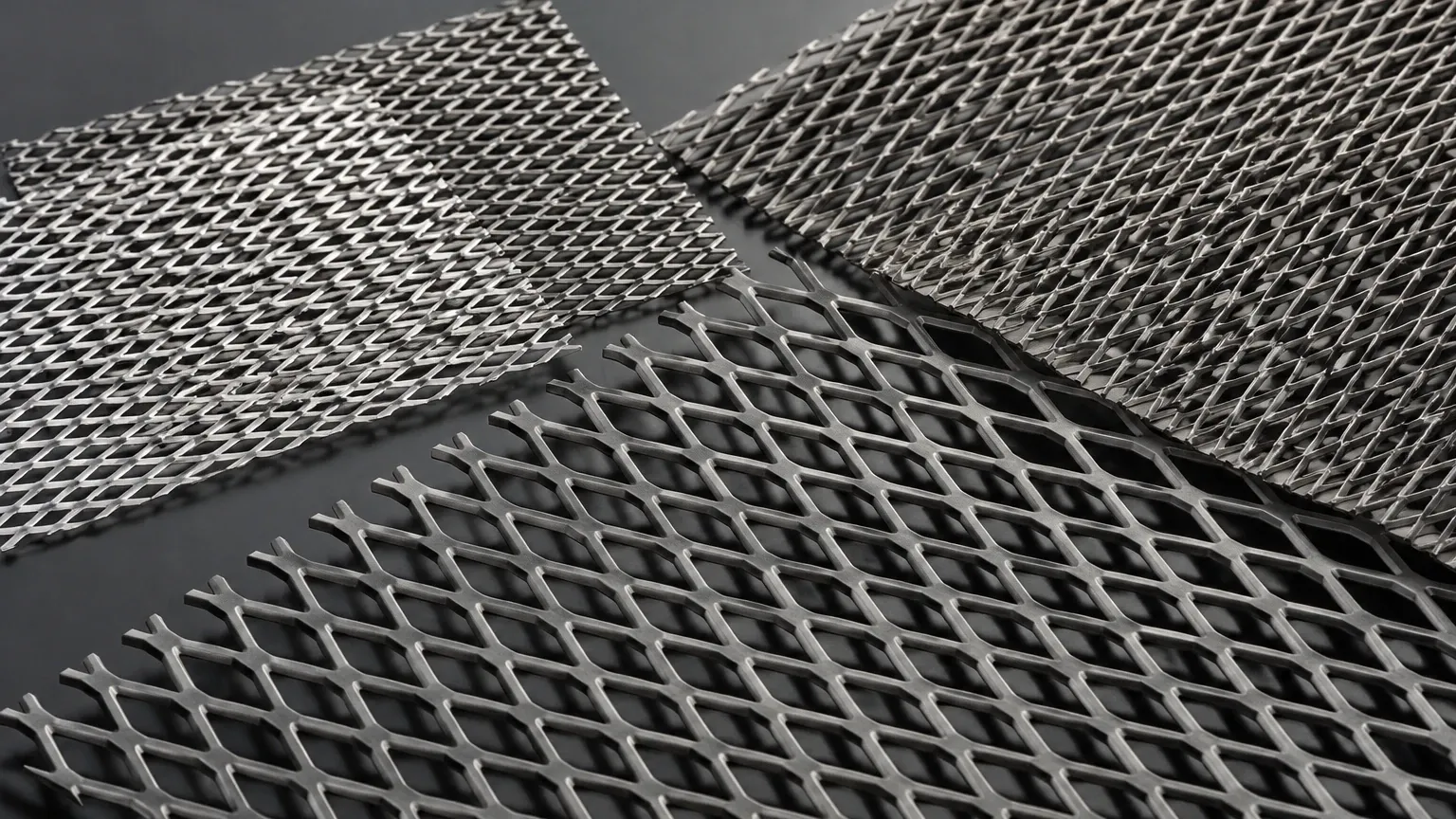
Unlike perforated metal, which is created by punching holes and removing material, expanded metal is produced through a process that leaves no waste. The metal is slit and then pulled taut, creating a series of interconnected diamonds. This process results in a material that is stronger than the original sheet while remaining lightweight.
To measure expanded metal correctly, one must understand the orientation of the diamonds. The "way" of the design refers to the direction of the diamond pattern relative to the dimensions of the sheet. Most industrial filters utilize these patterns to provide a high open-area ratio while supporting finer mesh layers. Incorrectly identifying the orientation can lead to structural failure if the material is loaded against its strongest axis.
Key Terminology for Accurate Measurement
When specifying expanded metal for a project, four primary measurements define the diamond opening. These are typically measured using precision calipers to ensure accuracy within industrial tolerances.
1. SWD (Short Way of Design)
The Short Way of Design is the distance measured from the center of one bond to the center of the next bond across the short axis of the diamond. It is important to note that SWD is a center-to-center measurement, not the size of the hole itself. This metric is essential for determining the overall pattern density.
2. LWD (Long Way of Design)
The Long Way of Design is the distance from the center of one bond to the center of the next bond across the long axis of the diamond. Together, SWD and LWD define the pitch of the expansion and are the primary figures used in standard industry catalogs.
3. SWO (Short Way of Opening)
For filtration applications, the SWO is often the most critical dimension. It measures the actual clear distance of the opening across the short axis, from the inside edge of one strand to the inside edge of the opposite strand. This determines the maximum size of a component or particle that can pass through the opening.
4. LWO (Long Way of Opening)
Similar to SWO, the Long Way of Opening measures the clear distance across the long axis of the diamond. While the LWO does not usually dictate filtration accuracy, it significantly impacts the open area percentage and the structural rigidity of the sheet.
Measuring Strand Dimensions and Thickness
Beyond the diamond openings, the physical properties of the metal strands themselves determine the weight, strength, and pressure drop characteristics of the filter component.
Strand Width
Strand width refers to the amount of metal between the openings. In the manufacturing process, this is determined by how far the sheet is fed into the machine before the slit is made. A wider strand increases the strength and weight of the material but reduces the open area.
Strand Thickness
Strand thickness is the gauge or thickness of the base metal used to produce the expanded metal. In "Standard" or "Raised" expanded metal, the strand thickness is the same as the original sheet thickness. However, the measurement of the total profile (the overall thickness of the sheet) will be much greater because the strands are turned at an angle during the expansion process.
Standard vs. Flattened Expanded Metal
One of the most common points of confusion in procurement is the difference between standard (raised) and flattened expanded metal. The measurement approach changes slightly depending on which type is selected.
Standard (Raised) Expanded Metal
In its standard form, expanded metal has strands that are tilted at an angle to the original plane of the sheet. This creates a 3D texture that provides excellent grip and high structural rigidity. When measuring standard expanded metal, engineers must account for the "Overall Thickness," which is the total height of the material from the top of the highest strand to the bottom of the lowest. This dimension is vital when the material must fit into a narrow slot or a filter housing sleeve.
Flattened Expanded Metal
Flattened expanded metal is produced by passing standard expanded metal through a cold-rolling mill. This process flattens the strands back into a single plane, resulting in a smooth, flat surface. While flattening makes the material thinner and easier to handle in certain fabrication processes, it also stretches the diamond dimensions slightly. If a project requires flattened Perforated & Expanded Metal, measurements should be taken *after* the flattening process to ensure the final dimensions meet the design specifications.
Calculating Open Area for Filtration
In B2B industrial applications, particularly in chemical processing or hydraulic systems, the "Open Area" percentage is a key performance indicator. It dictates the flow rate and the initial pressure drop across the filter.
The open area is calculated based on the relationship between the strand width and the SWD. A simplified formula used by engineers is:
Open Area % = (1 – (2 × Strand Width) / SWD) × 100
(Note: This formula assumes standard diamond geometry. For complex or custom expansions, manufacturers like Kaifil provide precise calculations based on CAD models.)
When selecting a support structure for a fine wire mesh filter, the open area must be high enough to prevent flow restriction, but the strands must be wide enough to support the mesh under high-pressure conditions without causing the mesh to sag or tear.
Step-by-Step Guide: How to Measure Expanded Metal Size
To ensure consistent results that align with manufacturer specifications, follow these steps using a digital caliper:
1. Identify the Orientation: Lay the sheet flat and determine which direction the diamonds are running. The LWD usually runs parallel to the width of the original coil.
2. Measure the SWD: Place the caliper tips at the center of a bond (where two diamonds meet) and measure to the center of the next bond in the short direction.
3. Measure the LWD: Repeat the process in the long direction, measuring center-to-center.
4. Determine the Opening (SWO/LWO): Measure the clear space inside the diamond. This is the most important step for filtration clearance checks.
5. Measure Strand Width: Measure the width of a single metal strand.
6. Measure Overall Thickness: For raised metal, use the depth gauge of the caliper or a micrometer to find the total height of the profile. For flattened metal, measure the thickness of the flat strand.
7. Confirm Sheet Dimensions: Finally, measure the overall length and width of the sheet, noting if the diamonds are "random cut" (edges may have partial diamonds) or "bond cut" (edges are cut through the center of the bonds for a cleaner finish).
Common Risks and Engineering Considerations
Failure to accurately measure and specify expanded metal can lead to several industrial challenges:
* Flow Interference: If the strand width is too large or the SWO is too small, the filter may experience an unacceptable pressure drop, leading to system inefficiency or pump strain.
* Material Fatigue: In high-vibration environments, such as hydraulic return lines, choosing the wrong strand thickness can lead to metal fatigue and downstream contamination.
* Compatibility Issues: In pharmaceutical or food-grade applications, the material must be easy to clean. Raised expanded metal may trap particles in the "pockets" created by the angled strands, making flattened metal a more hygienic choice.
* Directional Strength: Expanded metal is significantly stronger when supported along the LWD. If the measurement and installation orientation are mismatched, the filter element may collapse under pressure.
Information to Confirm Before Purchasing
Before finalizing a custom order for filtration components, technical teams should confirm the following with their manufacturer:
* Material Grade: Is Stainless Steel 304 sufficient, or does the chemical environment require the superior corrosion resistance of 316L?
* Flattened vs. Raised: Does the application require a flat surface for bonding or a raised surface for maximum rigidity?
* Tolerance Requirements: What is the allowable variance in SWD and LWD for your specific housing?
* Surface Treatment: Does the metal require ultrasonic cleaning, passivating, or electro-polishing to meet industry standards?
By following these measurement protocols, engineers can ensure that the Perforated & Expanded Metal components they integrate into their systems will perform reliably under demanding industrial conditions. Accurate measurement is not just about fit; it is about the long-term efficiency and safety of the filtration process.
