


How Do You Spell Expanded Metal
In the precision-driven world of industrial manufacturing and filtration, terminology is more than just a matter of linguistics; it is a foundation for engineering accuracy. While the question "how do you spell expanded metal" might seem elementary, it serves as an entry point into a complex field of material science and mechanical engineering. For procurement officers, design engineers, and maintenance managers, understanding the nuances of Perforated & Expanded Metal is critical for ensuring the structural integrity and filtration efficiency of industrial systems.
Expanded metal is spelled exactly as it sounds, but its technical definition is specific: it refers to a sheet of metal that has been simultaneously slit and stretched into a rigid, non-raveling mesh with diamond-shaped openings. Unlike woven wire, which can fray, or perforated metal, which involves material waste, expanded metal is a single-piece construction that offers a unique strength-to-weight ratio. This article explores the technical specifications, manufacturing processes, and selection criteria that professionals must consider when integrating these materials into industrial applications.
Terminology and Definition in Industrial Manufacturing
When addressing the query of how do you spell expanded metal, it is helpful to look at the terminology used in technical data sheets and ISO standards. The term "expanded" describes the physical transformation of the base material. In the manufacturing cycle, a solid sheet or coil of metal—often stainless steel, carbon steel, or aluminum—is fed through a machine that performs a pressurized slitting and stretching operation.
This process does not involve the removal of any material, which is a key distinction from perforated metal. Because the metal is "expanded" rather than punched, the resulting mesh maintains the structural continuity of the original sheet. In B2B procurement, precision in spelling and terminology ensures that specifications for mesh size, strand thickness, and material grade are communicated correctly across global supply chains. Miscommunication in technical documentation can lead to significant errors in filtration performance or structural failure in high-pressure environments.
Perforated & Expanded Metal: A Comparative Engineering Analysis
For engineers designing filtration or support systems, choosing between perforated and expanded metal is a primary decision. Both materials fall under the broader category of metal mesh, but their physical properties and manufacturing footprints differ significantly.
Material Efficiency and Cost
Perforated metal is created by punching holes into a sheet. This process results in "slugs" or waste material that must be recycled. In contrast, expanded metal is produced by stretching the material, which can increase the area of the original sheet by up to ten times without any waste. For large-scale industrial projects, this makes expanded metal a more cost-effective solution when high open-area percentages are required.
Structural Integrity
Because expanded metal is composed of a single piece of material, it does not have joins, welds, or weaves that can fail under stress. The strands and bonds are oriented at an angle to the plane of the sheet, providing inherent directional strength. Perforated metal, while structurally sound, relies on the remaining "bridge" of metal between holes. The choice between the two often depends on whether the application requires the flat, uniform surface of perforated metal or the three-dimensional, high-grip, and high-strength characteristics of expanded metal.
Filtration Characteristics
In filtration applications, Perforated & Expanded Metal serve different roles. Perforated sheets are often used as outer guards or internal cores for filter cartridges due to their smooth surface and precise hole geometry. Expanded metal is frequently utilized as a support medium for finer filter meshes or as a primary coarse filter in HVAC and grease extraction systems, where its angled strands help deflect and capture larger particulates.
The Mechanics of the Expansion Process
Understanding the manufacturing process is essential for evaluating the quality of the finished product. The expansion process involves a reciprocating upper blade that slits the metal while simultaneously stretching it downward. This creates the characteristic diamond pattern.
Standard vs. Flattened Expanded Metal
There are two primary forms of expanded metal available to industrial buyers:
1. Standard (Raised) Expanded Metal: This is the product as it comes off the expansion machine. The strands and bonds are set at a sharp angle to the plane of the sheet. This provides maximum rigidity and is ideal for applications requiring slip resistance or high structural reinforcement.
2. Flattened Expanded Metal: The standard expanded metal is passed through a cold-rolling reducing mill. This flattens the strands and bonds into the same plane as the sheet. Flattened expanded metal is thinner, smoother, and slightly longer than the standard version. It is preferred in filtration applications where a smooth surface is necessary to prevent damage to delicate filter media or to facilitate easier cleaning.
Key Performance Metrics for Engineers
When specifying expanded metal for a project, engineers must use standardized metrics to ensure the material meets the application's requirements. The following terms are the "vocabulary" of the industry:
* SWD (Short Way of Design): The distance from the center of one bond to the center of the next bond measured across the short diamond diagonal.
* LWD (Long Way of Design): The distance from the center of one bond to the center of the next bond measured across the long diamond diagonal.
* SWO (Short Way of Opening): The actual width of the opening, measured from the inside of the bonds.
* LWO (Long Way of Opening): The actual length of the opening, measured from the inside of the bonds.
* Strand Width: The amount of metal fed into the machine for each stroke of the blade.
* Strand Thickness: The thickness of the original base metal.
For filtration systems, the Open Area Percentage is perhaps the most critical metric. It determines the flow rate and pressure drop across the filter. High open area reduces resistance but may sacrifice structural support. Kaifil specializes in balancing these variables to create custom filtration components that optimize both throughput and durability.
Material Selection for Harsh Industrial Environments
The environment in which the metal will operate dictates the material grade. In industries such as chemical processing, pharmaceuticals, and food production, corrosion resistance and hygiene are paramount.
* Stainless Steel 304: The most common grade, offering good corrosion resistance and excellent fabrication characteristics. It is suitable for most general industrial filtration needs.
* Stainless Steel 316/316L: Contains molybdenum, which provides superior resistance to chlorides and pitting. This is the industry standard for marine environments, pharmaceutical manufacturing, and aggressive chemical processing.
* Specialty Alloys: For extreme temperatures or highly acidic environments, materials like Monel, Inconel, or Titanium may be expanded to meet specific engineering demands.
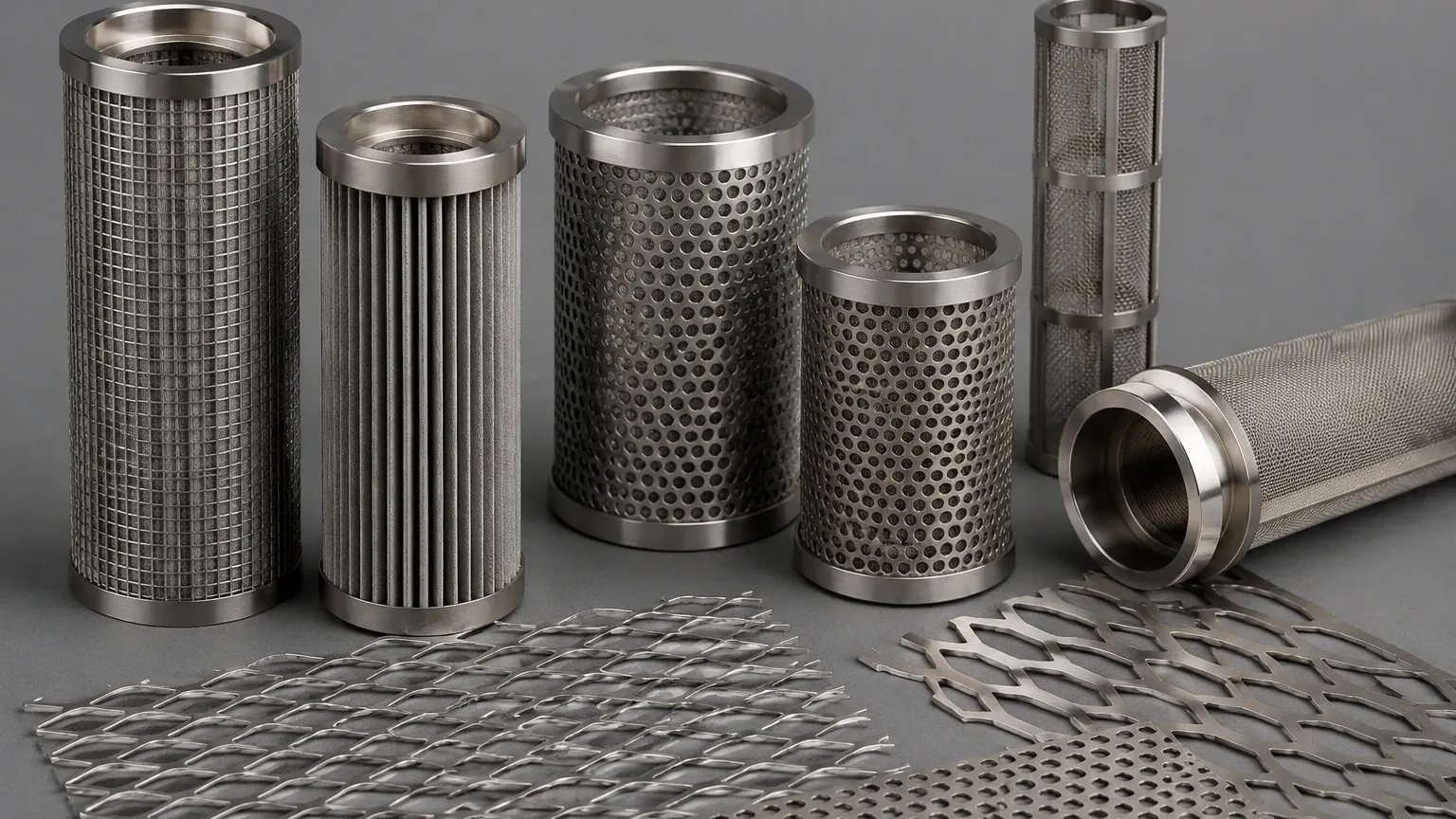
Selecting the right material ensures that the Perforated & Expanded Metal components do not contaminate the process stream or fail prematurely due to chemical degradation.
Applications in Filtration and Support Structures
Expanded metal is a versatile component in many industrial assemblies. Its role extends beyond simple screening:
1. Filter Media Support: In pleated filter cartridges, expanded metal provides the necessary rigidity to prevent the pleats from collapsing under high differential pressure. Its open structure allows for maximum contact between the fluid and the filter media.
2. Pre-filtration: In heavy-duty hydraulic or air intake systems, expanded metal acts as a primary barrier against large debris, protecting more sensitive downstream filtration stages.
3. Flame Arrestors: The high surface area and thermal conductivity of certain expanded metal configurations make them effective in quenching flames and preventing the passage of fire through vent pipes or tanks.
4. Centrifuge Liners: Expanded metal can be used in centrifugal separation to support the fine mesh screens that capture solids while allowing liquids to pass through at high speeds.
Procurement Considerations and Quality Standards
For B2B buyers, the total cost of ownership is more important than the initial purchase price. When evaluating suppliers for expanded metal components, consider the following:
* Tolerances: Precision in the SWD and LWD dimensions is vital for components that must fit into tight housings. Ask for the manufacturer’s standard tolerances and their ability to meet tighter specifications if required.
* Edge Conditions: Expanded metal can have "random" or "bond" edges. Random edges result in sharp points (sheared diamonds), while bond edges provide a smooth, finished perimeter. For safety and ease of installation in filter housings, bond edges are often preferred.
* Surface Finish: Depending on the application, the metal may require degreasing, pickling, or electropolishing. In food and pharmaceutical sectors, a smooth, burr-free finish is mandatory to prevent bacterial growth and ensure cleanability.
* Customization: Standard off-the-shelf mesh often fails to meet the specific pressure drop or particle retention needs of specialized equipment. Working with a manufacturer like Kaifil allows for the customization of strand width and opening sizes to match exact performance profiles.
Maintenance and Replacement Cycles
In industrial filtration, the longevity of expanded metal components depends on the mechanical load and the corrosivity of the environment. Unlike disposable filter media, expanded metal components are often designed to be permanent or semi-permanent parts of the system. However, they should be inspected regularly for:
* Erosion: High-velocity fluids containing abrasive particles can wear down the strands over time, increasing the opening size and reducing filtration efficiency.
* Fatigue: Constant pressure fluctuations can cause work-hardening and eventual cracking of the bonds.
* Blinding: If the mesh is used as a primary filter, particulates may become wedged in the diamond openings. Cleaning protocols (such as backwashing or ultrasonic cleaning) must be compatible with the material grade.
Conclusion: Precision in Specification
So, how do you spell expanded metal? You spell it with an eye toward engineering precision, material integrity, and application-specific design. In the B2B landscape, this material is a critical building block for efficient industrial processes. Whether it is used for its structural strength or its unique filtration properties, Perforated & Expanded Metal must be selected based on a deep understanding of its mechanical characteristics.
By focusing on technical factors such as SWD/LWD dimensions, material grades like 316L stainless steel, and the choice between standard or flattened finishes, engineers can ensure their systems operate at peak efficiency. Kaifil remains committed to providing the technical expertise and manufacturing quality necessary to turn these metal specifications into high-performance industrial solutions. When performance is non-negotiable, the details of the mesh—from the way it is spelled to the way it is stretched—make all the difference.
