


How to Cut Expanded Metal
Expanded metal is a versatile industrial material produced by simultaneously slitting and stretching a solid metal sheet. This process creates a diamond-shaped pattern of openings, supported by a network of metal "struts" and "bonds." In industrial filtration and structural applications, expanded metal is prized for its high strength-to-weight ratio and excellent open-area characteristics. However, due to its unique three-dimensional geometry—particularly in its "raised" form—knowing how to cut expanded metal effectively requires an understanding of both the material’s structural integrity and the specific tools required for various gauges.
For engineers and procurement professionals sourcing Perforated & Expanded Metal, understanding the fabrication process is essential for ensuring the final component meets the rigorous standards of chemical processing, hydraulic systems, or food-grade filtration. This guide details the technical methods, tool selections, and engineering considerations for cutting expanded metal in both field and factory environments.
Understanding the Material Geometry Before Cutting
Before selecting a cutting method, it is critical to analyze the physical properties of the expanded metal. Unlike flat perforated sheets, expanded metal has a distinct orientation that influences how it reacts to cutting forces.
Raised vs. Flattened Expanded Metal
Expanded metal comes in two primary forms: raised (standard) and flattened. Raised expanded metal features strands that are turned at a sharp angle to the plane of the sheet. This creates a textured surface that provides excellent grip but complicates cutting, as the tool must navigate varying heights. Flattened expanded metal has been cold-rolled to create a smooth, level surface, making it easier to cut with traditional shearing tools but slightly reducing its structural rigidity.
Orientation: LWD and SWD
The diamond pattern is defined by the Long Way of the Diamond (LWD) and the Short Way of the Diamond (SWD). Cutting parallel to the LWD typically results in a straighter edge with fewer "loose" strands, whereas cutting across the SWD can leave jagged edges that require extensive deburring. Engineers must specify the cutting path relative to these dimensions to minimize waste and ensure the mesh retains its intended filtration accuracy.
Manual Tools for Small-Scale and Precision Cutting
For thin-gauge stainless steel or aluminum expanded metal—often used in fine filtration or decorative guards—manual tools offer the highest degree of control for intricate shapes. However, they are labor-intensive and unsuitable for high-volume production.
Aviation Snips and Tin Snips
Aviation snips are the most common manual tool for thin-gauge expanded metal. They are categorized by the direction of the cut: straight, left-curve, or right-curve. When learning how to cut expanded metal with snips, the technician must cut through the "bonds" (where the strands intersect) rather than the middle of a strand to prevent the mesh from unraveling. This method is best for materials under 18 gauge.
Manual Bench Shears
A bench-mounted lever shear provides more mechanical advantage than hand snips. It is effective for cutting straight lines in medium-gauge expanded metal. The primary drawback is the potential for slight deformation at the edge of the cut, as the downward force can crush the raised strands of standard expanded metal.
Power Tools for On-Site Fabrication
In industrial maintenance or field installation scenarios, power tools are necessary to handle thicker stainless steel or carbon steel meshes. The choice of tool depends on the required edge quality and the thickness of the metal.
Angle Grinders with Cut-Off Wheels
The angle grinder is perhaps the most versatile tool for cutting expanded metal. Using a thin (1/16 inch or less) abrasive cut-off wheel allows the operator to slice through the bonds with minimal resistance.
* Pros: Highly portable and capable of cutting heavy-duty expanded metal.
* Cons: Generates significant heat and sparks. The heat-affected zone (HAZ) can potentially compromise the corrosion resistance of certain stainless steel alloys if not managed correctly. Furthermore, it produces a rough edge that necessitates secondary grinding.
Circular Saws with Metal-Cutting Blades
A circular saw equipped with a carbide-tipped metal-cutting blade is an excellent choice for making long, straight cuts in flattened expanded metal. Unlike abrasive wheels, carbide blades produce "cold cuts," which minimize the HAZ and leave a cleaner edge. When using this method on raised expanded metal, the material must be securely clamped to a sacrificial backing board to prevent the blade from catching on the angled strands.
Reciprocating Saws
While useful for demolition or rough-ins, reciprocating saws are generally discouraged for precision filtration components. The vibration and aggressive stroke of the blade can easily distort the mesh pattern and cause the metal to "chatter," leading to uneven cuts and potential tool breakage.
Industrial Cutting Methods for High Precision
For OEM applications where dimensional tolerances are tight and edge quality is paramount, manual and handheld power tools are insufficient. Professional manufacturers like Kaifil utilize industrial machinery to ensure that Perforated & Expanded Metal components fit perfectly into filter housings or structural frames.
Guillotine Shearing
Industrial shears use a high-pressure blade to cut across the entire width of the sheet in a single stroke. This is the fastest method for producing rectangular panels. For expanded metal, the shear must be calibrated to account for the material's thickness and the "void" spaces in the mesh. Shearing is most effective for flattened expanded metal; for raised material, specialized hold-downs are required to prevent the mesh from shifting during the cut.
Plasma Cutting
Plasma cutting uses a high-velocity jet of ionized gas to melt through the metal. It is highly effective for thick stainless steel expanded metal that would be difficult to cut mechanically. Because plasma is a non-contact method, there is no risk of mechanical distortion. However, the dross (solidified melted metal) left on the edges must be removed, especially in food-grade or pharmaceutical filtration applications where particulate shedding is a concern.
Laser Cutting
Laser cutting offers the highest level of precision. It is the preferred method for creating custom-shaped filter cartridges or components with complex geometries. The CNC-controlled laser can follow intricate paths, cutting through bonds and strands with microscopic accuracy. This method also minimizes the heat-affected zone, preserving the metallurgical properties of high-performance alloys.
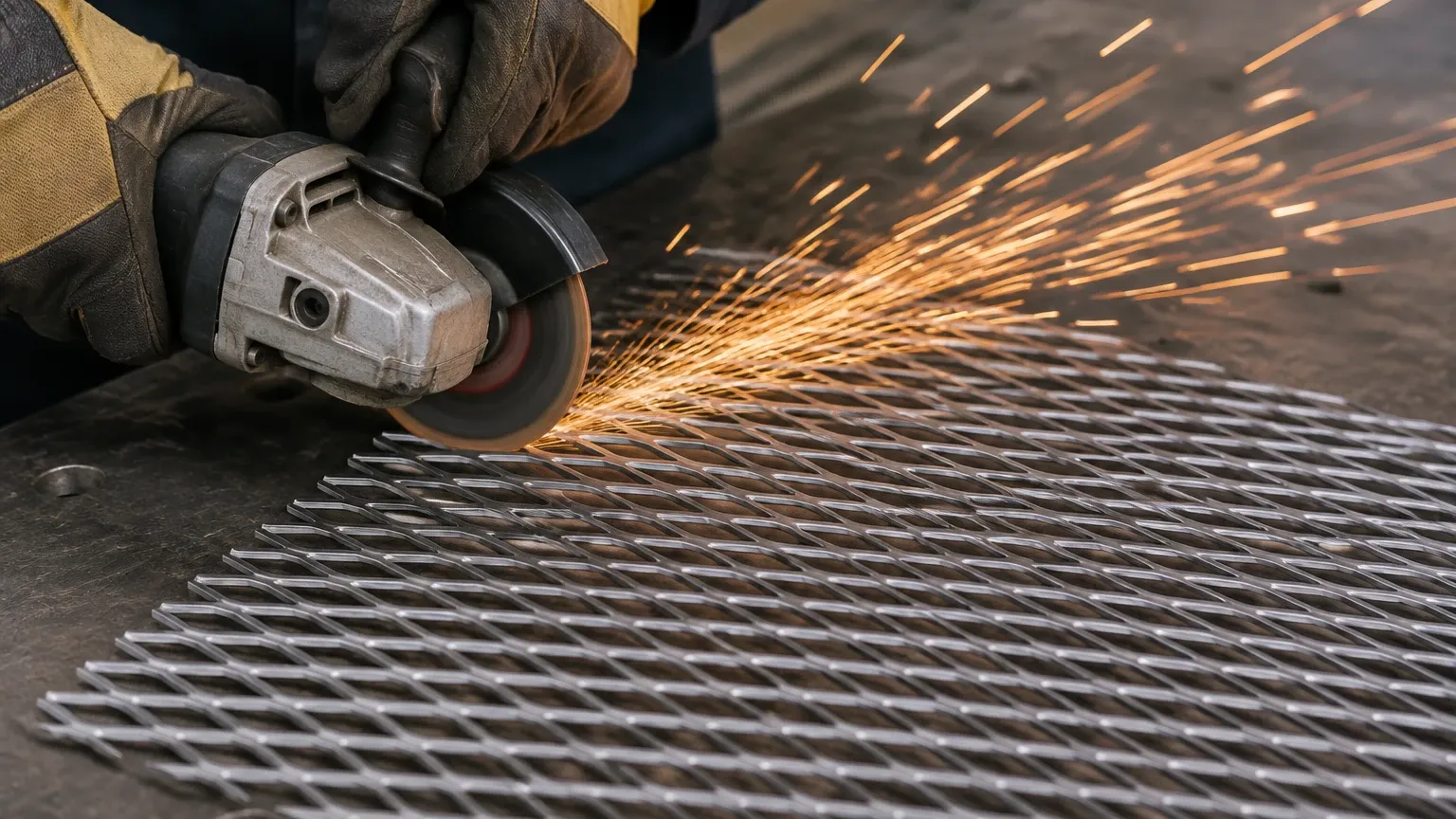
Step-by-Step Guide: How to Cut Expanded Metal Safely
Regardless of the tool selected, following a standardized process ensures both operator safety and material integrity.
1. Measurement and Layout: Use a high-visibility marker or layout dye to indicate the cut line. When possible, align the cut line with the bonds of the mesh to create a "closed" edge, which is stronger and safer to handle.
2. Securing the Material: Expanded metal is prone to vibration. Clamp the sheet firmly to a stable work surface. If cutting thin mesh, sandwiching it between two pieces of plywood can prevent the metal from bending or tearing.
3. Tool Preparation: Ensure that blades or discs are rated for the specific material (e.g., stainless steel-specific wheels for 304 or 316 grades). Dull tools increase the risk of "snagging," which can pull the mesh out of alignment.
4. Executing the Cut: Maintain a steady speed. For power tools, let the tool do the work; applying excessive pressure can cause the blade to bind in the diamond openings.
5. Deburring and Finishing: The cutting process inevitably leaves sharp "burrs" or jagged strand ends. Use a flap disc, hand file, or deburring tool to smooth all edges. In filtration systems, these burrs can break off and contaminate the filtrate, making this step critical for quality control.
Engineering Considerations for Cut Edges
When designing a system that incorporates expanded metal, engineers must consider how the cut edge will be integrated into the final assembly.
* Open vs. Closed Edges: An "open" edge consists of cut strands that resemble teeth. These are sharp and structurally weak. A "closed" edge is cut through the bonds, providing a continuous perimeter. For safety and ease of welding, closed edges are preferred.
* Edge Treatment: In many industrial applications, the cut edge of the expanded metal is encased in a U-profile frame or "U-edging." This hides the sharp edges, adds rigidity, and provides a clean surface for mounting or sealing.
* Impact on Filtration: If the cutting process distorts the diamond openings near the edge, the effective filtration area may be reduced. Precision cutting ensures that the open-area ratio remains consistent across the entire panel.
Total Cost and Quality Considerations
While knowing how to cut expanded metal in-house is useful for small adjustments, sourcing pre-cut, precision-fabricated components is often more cost-effective for B2B applications. Manual cutting leads to higher waste rates, increased labor costs, and potential safety hazards due to the sharp nature of the material.
By specifying exact dimensions and edge requirements during the procurement of Perforated & Expanded Metal, companies can reduce secondary processing time and ensure that the material performs reliably in demanding environments like hydraulic filtration or chemical straining. Professional fabrication ensures that the structural integrity of the mesh is maintained, the edges are properly finished, and the dimensional tolerances meet the specific needs of the industrial application.
