


Honeycomb Expanded Metal
In the landscape of industrial filtration and structural support, the choice of media significantly influences the efficiency, longevity, and mechanical integrity of a system. Honeycomb expanded metal represents a specialized geometry within the broader category of Perforated & Expanded Metal. Unlike standard diamond-shaped expanded patterns, the honeycomb or hexagonal configuration is engineered for specific performance characteristics, particularly where high open-area ratios must coexist with structural rigidity. For engineers and procurement specialists, understanding the technical nuances of this material is essential for optimizing filtration performance in chemical processing, aerospace, and high-pressure hydraulic applications.
Understanding Honeycomb Expanded Metal in Industrial Filtration
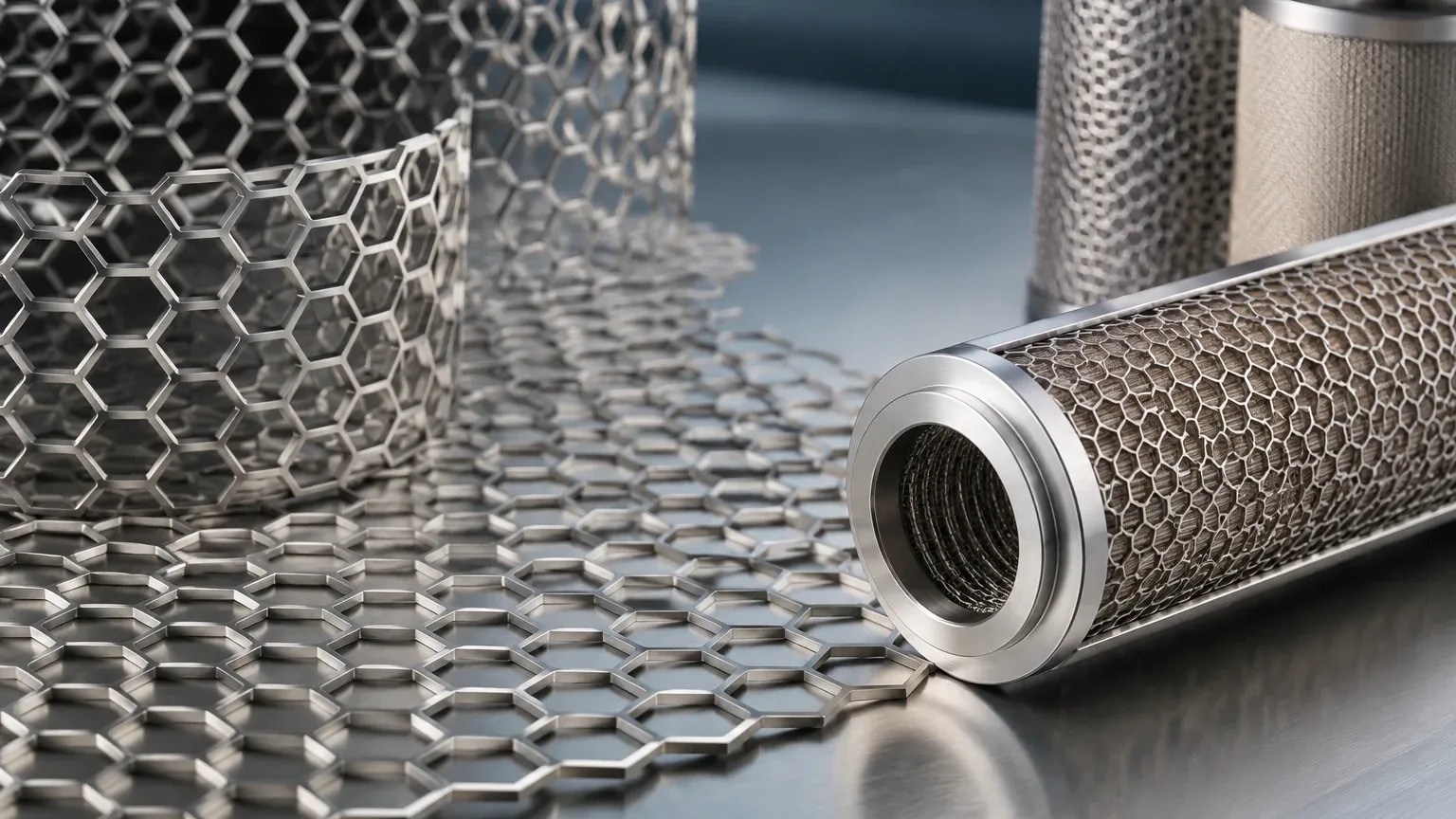
Honeycomb expanded metal is produced through a precision process of slitting and stretching metal sheets—most commonly stainless steel—using specialized tooling that creates a hexagonal aperture. This process is distinct from perforation; while perforated metal involves punching holes and generating scrap, expanded metal is stretched, meaning no material is lost. This makes it an inherently cost-effective solution for large-scale industrial projects.
In a filtration context, the honeycomb pattern serves two primary roles. First, it acts as a robust support structure for finer wire mesh or filter membranes. Second, it can function as a primary filter medium for coarse particles or as a flow straightener. The hexagonal shape is mathematically efficient, offering the highest perimeter-to-area ratio of any regular tiling, which translates to a high degree of structural stability even when the metal is stretched to achieve a high percentage of open area.
When evaluating honeycomb expanded metal, technical teams must consider the orientation of the "honeycomb" cells. The geometry is defined by the Long Way of Design (LWD) and the Short Way of Design (SWD). These dimensions, along with the strand width and thickness, determine the mechanical limits of the material under pressure. Because the metal is expanded rather than woven, it remains a single, continuous piece of material, which eliminates the risk of vibrating loose or fraying—a common failure mode in traditional woven wire cloth.
Technical Specifications and Material Selection
The performance of honeycomb expanded metal is dictated by its metallurgical composition. At Kaifil, the focus remains on high-performance alloys that can withstand the rigors of industrial environments. The selection of material is the first and most critical step in the engineering process.
Stainless Steel Grades
* Type 304/304L: The standard for general industrial use, providing excellent corrosion resistance and formability. It is suitable for most food and beverage applications and general water treatment.
* Type 316/316L: Containing molybdenum, this grade offers superior resistance to chlorides and pitting. It is the preferred choice for marine environments, pharmaceutical manufacturing, and aggressive chemical processing.
* Specialty Alloys: For extreme temperatures or highly acidic environments, alloys such as Hastelloy or Inconel may be utilized, though stainless steel remains the industry benchmark for the majority of filtration components.
Dimensional Parameters
To specify honeycomb expanded metal accurately, engineers must define several key variables:
1. Sheet Thickness: The original gauge of the metal before expansion.
2. Strand Width: The amount of metal between the hexagonal openings.
3. Overall Thickness: The total depth of the expanded sheet, which is often greater than the original sheet thickness due to the angling of the strands during the stretching process.
4. Open Area Percentage: Calculated based on the LWD, SWD, and strand width, this metric determines the flow capacity and pressure drop across the medium.
Engineering Advantages of the Hexagonal Geometry
The transition from standard diamond patterns to honeycomb expanded metal is often driven by the need for specific mechanical behaviors. The hexagonal structure provides several engineering advantages that are critical in high-stakes industrial applications.
Structural Rigidity and Weight
The honeycomb shape is renowned for its strength-to-weight ratio. In filtration cartridges, where the medium must withstand high differential pressures without collapsing, the hexagonal geometry provides uniform resistance to deformation. This allows engineers to use thinner, lighter sheets of metal while maintaining the same structural integrity as thicker, heavier perforated plates.
Flow Dynamics and Pressure Drop
In fluid and gas filtration, the goal is often to maximize flow while minimizing pressure drop. Honeycomb expanded metal allows for a very high percentage of open area—often exceeding 70% or 80%—without compromising the sheet's stability. Furthermore, the angled strands created during the expansion process can act as micro-vanes, which can be leveraged to influence flow direction or to create turbulence that assists in certain types of particulate separation.
Flow Straightening
One of the unique applications of the honeycomb pattern is its ability to straighten fluid flow. In air intake systems or liquid pipelines, turbulent flow can reduce the efficiency of downstream components. The depth of the hexagonal cells helps to align the fluid path, reducing turbulence and ensuring a more uniform velocity profile. This is particularly useful in precision cooling systems and aerospace test environments.
Application Scenarios in Demanding Environments
Honeycomb expanded metal is rarely a standalone component; it is usually integrated into a larger filtration or structural system. Its versatility allows it to solve complex engineering challenges across various sectors.
Support for Fine Filtration Media
In many stainless steel filter cartridges, the primary filtration is performed by a very fine, delicate wire mesh or a sintered metal fiber felt. These materials lack the structural strength to survive high-pressure flows. Honeycomb expanded metal is used as an inner or outer support core (the "cage"). Its high open area ensures that it does not impede the flow, while its rigidity protects the expensive filtration media from mechanical failure.
EMI and RFI Shielding
Beyond filtration, the continuous nature of expanded metal makes it an excellent conductor for electromagnetic interference (EMI) and radio frequency interference (RFI) shielding. The honeycomb pattern is particularly effective at blocking specific wavelengths while allowing for airflow and light transmission. This makes it a staple in the construction of shielded enclosures for sensitive electronic equipment in industrial control rooms.
Chemical and Petrochemical Processing
In reactors and catalysts, honeycomb expanded metal serves as a support grid for catalyst beds. The material must withstand both chemical corrosion and thermal expansion cycles. The hexagonal grid provides a stable platform that prevents the catalyst material from shifting, which ensures consistent reaction rates and prevents "channeling" within the reactor.
Selection Criteria for Engineering and Procurement
Choosing the right honeycomb expanded metal requires a balance between performance requirements and budget constraints. When consulting with a manufacturer like Kaifil, technical teams should be prepared to confirm several operational parameters to ensure the final product meets the application's demands.
Load-Bearing Requirements
What is the maximum pressure the filter will encounter? Is the load static or dynamic? Honeycomb patterns handle compressive loads well, but the orientation of the expansion (LWD vs. SWD) relative to the flow direction can change the burst strength of a cylindrical filter cartridge. Procurement teams should provide the maximum expected differential pressure (ΔP) to the manufacturer.
Chemical Compatibility
While stainless steel is highly versatile, the specific chemical environment (pH levels, presence of halides, operating temperature) will dictate whether 304L or 316L is required. Using an inappropriate grade can lead to stress corrosion cracking or intergranular corrosion, significantly shortening the component's lifespan.
Customization and Fabrication
Standard sheets are rarely the final solution. Most industrial applications require honeycomb expanded metal to be cut to size, rolled into cylinders, or welded into frames. It is important to confirm that the manufacturer has the capabilities to perform these secondary operations without compromising the integrity of the hexagonal pattern. For example, welding expanded metal requires precision to ensure that the junctions of the strands are properly fused to the end caps or frames.
Maintenance, Durability, and Total Cost of Ownership
From a B2B perspective, the initial purchase price of a filtration component is only one part of the total cost of ownership (TCO). Honeycomb expanded metal is often chosen specifically because it lowers the TCO through durability and ease of maintenance.
Cleaning and Reusability
Unlike disposable polymer filters, stainless steel honeycomb components are cleanable and reusable. Depending on the contaminant, they can be cleaned via backwashing, ultrasonic cleaning, or chemical immersion. The hexagonal openings are less prone to "blinding" (permanent clogging) than some woven patterns because the strands are angled, allowing for easier release of trapped particles during the cleaning cycle.
Replacement Cycles
Because expanded metal is a single-piece structure, it does not suffer from the wire migration or fraying that can occur in woven mesh. This leads to longer replacement cycles and fewer unplanned shutdowns. In high-vibration environments, such as hydraulic systems on heavy machinery, the structural integrity of the honeycomb pattern ensures that the filter remains intact, protecting downstream pumps and valves from catastrophic failure.
Evaluation of Risks
The primary risk in selecting expanded metal is choosing a strand thickness that is too light for the mechanical load, or a material grade that is insufficient for the chemical environment. Working with a specialized manufacturer allows for the verification of these specs through material certifications and pressure testing. Engineers should always request Mill Test Reports (MTRs) to verify the alloy composition and ensure compliance with industry standards like ASTM or ISO.
Conclusion: Technical Confirmation for Procurement
Before finalizing a purchase of honeycomb expanded metal, technical and procurement teams should confirm the following data points with their supplier:
* Dimensional Accuracy: Confirm LWD, SWD, and strand dimensions relative to the required open area.
* Material Certification: Ensure the stainless steel grade matches the chemical environment of the application.
* Fabrication Limits: Verify that the material can be formed or welded into the specific geometry required for the filter housing.
* Performance Expectations: Define the expected flow rate and maximum allowable pressure drop.
By focusing on these technical boundaries, industrial operations can leverage the unique benefits of the honeycomb pattern within the Perforated & Expanded Metal family to achieve reliable, high-performance filtration and structural support. Whether used as a flow straightener in a laboratory or a support cage in a chemical plant, honeycomb expanded metal remains a critical component for modern industrial engineering.
