


Industrial Perforated Metal Sheet
In the realm of industrial filtration and structural engineering, the industrial perforated metal sheet serves as a critical component, balancing mechanical strength with precise fluid or gas permeability. Unlike standard decorative materials, industrial-grade perforated sheets are engineered to meet rigorous tolerances, specific open-area ratios, and demanding environmental conditions. For engineers and procurement teams, selecting the correct perforated or expanded metal involves a deep understanding of material science, hole geometry, and the mechanical stresses inherent in industrial applications.
At Kaifil, manufacturing expertise focuses on high-performance Perforated & Expanded Metal solutions designed for filtration, separation, and structural support. This guide examines the technical parameters, engineering considerations, and selection criteria essential for optimizing the performance of perforated metal in industrial environments.
Technical Fundamentals of Perforated Metal Sheets
An industrial perforated metal sheet is produced by mechanically punching or laser-cutting a series of holes into a solid metal plate. The resulting product is defined by its hole shape, size, pitch (the distance between hole centers), and the resulting open area. In industrial filtration, these parameters directly dictate flow rates, pressure drops, and particle retention capabilities.
Material Selection and Grade Properties
Material choice is the first and most critical decision in the engineering process. Because these components often operate in corrosive or high-temperature environments, stainless steel is the industry standard.
* Stainless Steel 304: The most common grade, offering excellent formability and general corrosion resistance. It is suitable for food processing and standard industrial filtration where extreme chemical exposure is not a factor.
* Stainless Steel 316/316L: Containing molybdenum, these grades provide superior resistance to chlorides and pitting. They are essential for marine environments, pharmaceutical manufacturing, and chemical processing plants.
* Specialty Alloys: For extreme conditions, materials like Duplex stainless steel or high-nickel alloys may be used to withstand high-pressure hydraulic systems or highly acidic media.
Understanding Hole Patterns and Open Area Calculations
The geometry of the perforations determines the structural integrity and the hydraulic performance of the sheet. For an engineer, the "Open Area Percentage" is the most vital metric, as it determines the efficiency of the media passing through the filter.
Common Hole Geometries
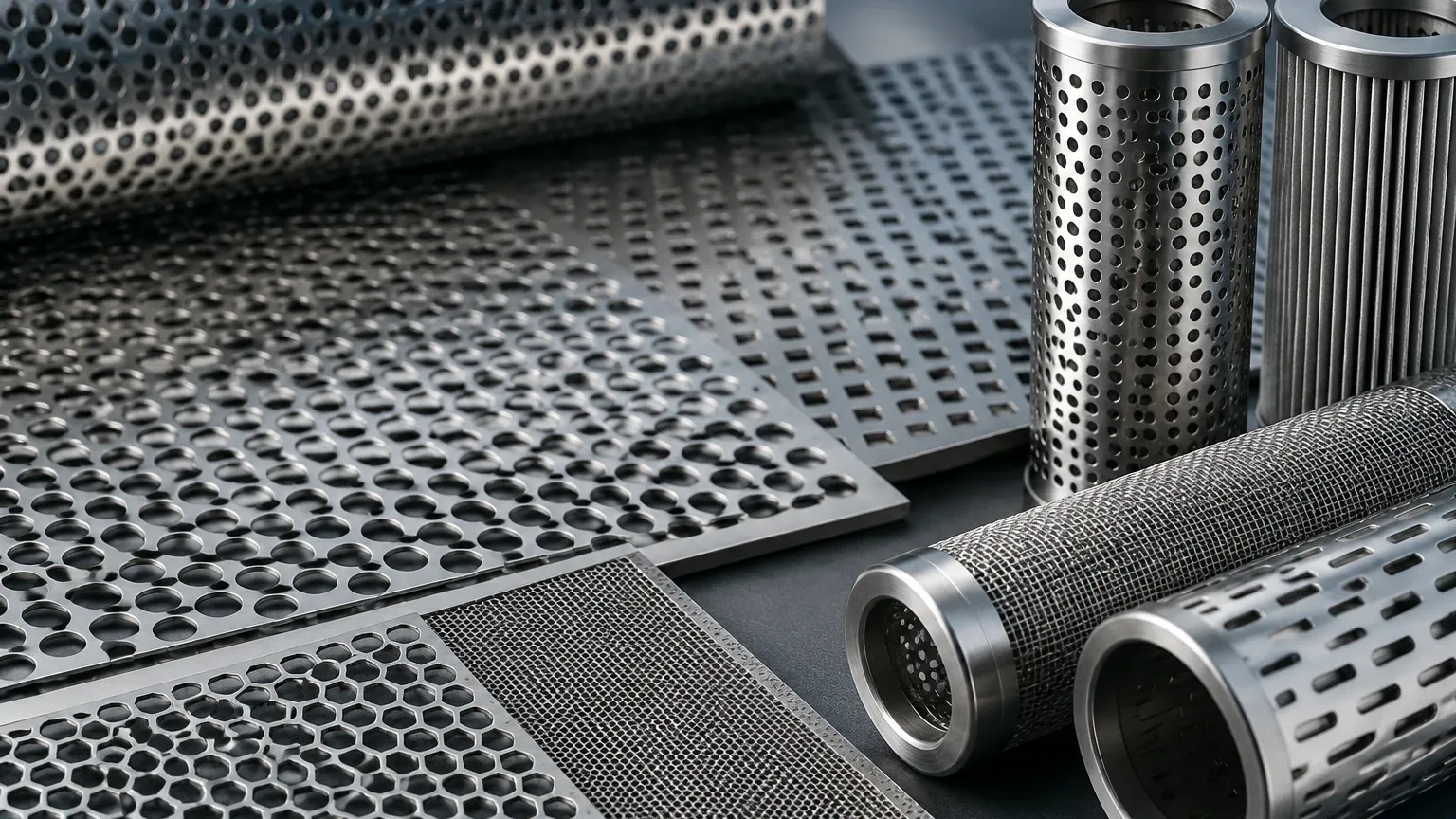
1. Round Holes: The most popular configuration due to its structural stability and ease of manufacturing. Round holes provide the best strength-to-weight ratio and are typically arranged in a 60-degree staggered pattern, which maximizes open area and provides uniform strength in all directions.
2. Square Holes: Often used when a higher open area is required. While they offer high visibility and flow, square holes are more prone to structural deformation under high-pressure loads compared to round holes.
3. Slotted Holes: Frequently utilized in vibrating screens and centrifugal filters. Slotted perforations are ideal for materials that are elongated or require specific orientation during the separation process.
Calculating Open Area
For a standard 60-degree staggered round hole pattern, the formula for open area (OA%) is:
`OA% = (d² * 90.69) / p²`
Where `d` is the hole diameter and `p` is the pitch. Accurate calculation is necessary to ensure that the industrial perforated metal sheet does not become a bottleneck in the fluid system, leading to excessive pump wear or system failure.
Perforated vs. Expanded Metal in Industrial Filtration
While often grouped together, perforated metal and expanded metal serve different functional roles within a filtration system. Understanding the distinction is key to selecting the right Perforated & Expanded Metal product for a specific application.
Perforated Metal is characterized by its precision. The CNC punching process allows for exact hole placement and specific margins (unperforated edges), which are crucial for welding the sheet into filter cartridges or cylinders. It provides a smooth surface that is easy to clean and maintain.
Expanded Metal, on the other hand, is created by slitting and stretching the metal sheet simultaneously. This process creates a diamond-shaped mesh without any material waste. In filtration, expanded metal is frequently used as a support layer for fine wire mesh. Its three-dimensional structure provides excellent rigidity and helps to create a "stand-off" space that prevents the fine mesh from collapsing against the structural core under high differential pressure.
Engineering Considerations for Filtration Systems
When integrating an industrial perforated metal sheet into a filtration assembly, several engineering factors must be addressed to ensure long-term reliability and performance.
Pressure Drop and Flow Dynamics
Every perforation introduces a degree of resistance to the flow. If the open area is too low, the pressure drop (Delta P) across the filter will increase, necessitating higher energy consumption and potentially leading to bypass or structural failure. Engineers must balance the need for structural strength (smaller holes, larger bridges) with the requirement for low resistance (larger holes, smaller bridges).
Structural Load and Collapse Strength
In high-pressure hydraulic or oil filtration, the perforated sheet often acts as the center core of a filter cartridge. It must withstand the external pressure of the fluid pushing against it. The "collapse strength" of the perforated tube is a function of the material thickness, the diameter of the tube, and the ligament width (the metal remaining between the holes). Kaifil utilizes advanced manufacturing techniques to ensure that even high-open-area sheets maintain the necessary hoop strength for demanding applications.
Compatibility with Fine Mesh Layers
In many multi-stage filters, a perforated sheet provides the structural skeleton, while a fine stainless steel wire mesh provides the actual filtration. The surface finish of the perforated sheet is critical here; it must be burr-free and level to prevent the fine mesh from being punctured or abraded during high-pressure pulses or cleaning cycles.
Manufacturing Precision and Customization
Industrial applications rarely allow for "off-the-shelf" solutions. Customization is often required to meet specific housing dimensions or filtration requirements. Key customization options for an industrial perforated metal sheet include:
* Margins and Blank Areas: Custom margins allow for easier welding and assembly into larger structures. By leaving specific areas unperforated, the structural integrity of the final component is significantly enhanced.
* Post-Processing: Industrial sheets often undergo leveling to ensure they are perfectly flat, and degreasing to remove lubricants used during the punching process. For pharmaceutical and food applications, electropolishing is often employed to create a mirror-like, ultra-clean surface that prevents bacterial growth.
* Forming and Welding: Perforated sheets can be rolled into cylinders, fabricated into cones, or pleated. Precise welding (TIG, Plasma, or Laser) is required to ensure the seams are as strong as the base material.
Selection Guide: Choosing the Right Perforated Sheet
To specify the correct industrial perforated metal sheet, procurement and engineering teams should confirm the following data points before moving to production:
1. Environment: Will the sheet be exposed to salt water, acidic chemicals, or high temperatures? (Determines material grade).
2. Required Flow Rate: What is the maximum allowable pressure drop? (Determines open area percentage).
3. Particle Size: What is the smallest particle that needs to be retained or supported? (Determines hole diameter).
4. Mechanical Stress: Will the sheet be subject to high-pressure spikes or mechanical impact? (Determines sheet thickness and ligament width).
5. Assembly Requirements: Does the sheet need to be welded into a cylinder or bolted into a frame? (Determines margin requirements and tolerances).
Quality Assurance and Compliance
In B2B industrial procurement, quality verification is non-negotiable. A high-quality industrial perforated metal sheet should be inspected for:
* Hole Uniformity: Ensuring that hole diameters and pitches are consistent across the entire sheet to prevent localized high-pressure zones.
* Flatness: Essential for automated assembly and welding processes.
* Surface Integrity: The absence of burrs, oil residue, or surface cracks that could compromise the filtration media or the purity of the fluid.
Kaifil adheres to strict quality control standards, ensuring that every Perforated & Expanded Metal component meets the technical specifications required for its intended application. By focusing on precision manufacturing and material integrity, we provide filtration components that offer durability and reliable performance in the most demanding industrial environments.
Conclusion
The industrial perforated metal sheet is far more than a simple piece of metal with holes; it is a precision-engineered component that serves as the backbone of many industrial filtration systems. Whether used as a primary filter, a support structure for fine mesh, or a flow diffuser, its performance is dictated by the careful selection of material, hole geometry, and manufacturing quality. By understanding these technical variables and working with a specialized manufacturer like Kaifil, engineers can optimize their filtration processes, reduce maintenance costs, and ensure the longevity of their industrial equipment.
