


Interior Perforated Metal Panels
In modern industrial and commercial architecture, the selection of surfacing materials is driven by a balance of structural integrity, environmental control, and long-term durability. Interior perforated metal panels have emerged as a primary solution for engineers and specifiers who require high-performance materials capable of managing acoustics, airflow, and light diffusion. Unlike standard decorative sheets, industrial-grade perforated panels are engineered components that must meet specific mechanical tolerances and material standards to function effectively within complex building systems.
As a specialized manufacturer of Perforated & Expanded Metal, Kaifil applies the same precision required for industrial filtration components to the production of architectural panels. Understanding the technical nuances of hole patterns, open area percentages, and material properties is essential for procurement teams and engineers to ensure the selected panels meet the rigorous demands of their specific application.
Technical Specifications of Interior Perforated Metal Panels
The performance of interior perforated metal panels is fundamentally determined by their geometric configuration. The process of perforating metal involves punching a predetermined pattern of holes into a solid sheet, which alters the material's physical properties. Engineers must evaluate several key parameters during the design phase:
Hole Patterns and Geometry
Round holes are the most common and cost-effective pattern due to the simplicity of the tooling and the structural stability they provide. However, square, slotted, and hexagonal patterns are frequently utilized for specific functional requirements. For instance, hexagonal patterns offer a high open-area ratio while maintaining significant sheet strength, making them ideal for high-airflow environments.
Pitch and Orientation
The arrangement of holes—whether staggered or straight—impacts both the aesthetics and the mechanical strength of the panel. A 60-degree staggered pattern is the industry standard for maximum strength and uniform stress distribution. In contrast, straight patterns are often chosen for specific visual alignments but may require thicker gauges to compensate for reduced structural rigidity.
Open Area Calculation
The "Open Area" is the percentage of the sheet that is occupied by holes. This is a critical metric for HVAC engineers and acoustic consultants. A higher open area allows for greater airflow and transparency but reduces the load-bearing capacity of the panel. Calculating the exact open area is vital for ensuring that interior perforated metal panels do not create excessive static pressure in ventilation systems.
Material Selection for Industrial and Commercial Interiors
Material choice is the most significant factor in determining the lifespan and maintenance requirements of interior panels. At Kaifil, we leverage our expertise in stainless steel filtration to provide guidance on the most suitable alloys for interior environments.
Stainless Steel (Grades 304 and 316)
Stainless steel is the preferred material for environments requiring high levels of hygiene or corrosion resistance, such as pharmaceutical facilities, commercial kitchens, and laboratories. Grade 304 is suitable for most standard interior applications, while Grade 316 is recommended for interiors exposed to harsh cleaning chemicals or high humidity. Stainless steel panels offer superior durability and a permanent finish that does not require additional coating.
Aluminum Alloys
Aluminum is frequently selected for interior perforated metal panels when weight reduction is a priority. It is naturally corrosion-resistant and highly malleable, allowing for complex forming and bending. Aluminum panels are often finished with anodizing or powder coating to achieve specific color requirements while protecting the substrate.
Carbon Steel and Galvanized Steel
For projects where budget is a primary constraint and the environment is strictly climate-controlled, carbon steel provides a robust solution. However, it must be finished with a protective layer, such as powder coating, to prevent oxidation. Galvanized steel offers a middle ground, providing a sacrificial zinc coating that protects against minor moisture exposure.
Acoustic Performance and Airflow Control
One of the primary functional roles of interior perforated metal panels is sound management. In large industrial halls, transit hubs, or open-plan offices, reverberation can significantly impact safety and productivity. Perforated panels act as a "transparent" facing for acoustic insulation materials.
Noise Reduction Coefficient (NRC)
When backed with acoustic batts or specialized fabrics, perforated metal panels can achieve high NRC ratings. The sound waves pass through the perforations and are trapped by the absorbent material behind the panel. The hole size and spacing must be carefully tuned; if the holes are too small or the open area is too low, the panel may reflect sound rather than allowing it to pass through to the insulation.
Airflow and HVAC Integration
In data centers and cleanrooms, perforated panels are used to manage laminar airflow. The precision of the perforation process ensures that air is distributed evenly across the space, preventing hot spots and maintaining pressure differentials. Engineers must specify the hole diameter and pitch to match the CFM (cubic feet per minute) requirements of the mechanical system.
Structural Integrity and Engineering Considerations
Integrating interior perforated metal panels into a building's structure requires an understanding of how the perforation process affects the base material. Removing material through punching inherently weakens the sheet, which must be accounted for in the framing and support system.
Ligament Width
The "ligament" is the solid metal remaining between the holes. If the ligament is too narrow relative to the material thickness, the panel may warp during the punching process or fail under mechanical stress. A general rule of engineering for perforated metal is that the hole diameter should not be smaller than the material thickness to ensure clean punches and tool longevity.
Margins and Unperforated Borders
Customized panels often include unperforated borders or "margins" to facilitate mounting and increase edge stiffness. Providing exact dimensions for these margins is crucial during the OEM manufacturing process, as it allows the panels to be bolted or welded directly to sub-frames without compromising the pattern's integrity.
Flatness and Leveling
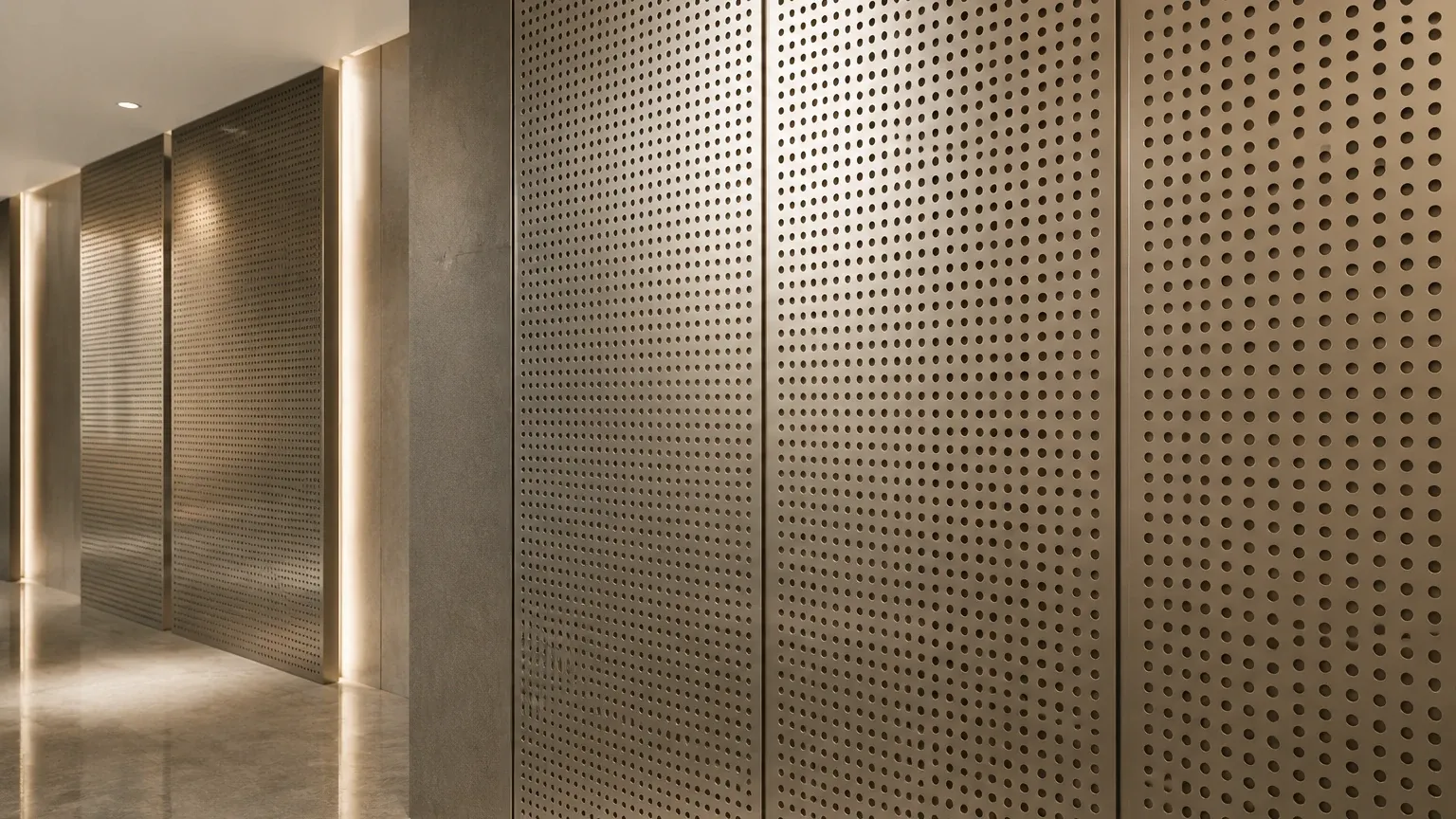
High-speed punching can introduce internal stresses into the metal, causing it to curl or bow. Professional manufacturers like Kaifil utilize precision leveling equipment to ensure that every panel meets flatness tolerances required for seamless installation. This is particularly important for large-scale wall cladding where even minor deviations are visible.
Customization and OEM Manufacturing Capabilities
Standard off-the-shelf panels rarely meet the specific needs of complex industrial projects. Customization is often necessary to accommodate lighting fixtures, sprinkler heads, or unique architectural geometries. Kaifil’s background in precision metal filter components allows us to offer a high degree of customization for Perforated & Expanded Metal products.
Precision Tooling
Advanced CNC punching technology allows for the creation of complex hole arrangements and varied hole sizes within a single panel. This capability is essential for creating "gradient" patterns where the open area changes across the surface of the panel to meet varying acoustic or lighting needs.
Finishing and Secondary Operations
Beyond the perforation itself, panels often require secondary operations such as shearing, notching, bending, and welding. Providing a complete, ready-to-install component reduces on-site labor and ensures that all cut edges are treated or deburred to prevent safety hazards. For stainless steel panels, various surface finishes—from dull mill finishes to high-grit polishes—can be applied to meet the project's aesthetic and functional requirements.
Evaluating Total Cost and Maintenance
When purchasing interior perforated metal panels, procurement teams should look beyond the initial price per square foot and consider the total cost of ownership. High-quality materials and precision manufacturing reduce the likelihood of replacement and simplify maintenance cycles.
Durability vs. Initial Cost
While aluminum or carbon steel may have a lower upfront cost, stainless steel often provides better value in high-traffic or industrial environments due to its resistance to impact and abrasion. The structural rigidity of stainless steel also allows for the use of thinner gauges in some applications, potentially offsetting the higher material cost.
Maintenance Protocols
Interior panels are subject to dust accumulation and, in some industries, chemical exposure. Perforated surfaces are relatively easy to maintain with pressurized air or standard cleaning solutions, provided the material is compatible with the cleaning agents. For food and pharmaceutical applications, the burr-free finish provided by high-quality perforation is essential to prevent the buildup of contaminants within the holes.
Conclusion: Selecting the Right Partner for Metal Filtration and Surfacing
Choosing the correct interior perforated metal panels involves a deep dive into material science, mechanical engineering, and acoustic theory. By focusing on technical specifications such as open area, ligament strength, and material grade, engineers can specify solutions that perform reliably for decades.
Kaifil provides the technical expertise and manufacturing precision necessary to deliver high-performance metal components for the most demanding applications. Whether you are designing a specialized ventilation system or a durable interior cladding solution, our experience in custom metal fabrication ensures that your project requirements are met with accuracy. For detailed technical data and to explore our range of materials and patterns, Review product options and application support to find the optimal solution for your next project.
